
Practical guide to lunar astrophotography: how to photograph the Moon with the equipment you already have
The Moon is probably the most photographed astronomical object in the night sky. Its brightness, apparent size, and ease of localization make it the perfect target for getting started in astrophotography. And the best part is that you don't need a professional observatory or extremely expensive equipment to get amazing images.
With patience, some practice, and by learning to leverage the equipment you already have at home—whether it's a mobile phone, a DSLR camera, or even a basic telescope—you can capture truly spectacular lunar photographs.
Patience: The Secret to Good Astrophotography
In astrophotography, there's a very important concept known as "lucky imaging." This technique involves taking many consecutive captures to increase the chances of obtaining perfectly focused images free from atmospheric turbulence.
The Earth's atmosphere is never completely stable. Air currents generate small distortions that particularly affect the fine details of the lunar surface. For this reason, astrophotographers commonly take dozens or even hundreds of photographs to later select the best ones.
Digital processing also plays a fundamental role. Editing and stacking programs allow you to improve sharpness, increase contrast, and highlight the craters, maria, and mountain ranges of our natural satellite.
How to photograph the Moon with a mobile phone
Current smartphones offer much better results than many imagine. With some basic adjustments, it's possible to get very interesting images of the Moon.
Essential mobile tips
- Use a tripod or a stable support point.
- Always deactivate the flash.
- Tap the screen on the Moon to lock focus.
- Manually reduce exposure to prevent it from appearing completely white.
- Use the self-timer to avoid vibrations when pressing the shutter button.
- Photograph during dawn or dusk for a less contrasted sky.
If your mobile has manual or Pro mode, try settings like:
- Low ISO (50–100)
- Fast shutter speed (1/125s or faster)
- Manual focus to infinity
The goal is to preserve the details of the lunar surface and avoid overexposure.
Lunar photography with DSLR or mirrorless cameras
Digital cameras offer greater creative control and allow capturing images in RAW format, which is highly recommended for later editing without loss of quality.
The key is to correctly balance the three fundamental exposure parameters:
- Aperture
- Shutter speed
- ISO sensitivity
One of the most used rules in lunar photography is known as the "Looney 11."
This rule recommends starting with an aperture of f/11 and setting the shutter speed equal to the ISO value used. For example:
- ISO 100 → 1/100s
- ISO 200 → 1/200s
This serves as a starting point for getting a correctly exposed Moon.
Why avoid high ISOs?
Although increasing the ISO makes the image brighter, it also increases digital noise. In lunar astrophotography, it is usually desirable to keep ISOs low to preserve as much detail as possible.
Photographing the Moon with a Telescope
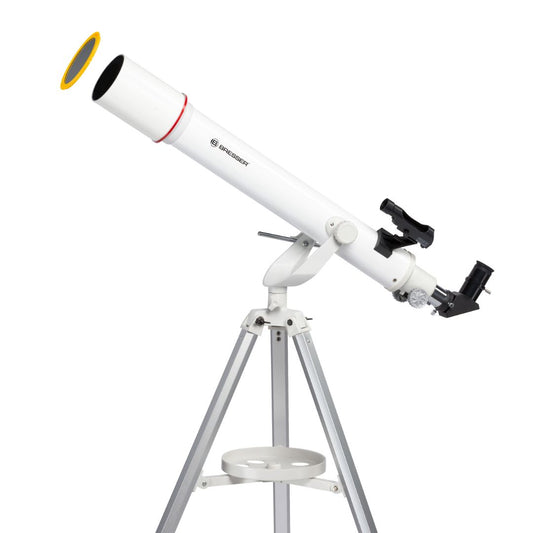
This is where the real magic begins for many enthusiasts. A telescope allows you to get close to incredible details of the lunar surface: craters, mountains, valleys, and lunar maria.
Afocal method: mobile or camera over the eyepiece
The simplest way to get started is to place the camera or mobile phone in front of the telescope's eyepiece using a smartphone adapter.
This method allows for very good results without needing to modify the equipment.
Important tips:
- Use moderate magnification.
- Maintain fast speeds.
- Adjust focus from the telescope, not from the camera.
- Wait for moments of atmospheric stability.
Prime focus photography: the next level
The technique most used by advanced amateurs is prime focus. In this case, the telescope acts directly as a huge telephoto lens.
This requires two accessories:
- A T-ring compatible with the camera.
- A T-adapter for the telescope.
The assembly removes the eyepiece and connects the camera directly to the optical tube.
Advantages of prime focus
- Much greater sharpness
- Better use of the telescope's focal length
- More detail in craters and lunar reliefs
- Fewer optical aberrations
In addition, it is recommended to activate functions such as:
- Live View
- Mirror lock-up
- Remote shooting
- Control from a laptop
All of this helps reduce vibrations and improve focus.
What telescope is recommended for lunar photography?
The Moon can be photographed with virtually any telescope, but some models offer particularly good results:
For beginners
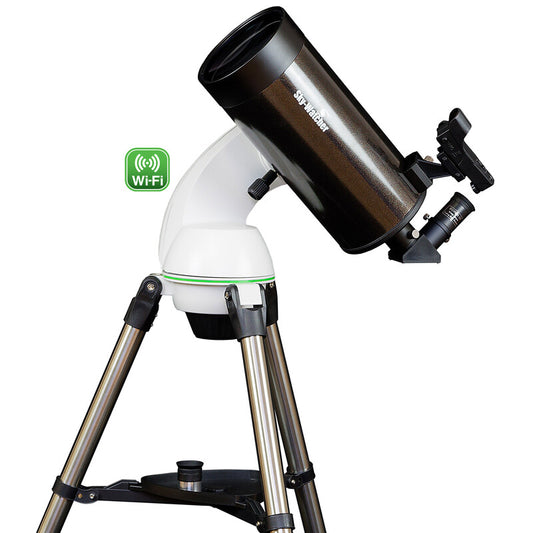
- Compact 90mm or 102mm Maksutovs
For greater detail
- Schmidt-Cassegrain
Telescopes with long focal lengths usually offer very detailed and easy-to-capture lunar images.
The best time to photograph the Moon
Although many think that the full Moon is the best phase, the most interesting moments usually occur during:
- First quarter
- Last quarter
During these phases, sunlight strikes the lunar surface sideways and generates very distinct shadows that highlight the relief of craters and mountains.
The key is to practice
Lunar astrophotography is one of the best ways to get started in practical astronomy. It doesn't matter if you use a mobile phone, a DSLR camera, or a basic telescope: with patience and practice, you can greatly improve your results.
Each session helps to better understand lighting, focus, atmospheric stability, and capture settings. And that's precisely where a large part of the magic of astrophotography lies.
Next time you observe the Moon, try to photograph it. You might discover a new fascinating hobby.