
Explore Scientific
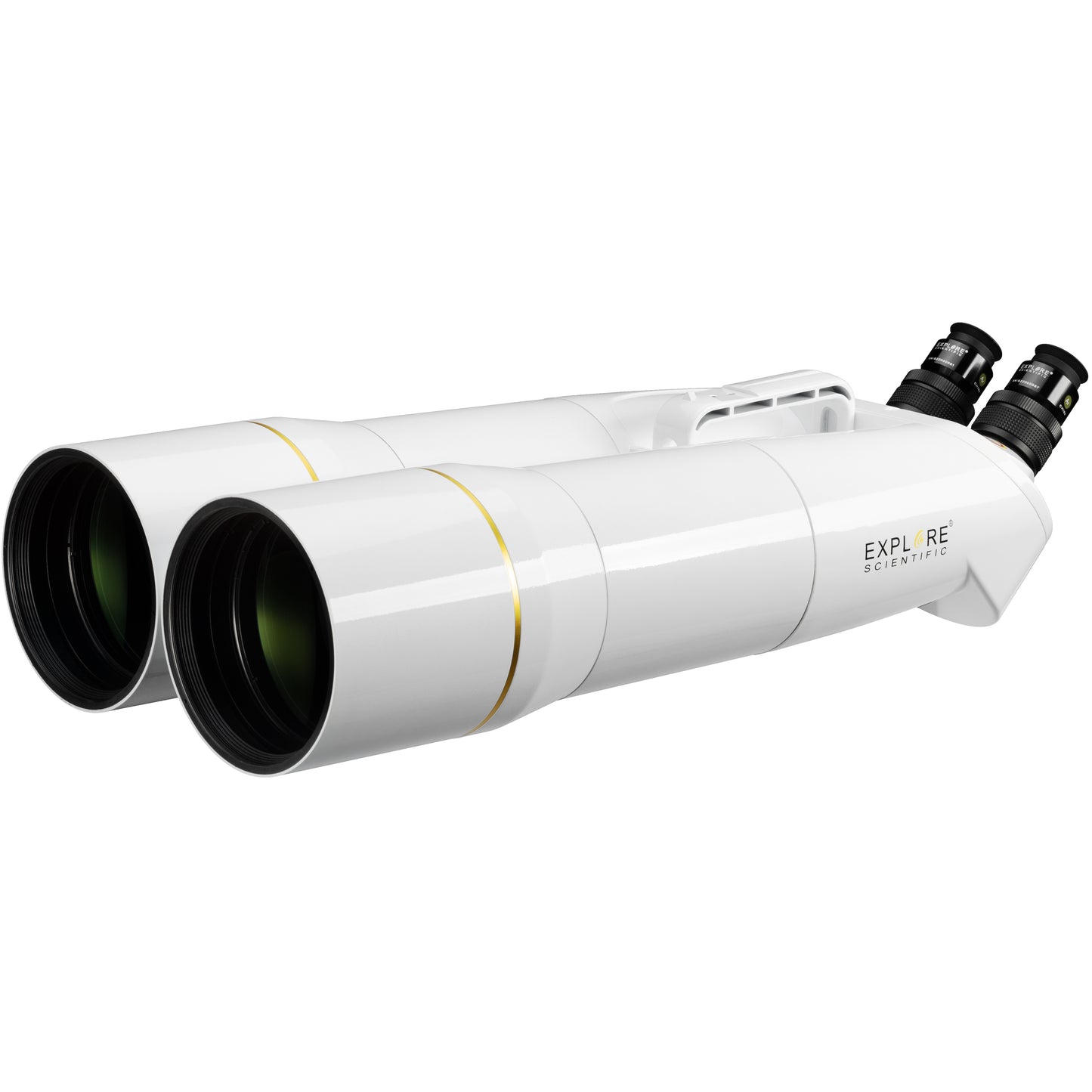
EXPLORE SCIENTIFIC BT-120 SF Giant Binocular with 62° LER 20mm Eyepieces
EXPLORE SCIENTIFIC BT-120 SF Giant Binocular with 62° LER 20mm Eyepieces
Regular price
£1,879.00
Regular price
Sale price
£1,879.00
Taxes is not included.
Shipping calculated at checkout.
In stock
Quantity
Couldn't load pickup availability
- SECURE PAYMENT
- FAST SHIPPING AVAILABLE
- EXPERT CONSULTING
Giant binoculars for observing the starry sky, nature, and landscapes.
Observe the beauty of the starry night sky and distant objects in nature during the day. Globular clusters, luminous gas nebulae, the moon with its craters, and even planets can be beautifully observed on a clear night. But all distant things in nature and the landscape, even ships and airplanes, can also be seen in detail. With the all-terrain binoculars of the EXPLORE SCIENTIFIC BT series, you can get as close as possible. Thanks to the large light-gathering lenses and professional coatings on all lens surfaces, these binoculars produce bright and luminous images even at night and at dusk, providing special visual pleasure. The comfortable 45-degree viewing angle allows for fatigue-free use, even when the binoculars are tilted towards the zenith.
A large binocular that can also be considered a double refractor telescope
Binoculars like these can truly be described as a double telescope. In this configuration, the full light-gathering power of a telescope is available to each eye. Experience a new dimension of observation accordingly. Objects are reproduced almost vividly in these binoculars, and observing with both eyes is a very relaxing experience. Last but not least, this comfortable form of observation increases the recognition of finer details (especially in weaker deep-sky objects) and effectively prevents eye fatigue.
Extremely robust binoculars with magnesium housing, sealed and nitrogen-filled
The BT series binoculars are designed for intensive outdoor use. The IPX6 sealed and nitrogen-filled design effectively prevents internal optics from fogging even in challenging weather conditions. The very lightweight magnesium housing saves weight and facilitates handling. Two EXPLORE SCIENTIFIC 20mm 62-degree LER series eyepieces are already included. EXPLORE SCIENTIFIC is an established manufacturer of very high-quality eyepieces in the field of astronomy. An optical system is only as good as its weakest component. For this reason, we deliver these giant binoculars with a pair of quality eyepieces from the 62-degree LER series. With an apparent field of view of 62 degrees and a focal length of 20mm, the BT-120 binoculars produce 33x magnification. Thus, these wide-angle eyepieces offer a very good overview (1.8-degree field of view) with moderate magnification. The long eye relief of these 15mm LER eyepieces and the soft, fold-down silicone eyecups also ensure comfortable and relaxed viewing. For astronomical use, their flat and sharp image field is an advantage and offers a particularly impressive viewing experience even during the day. Thanks to the waterproof design and argon filling, these eyepieces are absolutely durable and easy to clean.
Interchangeable eyepieces with 1.25 inch / 31.7 mm plug diameter
Adjust the magnification and field of view to your individual needs and choose from a wide range of available eyepieces. All types of eyepieces with a 1.25 inch / 31.7 mm insertion diameter can be used with the BT series binoculars. EXPLORE SCIENTIFIC eyepieces from the 62 and 82-degree series with focal lengths from 8 to 26 mm are particularly recommended (see article no. 02188xx and 02196xx). Magnification can range from 25x to 75x (binocular focal length : eyepiece focal length = magnification). Eyepieces are held in the binoculars by a precise brass ring clamp that ensures a tilt-free position.
Use of color and nebula filters for astronomical observations
Increase the contrast and visibility of objects and details by screwing the appropriate filters directly into the thread of the eyepiece barrels. Of course, the use of color and nebula filters should always be done in pairs. All EXPLORE SCIENTIFIC screw-in filters with a diameter of 1.25 inch / 31.7 mm are suitable (see article number 03102xx)
Comfortable 45-degree viewing and helical single focus
The 45-degree viewing angle allows for a relaxed observing position even when the binoculars are heavily tilted. Also, the individual interpupillary distance can be adjusted in a range of 54 to 76 mm. With the fine helical single focus, precise focusing is achieved effortlessly. Extendable dew shields The integrated dew shields can be extended in conditions of high humidity and cold. This prevents external objective lenses from fogging up and effectively protects against additional stray light entering from the sides.
Integrated carrying handle
A metal carrying handle located at the center of gravity facilitates transport and ensures a secure hold during tripod mounting.
Suitable tripods and tripod connection
FEATURES
Observe the beauty of the starry night sky and distant objects in nature during the day. Globular clusters, luminous gas nebulae, the moon with its craters, and even planets can be beautifully observed on a clear night. But all distant things in nature and the landscape, even ships and airplanes, can also be seen in detail. With the all-terrain binoculars of the EXPLORE SCIENTIFIC BT series, you can get as close as possible. Thanks to the large light-gathering lenses and professional coatings on all lens surfaces, these binoculars produce bright and luminous images even at night and at dusk, providing special visual pleasure. The comfortable 45-degree viewing angle allows for fatigue-free use, even when the binoculars are tilted towards the zenith.
A large binocular that can also be considered a double refractor telescope
Binoculars like these can truly be described as a double telescope. In this configuration, the full light-gathering power of a telescope is available to each eye. Experience a new dimension of observation accordingly. Objects are reproduced almost vividly in these binoculars, and observing with both eyes is a very relaxing experience. Last but not least, this comfortable form of observation increases the recognition of finer details (especially in weaker deep-sky objects) and effectively prevents eye fatigue.
Extremely robust binoculars with magnesium housing, sealed and nitrogen-filled
The BT series binoculars are designed for intensive outdoor use. The IPX6 sealed and nitrogen-filled design effectively prevents internal optics from fogging even in challenging weather conditions. The very lightweight magnesium housing saves weight and facilitates handling. Two EXPLORE SCIENTIFIC 20mm 62-degree LER series eyepieces are already included. EXPLORE SCIENTIFIC is an established manufacturer of very high-quality eyepieces in the field of astronomy. An optical system is only as good as its weakest component. For this reason, we deliver these giant binoculars with a pair of quality eyepieces from the 62-degree LER series. With an apparent field of view of 62 degrees and a focal length of 20mm, the BT-120 binoculars produce 33x magnification. Thus, these wide-angle eyepieces offer a very good overview (1.8-degree field of view) with moderate magnification. The long eye relief of these 15mm LER eyepieces and the soft, fold-down silicone eyecups also ensure comfortable and relaxed viewing. For astronomical use, their flat and sharp image field is an advantage and offers a particularly impressive viewing experience even during the day. Thanks to the waterproof design and argon filling, these eyepieces are absolutely durable and easy to clean.
Interchangeable eyepieces with 1.25 inch / 31.7 mm plug diameter
Adjust the magnification and field of view to your individual needs and choose from a wide range of available eyepieces. All types of eyepieces with a 1.25 inch / 31.7 mm insertion diameter can be used with the BT series binoculars. EXPLORE SCIENTIFIC eyepieces from the 62 and 82-degree series with focal lengths from 8 to 26 mm are particularly recommended (see article no. 02188xx and 02196xx). Magnification can range from 25x to 75x (binocular focal length : eyepiece focal length = magnification). Eyepieces are held in the binoculars by a precise brass ring clamp that ensures a tilt-free position.
Use of color and nebula filters for astronomical observations
Increase the contrast and visibility of objects and details by screwing the appropriate filters directly into the thread of the eyepiece barrels. Of course, the use of color and nebula filters should always be done in pairs. All EXPLORE SCIENTIFIC screw-in filters with a diameter of 1.25 inch / 31.7 mm are suitable (see article number 03102xx)
Comfortable 45-degree viewing and helical single focus
The 45-degree viewing angle allows for a relaxed observing position even when the binoculars are heavily tilted. Also, the individual interpupillary distance can be adjusted in a range of 54 to 76 mm. With the fine helical single focus, precise focusing is achieved effortlessly. Extendable dew shields The integrated dew shields can be extended in conditions of high humidity and cold. This prevents external objective lenses from fogging up and effectively protects against additional stray light entering from the sides.
Integrated carrying handle
A metal carrying handle located at the center of gravity facilitates transport and ensures a secure hold during tripod mounting.
Suitable tripods and tripod connection
When using these large binoculars, it is strongly recommended to use a robust photographic tripod with an adequate load capacity. Connection is made via two 1/4-inch threaded holes or one 3/8-inch threaded hole (standard photographic tripod thread) on the binocular's tripod adapter. The ideal solution is to use the optionally available EXPLORE SCIENTIFIC U-mount with field tripod (article no. 0114300). It is specially designed for the large BT series binoculars and ensures their transport. The excellent support mechanism, with adjustable friction on both axes, allows for easy movement and tracking. The position of the binocular remains stable depending on the adjusted friction intensity. It minimizes vibrations thanks to the solid construction of the U-mount and the large stainless steel tripod. Even at high magnifications, there are no noticeable vibrations, allowing for observation of the finest details in a chosen target.
FEATURES
- Large binoculars for observing the starry sky, nature, and landscapes
- Observe globular star clusters, luminous gas nebulae, the moon with its craters, and even planets
- Wildlife, ships, and airplanes can also be seen in detail
- High light-gathering lenses produce a bright and high-contrast image
- All-purpose binoculars, but especially suitable for twilight and night
- Comfortable 45-degree viewing angle allows for fatigue-free use
- A full lens telescope with all the light-gathering power per eye is available
- Extremely robust binoculars with magnesium housing, sealed and nitrogen-filled
- Two EXPLORE SCIENTIFIC 20mm 62-degree LER series eyepieces already included
- 33x magnification and an apparent field of view of 62 degrees, actual visible field of 1.8 degrees
- Long eye relief of 15 mm to the eyepiece lens for comfortable viewing
- Interchangeable eyepieces with standard 1.25 inch / 31.7 mm plug diameter
- Magnification can be adjusted from 25x to 75x with optional eyepieces
- Precise brass eyepiece compression ring clamps for tilt-free fit
- Color and nebula filters can be used for astronomical observations
- Extendable dew shields prevent external objective lenses from fogging up and stray light
- Integrated carrying handle facilitates transport and tripod mounting
- Tripod connection via two 1/4-inch threaded holes or one 3/8-inch threaded hole (standard photographic tripod thread)
- Tripod recommendation: EXPLORE SCIENTIFIC U-mount with field tripod (Art.No. 0114300)
- Objective type: Air-spaced achromatic lens (2 elements/ 1 group)
- Coating: Fully multi-coated on all optical surfaces
- Aperture, focal length, and aperture ratio: 120mm / 660mm / F=5.5
- Sealed according to IPX6 and nitrogen-filled: yes / yes
- Close focus distance: 35 meters
- Eyepiece mount diameter: 1.25'' / 31.7mm
- Adjustable interpupillary distance: 54 to 76 mm
- Helical single focus: yes
- BAK-4 prism system for a bright, high-contrast image
- Binocular dimensions and weight: 654 x 290 x 156 mm, 8.3 kg
- Binocular housing color: white
INCLUDED:
- Giant binoculars with carrying handle (without tripod)
- ES 20mm 62-degree LER series eyepieces (2pcs)
- Precisely fitting foam insert for transport
- Dust caps for objective lenses and eyepiece sockets
- User manual
SEGURIDAD PRODUCTOS
Fabricante: Bresser Iberia SLU | Valdemorillo, 1 - nave B | 28925 Alcorcón ESPAÑA | https://www.bresser-iberia.es/
⚠️ NOTAS DE ADVERTENCIA
GAFAS PARA LA OBSERVACIÓN DE ECLIPSE
- INSTRUCCIONES: Revise antes de cada uso. No utilice ni deseche si está dañado, rasgado, perforado o separado de alguna manera del marco. No lo use con otros dispositivos ópticos. No es un juguete. Los niños deben usarlo solo bajo la supervisión de un adulto. Limítese a 3 minutos de uso continuo, con interrupciones durante varias horas. No se mueva mientras usa este producto, no conduzca un vehículo ni opere maquinaria. No lo use si tiene un ojo enfermo o después de una operación ocular.
- ADVERTENCIA: Nunca mire directamente al sol sin protección ocular especial. Siempre use gafas de eclipse al observar el eclipse solar, especialmente si una parte del sol es visible. Mirar directamente al sol puede causar daños permanentes si no se toman las precauciones adecuadas. Se debe usar protección ocular adecuada, diseñada específicamente para la observación solar, para evitar que los rayos dañinos del sol lleguen a los ojos. Deséchelo después de 3 años y no lo utilice después de ese tiempo.
OBSERVACIÓN SOLAR CON TELESCOPIO
- Nunca mire al sol a través de un ocular/telescopio sin un filtro de protección verificado. Un filtro lunar nunca puede usarse para la observación solar. El filtro lunar solo es adecuado para la observación de la luna. El filtro solar debe montarse en la apertura del telescopio, no en el ocular. De lo contrario, el rayo de luz concentrado por la óptica destruirá inmediatamente la película del filtro, lo que provocará daños oculares graves e incluso ceguera total.
- Revise el filtro solar antes de cada observación solar y asegúrese de que no esté dañado. Manténgalo frente a una fuente de luz intensa para poder detectar posibles grietas y/o agujeros. No use el telescopio para la observación solar, incluso si el filtro solar está solo ligeramente dañado. En este caso, comuníquese con el fabricante para obtener las piezas de repuesto correspondientes.
- Siempre use el filtro solar cuando observe el sol. Asegúrese de que este filtro esté colocado correctamente en el telescopio según las instrucciones. El uso del filtro solar está destinado únicamente para su uso con este telescopio.
- Revise el ajuste del filtro solar antes de cada observación solar. Si se suelta accidentalmente de la abertura del objetivo, esto puede causar daños oculares inmediatos y permanentes, e incluso ceguera.
- Si el filtro solar no puede montarse de manera suficientemente firme en el tubo, mejore el ajuste colocando varias tiras de fieltro autoadhesivas o similares entre el filtro solar y la abertura del objetivo. Nunca use el filtro solar si no puede colocarse correctamente en el telescopio. En tal caso, siempre contacte primero con nuestro servicio al cliente.
- Tenga mucho cuidado al observar el sol. Incluso una mirada corta a través de la óptica sin protección puede causar daños oculares graves e incluso ceguera total.
- Los niños, incluso con el filtro montado correctamente, no deben mirar al sol a través del telescopio. Nunca deje a los niños sin supervisión.
- Nunca deje la óptica sin supervisión. Los niños y los adultos inexpertos podrían dirigir el telescopio hacia el sol sin las precauciones adecuadas y perder la vista.
- No realice observaciones solares sin la consulta previa de un médico después de una operación ocular o cualquier otra enfermedad ocular.
- Las ondas/pliegues en la película son normales y no constituyen un defecto del producto.
- No exponga el dispositivo a altas temperaturas.
ADVERTENCIAS Y SEGURIDAD DE LAS PILAS
- NO USE pilas falsas en los productos. Use solo las pilas proporcionadas. Use la pila EXCLUSIVAMENTE para el propósito previsto.
- Guarde las pilas fuera del alcance de los niños y mascotas.
- NO USE pilas que parezcan tener la carcasa dañada, inflada o modificada. No use pilas que hayan goteado, huelan, estén hinchadas o derretidas o presenten abolladuras, óxido, grietas o rayones.
- La pila NO debe ser desmontada, aplastada, perforada, triturada ni manipulada de ninguna otra forma.
- La pila NO debe exponerse a líquidos.
- No debe intentar secar una pila mojada o húmeda con un dispositivo o fuente de calor.
- El dispositivo o la pila NO deben ser colocados cerca de una fuente de calor o bajo la luz solar directa.
- La pila NO debe tocar objetos metálicos.
- La pila NO debe ser almacenada junto a materiales peligrosos o inflamables. Guarde la pila en un lugar fresco, seco y bien ventilado.
- La pila NO debe insertarse incorrectamente al cargarla.
- La pila NO debe cargarse bajo luz solar directa ni a temperaturas extremas. Cárguela a temperatura ambiente (20 °C – 26 °C).
- Evite dejar caer la pila o el producto. Si sospecha que la pila está dañada, reemplácela.
- Nunca deje su dispositivo conectado a la corriente más de 24 horas. Deje que la pila se agote y luego recárguela.
- Para obtener los mejores resultados, reemplace las pilas según el uso después de 12 meses o antes.
- Siga las regulaciones locales para la eliminación de las pilas usadas. NO arroje la pila al fuego ni al agua.