
Bresser
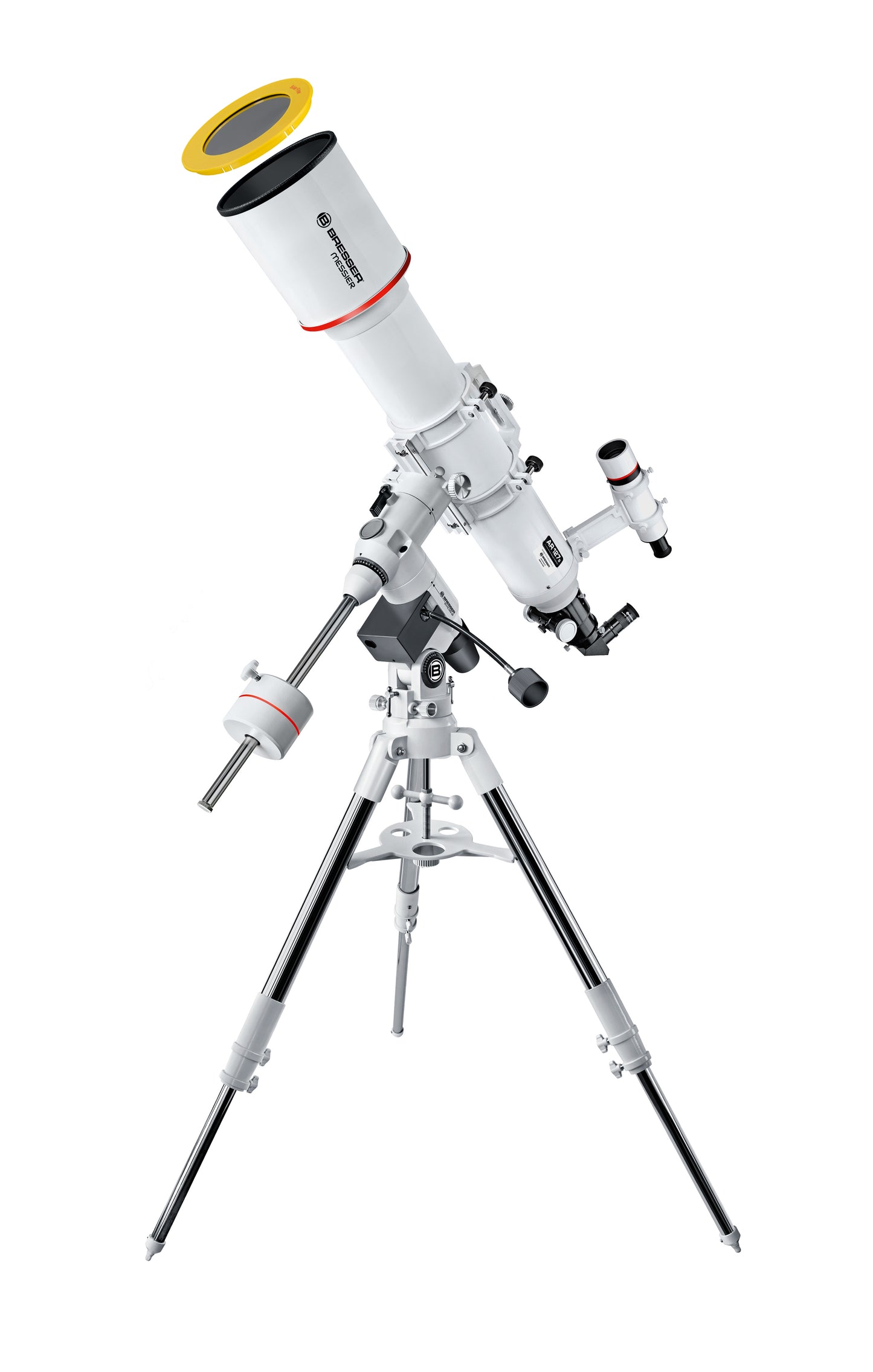
BRESSER Messier AR-127S/635 EXOS-2/EQ5 Hexafoc Telescope
BRESSER Messier AR-127S/635 EXOS-2/EQ5 Hexafoc Telescope
Regular price
£913.00
Regular price
Sale price
£913.00
Taxes is not included.
Shipping calculated at checkout.
In stock
Quantity
Couldn't load pickup availability
- SECURE PAYMENT
- FAST SHIPPING AVAILABLE
- EXPERT CONSULTING
NEW - now includes a high-quality objective solar filter for safe observation of sunspots, eclipses, and planetary transits. A high-quality telescope for night and solar observation.
Thanks to its short design, this instrument offers particularly wide and bright fields of view. Don't miss observing the Andromeda galaxy with the BRESSER Messier AR-127S! The brightness of this object, which can be seen over 2 million light-years away, is as spectacular in the MESSIER AR-127S as the observation of large gas nebulae. Thanks to the large aperture, nebula filters can already be used with the Messier AR-127S, allowing gas nebulae to be observed with incredibly clear contrast. The short tube length and stable mount make this combination ideal for quick observations, especially if the device is transported frequently. Thanks to the special construction as a four-lens achromat, low chromatic aberration and improved photographic correction are achieved compared to similar two-lens devices, despite the very fast f/5 focal ratio for a refractor.
The Telescope consists of a refractor telescope (Refractor) and an equatorial mount with a tripod included. The optics have a clear aperture of 127 mm with a focal length of 635 mm and a focal ratio of F5. The refractor has many extras such as tube clamps with a handle and integrated camera holder, a 31.7 mm (1.25") diagonal mirror, or an 8x50 finder scope. With the equatorial (also known as parallactic) EXOS-2 mount, one axis is aligned with the North Star. When tracking a celestial object, only one axis needs to be moved, which makes tracking much easier compared to mounts that only have left/right and up/down axes (alt-azimuth mount). With the 8x50 finder scope included in the set, celestial objects are easily found. The finder scope also has a reticle for more comfortable observation in the dark. The mount also features an illuminated polar finder that greatly simplifies alignment to the north. Through two flexible shafts connected to the fine movement unit, objects can be precisely adjusted and tracked in the eyepiece. The stable stainless steel tube tripod is height-adjustable and thus ensures a comfortable observing position.
Application area: The BRESSER Messier AR-127 on EXOS-2 offers the ambitious amateur astronomer good optics with a stable universal mount. The telescope's 127 mm aperture and short focal length are perfect for large objects such as open star clusters and large nebulae. For detailed observations of the Moon and planets in our solar system, it is recommended to purchase additional eyepieces and/or a Barlow lens to increase the focal length. With a total weight of approximately 24 kg, composed of the three parts (tube, mount with counterweight, tripod), the telescope is ideal for use outside bright cities. Only then can the optics deliver their maximum performance.
Special Features: Bresser EXOS-2 Equatorial (parallactic) mount with a load capacity of up to 13 kg (depending on telescope length) and polar finder. Ball bearings on both axes allow for precise and smooth movement. To facilitate tracking and navigation during observation, an optional GoTo motor set can be used.
OPTICAL FEATURES
INCLUDES
Thanks to its short design, this instrument offers particularly wide and bright fields of view. Don't miss observing the Andromeda galaxy with the BRESSER Messier AR-127S! The brightness of this object, which can be seen over 2 million light-years away, is as spectacular in the MESSIER AR-127S as the observation of large gas nebulae. Thanks to the large aperture, nebula filters can already be used with the Messier AR-127S, allowing gas nebulae to be observed with incredibly clear contrast. The short tube length and stable mount make this combination ideal for quick observations, especially if the device is transported frequently. Thanks to the special construction as a four-lens achromat, low chromatic aberration and improved photographic correction are achieved compared to similar two-lens devices, despite the very fast f/5 focal ratio for a refractor.
The Telescope consists of a refractor telescope (Refractor) and an equatorial mount with a tripod included. The optics have a clear aperture of 127 mm with a focal length of 635 mm and a focal ratio of F5. The refractor has many extras such as tube clamps with a handle and integrated camera holder, a 31.7 mm (1.25") diagonal mirror, or an 8x50 finder scope. With the equatorial (also known as parallactic) EXOS-2 mount, one axis is aligned with the North Star. When tracking a celestial object, only one axis needs to be moved, which makes tracking much easier compared to mounts that only have left/right and up/down axes (alt-azimuth mount). With the 8x50 finder scope included in the set, celestial objects are easily found. The finder scope also has a reticle for more comfortable observation in the dark. The mount also features an illuminated polar finder that greatly simplifies alignment to the north. Through two flexible shafts connected to the fine movement unit, objects can be precisely adjusted and tracked in the eyepiece. The stable stainless steel tube tripod is height-adjustable and thus ensures a comfortable observing position.
Application area: The BRESSER Messier AR-127 on EXOS-2 offers the ambitious amateur astronomer good optics with a stable universal mount. The telescope's 127 mm aperture and short focal length are perfect for large objects such as open star clusters and large nebulae. For detailed observations of the Moon and planets in our solar system, it is recommended to purchase additional eyepieces and/or a Barlow lens to increase the focal length. With a total weight of approximately 24 kg, composed of the three parts (tube, mount with counterweight, tripod), the telescope is ideal for use outside bright cities. Only then can the optics deliver their maximum performance.
Special Features: Bresser EXOS-2 Equatorial (parallactic) mount with a load capacity of up to 13 kg (depending on telescope length) and polar finder. Ball bearings on both axes allow for precise and smooth movement. To facilitate tracking and navigation during observation, an optional GoTo motor set can be used.
OPTICAL FEATURES
- Type: Refractor Telescope
- Lens diameter: 127 mm / Focal length: 635 mm / F/5
- Maximum useful magnification: 254x
- Telescope for night and solar observation
- High-quality BRESSER refractor optics
- Four-lens design for improved image performance
- Ideal universal telescope for planets, double stars, planetary nebulae, and deep sky
- High-quality Hexafoc focuser with a clear internal diameter of 2.5"
- Theoretical resolution in arc seconds: 0.91
- Eyepiece insertion diameter: 50.8mm (2") and 31.7mm (1.25")
- Finder scope: 8x50 optical finder scope with reticle
- Handle for comfortable transport with integrated camera holder (camera thread)
- Smartphone adapter included for celestial navigation
- Dovetail plate with stainless steel clamping surface
- 50.8 to 31.7 mm adapter with integrated T2 adapter (optional T2 ring required), with brass ring
- Stable parallactic mount with fine adjustment on both axes
- Ball bearings on both axes for more precise movements
- Height-adjustable stainless steel tripod (min. 69 cm / max. 109.5 cm)
- Load capacity up to 13 kg
- Upgradeable with the BRESSER Star Tracker GoTo Kit (article number 4951750)
- Bubble level for easy horizontal alignment
- Polar altitude scale for adjusting latitude
- Graduated scale rings for easy object location using a star atlas or planetarium software
- Polar finder with optional illumination (article number 4964212)
- Tripod weight: 4.7 kg
- Mount weight: 5.6 kg (without counterweight)
- Total weight incl. counterweight: 14.8 kg
- Batteries: not included
INCLUDES
- Optical tube with Hexafoc focuser
- Objective solar filter
- 26 mm Plössl eyepiece (24x magnification / 52° field of view)
- Adjustable polar finder with optional illumination
- 8x50 finder scope
- Camera holder for tube ring handle
- Smartphone adapter for navigation
- Dovetail plate with stainless steel clamping surface (universal 44 mm dovetail for GP/EQ5/LXD75)
- 50.8 mm (2") to 31.7 mm (1.25") adapter with T2 thread
- Stellarium planetarium software (downloadable)
- Rotating star chart
- BRESSER EXOS-2 mount
- 1 x 4.5 kg counterweight
- Stainless steel tube tripod with accessory tray
SEGURIDAD PRODUCTOS
Fabricante: Bresser Iberia SLU | Valdemorillo, 1 - nave B | 28925 Alcorcón ESPAÑA | https://www.bresser-iberia.es/
⚠️ NOTAS DE ADVERTENCIA
GAFAS PARA LA OBSERVACIÓN DE ECLIPSE
- INSTRUCCIONES: Revise antes de cada uso. No utilice ni deseche si está dañado, rasgado, perforado o separado de alguna manera del marco. No lo use con otros dispositivos ópticos. No es un juguete. Los niños deben usarlo solo bajo la supervisión de un adulto. Limítese a 3 minutos de uso continuo, con interrupciones durante varias horas. No se mueva mientras usa este producto, no conduzca un vehículo ni opere maquinaria. No lo use si tiene un ojo enfermo o después de una operación ocular.
- ADVERTENCIA: Nunca mire directamente al sol sin protección ocular especial. Siempre use gafas de eclipse al observar el eclipse solar, especialmente si una parte del sol es visible. Mirar directamente al sol puede causar daños permanentes si no se toman las precauciones adecuadas. Se debe usar protección ocular adecuada, diseñada específicamente para la observación solar, para evitar que los rayos dañinos del sol lleguen a los ojos. Deséchelo después de 3 años y no lo utilice después de ese tiempo.
OBSERVACIÓN SOLAR CON TELESCOPIO
- Nunca mire al sol a través de un ocular/telescopio sin un filtro de protección verificado. Un filtro lunar nunca puede usarse para la observación solar. El filtro lunar solo es adecuado para la observación de la luna. El filtro solar debe montarse en la apertura del telescopio, no en el ocular. De lo contrario, el rayo de luz concentrado por la óptica destruirá inmediatamente la película del filtro, lo que provocará daños oculares graves e incluso ceguera total.
- Revise el filtro solar antes de cada observación solar y asegúrese de que no esté dañado. Manténgalo frente a una fuente de luz intensa para poder detectar posibles grietas y/o agujeros. No use el telescopio para la observación solar, incluso si el filtro solar está solo ligeramente dañado. En este caso, comuníquese con el fabricante para obtener las piezas de repuesto correspondientes.
- Siempre use el filtro solar cuando observe el sol. Asegúrese de que este filtro esté colocado correctamente en el telescopio según las instrucciones. El uso del filtro solar está destinado únicamente para su uso con este telescopio.
- Revise el ajuste del filtro solar antes de cada observación solar. Si se suelta accidentalmente de la abertura del objetivo, esto puede causar daños oculares inmediatos y permanentes, e incluso ceguera.
- Si el filtro solar no puede montarse de manera suficientemente firme en el tubo, mejore el ajuste colocando varias tiras de fieltro autoadhesivas o similares entre el filtro solar y la abertura del objetivo. Nunca use el filtro solar si no puede colocarse correctamente en el telescopio. En tal caso, siempre contacte primero con nuestro servicio al cliente.
- Tenga mucho cuidado al observar el sol. Incluso una mirada corta a través de la óptica sin protección puede causar daños oculares graves e incluso ceguera total.
- Los niños, incluso con el filtro montado correctamente, no deben mirar al sol a través del telescopio. Nunca deje a los niños sin supervisión.
- Nunca deje la óptica sin supervisión. Los niños y los adultos inexpertos podrían dirigir el telescopio hacia el sol sin las precauciones adecuadas y perder la vista.
- No realice observaciones solares sin la consulta previa de un médico después de una operación ocular o cualquier otra enfermedad ocular.
- Las ondas/pliegues en la película son normales y no constituyen un defecto del producto.
- No exponga el dispositivo a altas temperaturas.
ADVERTENCIAS Y SEGURIDAD DE LAS PILAS
- NO USE pilas falsas en los productos. Use solo las pilas proporcionadas. Use la pila EXCLUSIVAMENTE para el propósito previsto.
- Guarde las pilas fuera del alcance de los niños y mascotas.
- NO USE pilas que parezcan tener la carcasa dañada, inflada o modificada. No use pilas que hayan goteado, huelan, estén hinchadas o derretidas o presenten abolladuras, óxido, grietas o rayones.
- La pila NO debe ser desmontada, aplastada, perforada, triturada ni manipulada de ninguna otra forma.
- La pila NO debe exponerse a líquidos.
- No debe intentar secar una pila mojada o húmeda con un dispositivo o fuente de calor.
- El dispositivo o la pila NO deben ser colocados cerca de una fuente de calor o bajo la luz solar directa.
- La pila NO debe tocar objetos metálicos.
- La pila NO debe ser almacenada junto a materiales peligrosos o inflamables. Guarde la pila en un lugar fresco, seco y bien ventilado.
- La pila NO debe insertarse incorrectamente al cargarla.
- La pila NO debe cargarse bajo luz solar directa ni a temperaturas extremas. Cárguela a temperatura ambiente (20 °C – 26 °C).
- Evite dejar caer la pila o el producto. Si sospecha que la pila está dañada, reemplácela.
- Nunca deje su dispositivo conectado a la corriente más de 24 horas. Deje que la pila se agote y luego recárguela.
- Para obtener los mejores resultados, reemplace las pilas según el uso después de 12 meses o antes.
- Siga las regulaciones locales para la eliminación de las pilas usadas. NO arroje la pila al fuego ni al agua.