

ZWO
ASI678MC ZWO Camera
ASI678MC ZWO Camera
In stock
Couldn't load pickup availability
- SECURE PAYMENT
- FAST SHIPPING AVAILABLE
- EXPERT CONSULTING
A next-generation uncooled color CMOS camera
- 1/1.8" Sony IMX678 color CMOS sensor with 8.4 million pixels (2 µ)
- Up to 47 fps at full resolution
- 12 bit analog to digital converter
- For planetary images, assisted visuals or “lucky images”
The ZWO ASI678MC camera is equipped with a color CMOS sensor with 8.4 million pixels (3840 x 2160 px) and 8.9 mm diagonal, in 16:9 format. At full resolution, the maximum acquisition speed reaches 47 images/second with a dynamic range of 12 bits. Equipped with the latest technologies of the STARVIS 2 sensor architecture offered by Sony, the camera offers state-of-the-art features: total absence of electroluminescence, wide dynamic range, very high sensitivity in the near infrared, dark current and very low readout noise.
With its 1/1.8" format color sensor, the ZWO ASI678MC camera is suitable for planetary imaging at high acquisition speed. You will thus obtain magnificent photographs of the planets, in color, freeing yourself from the dangers of turbulence thanks to its sensitivity to In low light conditions, the 662MC offers excellent results in assisted visual aids .
The IMX678 has square pixels that measure just 2 µm on a side. With such small pixels, it is very important to calculate the resulting sampling of your settings based on your viewing conditions and vision. If necessary, you will have to adapt the focal length of the instrument or perform binning, so as not to oversample the images.
Sensor performance
Designed by Sony for surveillance and security applications, the IMX678 sensor is based on the STARVIS 2 technical architecture. The latter integrates powerful functions that allow bright and contrasted images, with significant dynamics, even in extremely limited lighting conditions. The most important is the use of an optoelectronic structure called “back-illuminated” (or BSI, Backside Illumination sensor). All sensor electronics are placed below the photosites; The distance that light must travel through the sensor is reduced, as is the blocking of photons by non-photosensitive electronic elements. Sensitivity increases considerably, even in very low light conditions. The sensor is also extremely effective in the near-infrared (NIR), a spectral band prized by planetary astrophotographers for its lower sensitivity to atmospheric turbulence. This staggered structure allows more electronic components to be placed within the sensor itself, such as ADC, thus minimizing artifacts and noise.
Compared to previous generations of Sony sensors, the IMX678 offers very low read noise and reduced dark current, significantly improving the signal-to-noise ratio. When comparing two black images, we see that the ASI178MC image is less noisy and smoother.
Quantum efficiency and readout noise are the two most important parameters for measuring camera performance. High quantum efficiency and low readout noise are necessary conditions to significantly improve the signal-to-noise ratio.
The reading noise is the sum of several components: the thermal noise of the photosites, the noise linked to the sensor electronics and the quantization noise from the analog/digital conversion stages. The lower this read noise, the better the results; Therefore, technological work is carried out at each level to reduce it as much as possible. At the output, the camera incorporates a HCG (high conversion gain) device that can reduce playback noise at high gain while retaining the large dynamic range that would be obtained at low gain. This HCG mode is automatically activated as soon as the gain reaches 80.
The assembly mechanics
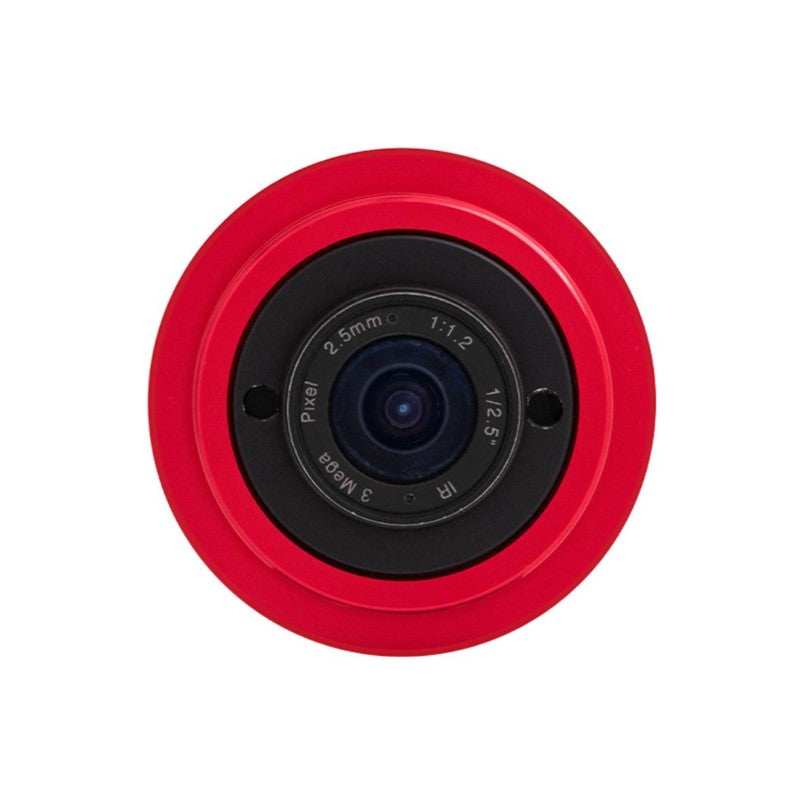
The ASI678MC has an M42 type female inlet thread; back focus is 12.5mm. A mechanical M42 to 31.75mm male converter is supplied, as well as a 2m long USB cable and an ST4 autoguide cable. ZWO also offers a good quality 2.5mm focal length lens. Thus equipped, the camera can also act as an All-Sky camera for sky surveillance.
Software
As with all ZWO brand cameras, the main and most complete camera control software is ASIStudio , downloadable for free from the manufacturer ZWO's website. The brand also offers a free SDK (Software Development Kit) so that many software programs, free or paid, natively support ZWO cameras: Prism, NINA, FireCapture, MaximDL, SharpCap, PHD2, AllSkEye, etc. We invite you to consult the specific documentation of this software for its level of compatibility or visit the ZWO website for a comprehensive list.
ZWO also offers a unified ASCOM driver to control all your accessories through the ASCOM/Alpaca platform. This driver can be downloaded for free from the ZWO website.
For Linux and Mac users, Indi or Indigo drivers They are free and available on the websites of these platforms. Control is then carried out using the KStars/Ekos software (on Linux) and AstroImager/AstroTelescope from the CloudMakers editor (on Mac).
Finally, ZWO cameras can be accessed through video drivers such as DirectShow or TWAIN. For more details, please visit the ZWO website.
Specifications

| Characteristic | ZWO ASI678MC Camera |
|---|---|
| Sensor | |
| Sensor | CMOSSony IMX678 |
| Sensor type | Colors |
| Sensor format | 1/1.8" |
| die size | 3840 x 2160 pixels |
| Dimensions of a pixel | 2.0 x 2.0µm |
| Die dimensions | 7.7 x 4.3mm (diagonal: 8.86mm) |
| Pixel capacity | 11,270 e- |
| Electronic | |
| A/D converter | 12 bit |
| Gain | 2.75 e-/ADU |
| Reading noise | 0.6 to 2.7 e- |
| Shutter | Electronic, “roller blind” type |
| Exposure time range | 32 µs at 2000 |
| Cooling | |
| Cooling type | Passive |
| Cooling regulation | No |
| water cooling | No |
| Connections | |
| computer interface | SuperSpeed USB 3.0 Type B |
| Self-guided interface | Yeah. ST4 compatible with RJ12 |
| Additional interfaces | None |
| Electrical power supply | 5V, via USB port |
Mechanical characteristics
| Characteristic | ZWO ASI678MC Camera |
|---|---|
| back focus | 12.5mm |
| Mechanical entry | Female thread M42x0.75 |
| protective porthole | D21 anti-IR glass |
| Dimensions (diameter x height) | 62mm x 37.1mm |
| Weight | 126g |
Items delivered:
- 1 ZWO ASI678MC color camera
- 1 x 2.5mm CCTV Fisheye Lens
- 1 USB3 cable (2m)
- 1 ST4 autoguiding cable
- 1 M42x0.75 male to 31.75 mm male adapter, with plug


⚠️ NOTAS DE ADVERTENCIA
GAFAS PARA LA OBSERVACIÓN DE ECLIPSE
- INSTRUCCIONES: Revise antes de cada uso. No utilice ni deseche si está dañado, rasgado, perforado o separado de alguna manera del marco. No lo use con otros dispositivos ópticos. No es un juguete. Los niños deben usarlo solo bajo la supervisión de un adulto. Limítese a 3 minutos de uso continuo, con interrupciones durante varias horas. No se mueva mientras usa este producto, no conduzca un vehículo ni opere maquinaria. No lo use si tiene un ojo enfermo o después de una operación ocular.
- ADVERTENCIA: Nunca mire directamente al sol sin protección ocular especial. Siempre use gafas de eclipse al observar el eclipse solar, especialmente si una parte del sol es visible. Mirar directamente al sol puede causar daños permanentes si no se toman las precauciones adecuadas. Se debe usar protección ocular adecuada, diseñada específicamente para la observación solar, para evitar que los rayos dañinos del sol lleguen a los ojos. Deséchelo después de 3 años y no lo utilice después de ese tiempo.
OBSERVACIÓN SOLAR CON TELESCOPIO
- Nunca mire al sol a través de un ocular/telescopio sin un filtro de protección verificado. Un filtro lunar nunca puede usarse para la observación solar. El filtro lunar solo es adecuado para la observación de la luna. El filtro solar debe montarse en la apertura del telescopio, no en el ocular. De lo contrario, el rayo de luz concentrado por la óptica destruirá inmediatamente la película del filtro, lo que provocará daños oculares graves e incluso ceguera total.
- Revise el filtro solar antes de cada observación solar y asegúrese de que no esté dañado. Manténgalo frente a una fuente de luz intensa para poder detectar posibles grietas y/o agujeros. No use el telescopio para la observación solar, incluso si el filtro solar está solo ligeramente dañado. En este caso, comuníquese con el fabricante para obtener las piezas de repuesto correspondientes.
- Siempre use el filtro solar cuando observe el sol. Asegúrese de que este filtro esté colocado correctamente en el telescopio según las instrucciones. El uso del filtro solar está destinado únicamente para su uso con este telescopio.
- Revise el ajuste del filtro solar antes de cada observación solar. Si se suelta accidentalmente de la abertura del objetivo, esto puede causar daños oculares inmediatos y permanentes, e incluso ceguera.
- Si el filtro solar no puede montarse de manera suficientemente firme en el tubo, mejore el ajuste colocando varias tiras de fieltro autoadhesivas o similares entre el filtro solar y la abertura del objetivo. Nunca use el filtro solar si no puede colocarse correctamente en el telescopio. En tal caso, siempre contacte primero con nuestro servicio al cliente.
- Tenga mucho cuidado al observar el sol. Incluso una mirada corta a través de la óptica sin protección puede causar daños oculares graves e incluso ceguera total.
- Los niños, incluso con el filtro montado correctamente, no deben mirar al sol a través del telescopio. Nunca deje a los niños sin supervisión.
- Nunca deje la óptica sin supervisión. Los niños y los adultos inexpertos podrían dirigir el telescopio hacia el sol sin las precauciones adecuadas y perder la vista.
- No realice observaciones solares sin la consulta previa de un médico después de una operación ocular o cualquier otra enfermedad ocular.
- Las ondas/pliegues en la película son normales y no constituyen un defecto del producto.
- No exponga el dispositivo a altas temperaturas.
ADVERTENCIAS Y SEGURIDAD DE LAS PILAS
- NO USE pilas falsas en los productos. Use solo las pilas proporcionadas. Use la pila EXCLUSIVAMENTE para el propósito previsto.
- Guarde las pilas fuera del alcance de los niños y mascotas.
- NO USE pilas que parezcan tener la carcasa dañada, inflada o modificada. No use pilas que hayan goteado, huelan, estén hinchadas o derretidas o presenten abolladuras, óxido, grietas o rayones.
- La pila NO debe ser desmontada, aplastada, perforada, triturada ni manipulada de ninguna otra forma.
- La pila NO debe exponerse a líquidos.
- No debe intentar secar una pila mojada o húmeda con un dispositivo o fuente de calor.
- El dispositivo o la pila NO deben ser colocados cerca de una fuente de calor o bajo la luz solar directa.
- La pila NO debe tocar objetos metálicos.
- La pila NO debe ser almacenada junto a materiales peligrosos o inflamables. Guarde la pila en un lugar fresco, seco y bien ventilado.
- La pila NO debe insertarse incorrectamente al cargarla.
- La pila NO debe cargarse bajo luz solar directa ni a temperaturas extremas. Cárguela a temperatura ambiente (20 °C – 26 °C).
- Evite dejar caer la pila o el producto. Si sospecha que la pila está dañada, reemplácela.
- Nunca deje su dispositivo conectado a la corriente más de 24 horas. Deje que la pila se agote y luego recárguela.
- Para obtener los mejores resultados, reemplace las pilas según el uso después de 12 meses o antes.
- Siga las regulaciones locales para la eliminación de las pilas usadas. NO arroje la pila al fuego ni al agua.