
Omegon
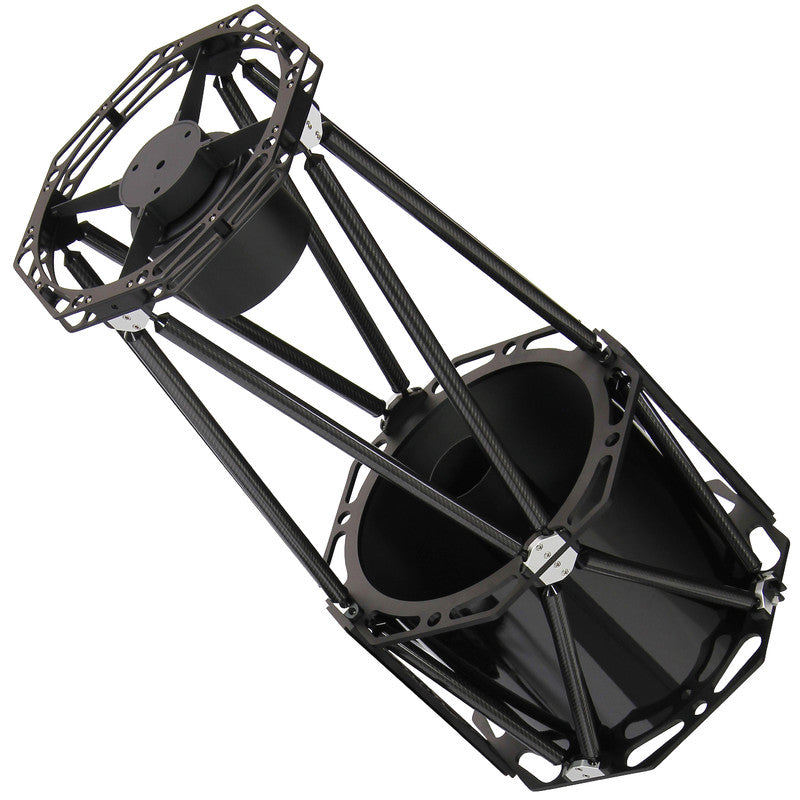
Ritchey-Chretien Pro RC 406/3250 Truss OTA
Ritchey-Chretien Pro RC 406/3250 Truss OTA
Couldn't load pickup availability
- SECURE PAYMENT
- AVAILABLE ON REQUEST
- ESTIMATED DELIVERY: 3 WEEKS
Omegon Truss Carbon RC Telescope: professional astrophotography for your observatory
Is astrophotography your passion, and are you looking for the perfect telescope for your observatory? Ritchey-Chrétien telescopes combine a large mirror optical tube with almost perfect image quality. A pair of hyperbolic mirrors provide a wide, well-illuminated field of view free of comatic aberration, all in a compact format. The result: perfect stars right up to the edge of the image. This is why it is the preferred system for many professional observatories and institutions.
You too can choose professional technology for your private observatory! Omegon RC telescopes are so well-balanced that they can be used without problems even in the smallest observatories.
Advantages at a glance:
- Hyperbolic mirrors: extremely sharp images and a large field of view without correctors
- Quartz mirrors: greater focusing stability without the need for readjustments for an always sharp image
- Compatible with large format CCD cameras: illumination of approx. 60 mm
- Carbon Truss optical tube: rigid open carbon truss system
- High reflection: dielectric coating with 92-94% reflection for clear, high-contrast observations and astrophotos
- Fast cooling thanks to the open design
- High-performance electric fan: minimises tube seeing and accelerates cooling
Hyperbolic mirror for better image quality
RC telescopes are equipped with hyperbolic primary and secondary mirrors. Not with spherical mirrors, like Schmidt-Cassegrain systems. The RC design is very carefully crafted: the optical tube offers a wider field of view and considerably less optical aberration.
Impeccable image quality in a larger field of view: this is the task of these telescopes. That's why they are the preferred choice for astrophotography. And that's also why RC optical tubes are ideal for CCD cameras, which means you can take sharp photos right up to the edge without a corrector. This way you can capture beautiful snapshots of the sky.
Especially useful in a wider spectral region
RC telescopes do not have any lenses in the beam path. This is a great advantage, because refractive effects such as chromaticism or dispersion are avoided. The useful region of the spectrum beyond visible light is wider. This way, you can delve into the interesting world of ultraviolet and infrared rays with your camera.
Quartz primary mirror
If you have experience in astrophotography, you have probably experienced the focus shifting during long exposures. It is very annoying! The advantage of this model is that it has 2 quartz mirrors. It hardly suffers from thermal expansion, so it produces fantastic images and maintains focus throughout the night.
The 2 mirrors of the telescope have a 92-94% reflective coating for clearer and higher contrast images. Compared to the mirrors of "normal" telescopes, with an 88% coating, this guarantees up to 17% more light.
Greater observing agility: fan for the primary mirror
Only a slight, imperceptible hum, but with a gigantic effect: the integrated 12V fan can cool the primary mirror up to 50% faster, so your telescope can reach optimal image quality much sooner. No more long waits!
Open design carbon optical tube
Most professional telescopes have an open tube. Well, this telescope also benefits from the advantages associated with this design. Carbon trusses are rigid, lightweight and very resistant to temperature changes. In fact, that is another reason why its focus is so stable. Air circulation is better in open tubes and prevents a microclimate from forming inside.
Large unhindered aperture: 3" focuser
The rear end is extremely important. A 3" linear Crayford focuser with ball bearings provides enough space to illuminate even the widest fields of view without vignetting. This hybrid between Crayford and rail combines the simplicity of Crayford focusers and the stability of a good rack and pinion focuser.
- Always perfect alignment to your observing target: fully rotatable focuser
- 2 and 1.25" adapters with integrated compression ring
- Precision focusing: 1:10 reduction for fine focus adjustment
- Graduated scale: to quickly regain focus
- High stability: camera support on the optical axis without tilting for a sharp image
Individually adjustable focuser
A total of 6 collimation screws allow you to precisely adjust this 3" focuser in your mirror optical tube. This prevents unwanted slippage, keeping the eyepiece or your camera always on the optical axis. Excellent: this focuser has a homogeneous 3" diameter, which is not always a given, as many similar focusers narrow towards the eyepiece side.
Better image quality than with SC telescopes
RC telescopes are, in essence, completely different from SC or Maksutov. They are open systems without a corrector plate that adjust much faster to ambient temperature than SC telescopes. In addition, by not having a plate at the front, these telescopes capture clearer images without the risk of reflections. Ritchey-Chrétien systems are the most highly corrected double-mirror telescopes available. The sharpness of the field of view, including the edge, is impressive. So it's no wonder that practically all large research telescopes in professional observatories use this type of optical tube.
And now within everyone's reach
The manufacture of hyperbolic mirrors is a science and an art. Until a few years ago, RC telescopes were among the most expensive in the world and were only found in international research institutions. However, today this technology is also affordable for experienced amateur astronomers.
⚠️ NOTAS DE ADVERTENCIA
GAFAS PARA LA OBSERVACIÓN DE ECLIPSE
- INSTRUCCIONES: Revise antes de cada uso. No utilice ni deseche si está dañado, rasgado, perforado o separado de alguna manera del marco. No lo use con otros dispositivos ópticos. No es un juguete. Los niños deben usarlo solo bajo la supervisión de un adulto. Limítese a 3 minutos de uso continuo, con interrupciones durante varias horas. No se mueva mientras usa este producto, no conduzca un vehículo ni opere maquinaria. No lo use si tiene un ojo enfermo o después de una operación ocular.
- ADVERTENCIA: Nunca mire directamente al sol sin protección ocular especial. Siempre use gafas de eclipse al observar el eclipse solar, especialmente si una parte del sol es visible. Mirar directamente al sol puede causar daños permanentes si no se toman las precauciones adecuadas. Se debe usar protección ocular adecuada, diseñada específicamente para la observación solar, para evitar que los rayos dañinos del sol lleguen a los ojos. Deséchelo después de 3 años y no lo utilice después de ese tiempo.
OBSERVACIÓN SOLAR CON TELESCOPIO
- Nunca mire al sol a través de un ocular/telescopio sin un filtro de protección verificado. Un filtro lunar nunca puede usarse para la observación solar. El filtro lunar solo es adecuado para la observación de la luna. El filtro solar debe montarse en la apertura del telescopio, no en el ocular. De lo contrario, el rayo de luz concentrado por la óptica destruirá inmediatamente la película del filtro, lo que provocará daños oculares graves e incluso ceguera total.
- Revise el filtro solar antes de cada observación solar y asegúrese de que no esté dañado. Manténgalo frente a una fuente de luz intensa para poder detectar posibles grietas y/o agujeros. No use el telescopio para la observación solar, incluso si el filtro solar está solo ligeramente dañado. En este caso, comuníquese con el fabricante para obtener las piezas de repuesto correspondientes.
- Siempre use el filtro solar cuando observe el sol. Asegúrese de que este filtro esté colocado correctamente en el telescopio según las instrucciones. El uso del filtro solar está destinado únicamente para su uso con este telescopio.
- Revise el ajuste del filtro solar antes de cada observación solar. Si se suelta accidentalmente de la abertura del objetivo, esto puede causar daños oculares inmediatos y permanentes, e incluso ceguera.
- Si el filtro solar no puede montarse de manera suficientemente firme en el tubo, mejore el ajuste colocando varias tiras de fieltro autoadhesivas o similares entre el filtro solar y la abertura del objetivo. Nunca use el filtro solar si no puede colocarse correctamente en el telescopio. En tal caso, siempre contacte primero con nuestro servicio al cliente.
- Tenga mucho cuidado al observar el sol. Incluso una mirada corta a través de la óptica sin protección puede causar daños oculares graves e incluso ceguera total.
- Los niños, incluso con el filtro montado correctamente, no deben mirar al sol a través del telescopio. Nunca deje a los niños sin supervisión.
- Nunca deje la óptica sin supervisión. Los niños y los adultos inexpertos podrían dirigir el telescopio hacia el sol sin las precauciones adecuadas y perder la vista.
- No realice observaciones solares sin la consulta previa de un médico después de una operación ocular o cualquier otra enfermedad ocular.
- Las ondas/pliegues en la película son normales y no constituyen un defecto del producto.
- No exponga el dispositivo a altas temperaturas.
ADVERTENCIAS Y SEGURIDAD DE LAS PILAS
- NO USE pilas falsas en los productos. Use solo las pilas proporcionadas. Use la pila EXCLUSIVAMENTE para el propósito previsto.
- Guarde las pilas fuera del alcance de los niños y mascotas.
- NO USE pilas que parezcan tener la carcasa dañada, inflada o modificada. No use pilas que hayan goteado, huelan, estén hinchadas o derretidas o presenten abolladuras, óxido, grietas o rayones.
- La pila NO debe ser desmontada, aplastada, perforada, triturada ni manipulada de ninguna otra forma.
- La pila NO debe exponerse a líquidos.
- No debe intentar secar una pila mojada o húmeda con un dispositivo o fuente de calor.
- El dispositivo o la pila NO deben ser colocados cerca de una fuente de calor o bajo la luz solar directa.
- La pila NO debe tocar objetos metálicos.
- La pila NO debe ser almacenada junto a materiales peligrosos o inflamables. Guarde la pila en un lugar fresco, seco y bien ventilado.
- La pila NO debe insertarse incorrectamente al cargarla.
- La pila NO debe cargarse bajo luz solar directa ni a temperaturas extremas. Cárguela a temperatura ambiente (20 °C – 26 °C).
- Evite dejar caer la pila o el producto. Si sospecha que la pila está dañada, reemplácela.
- Nunca deje su dispositivo conectado a la corriente más de 24 horas. Deje que la pila se agote y luego recárguela.
- Para obtener los mejores resultados, reemplace las pilas según el uso después de 12 meses o antes.
- Siga las regulaciones locales para la eliminación de las pilas usadas. NO arroje la pila al fuego ni al agua.
Telescope accessories
-

Astronomy cameras
Astronomy cameras , specially designed to capture images from space, offer several...
-

Alignment Accessories
Collimation is the exact orientation of the optics within a telescope. It...


