

Levenhuk
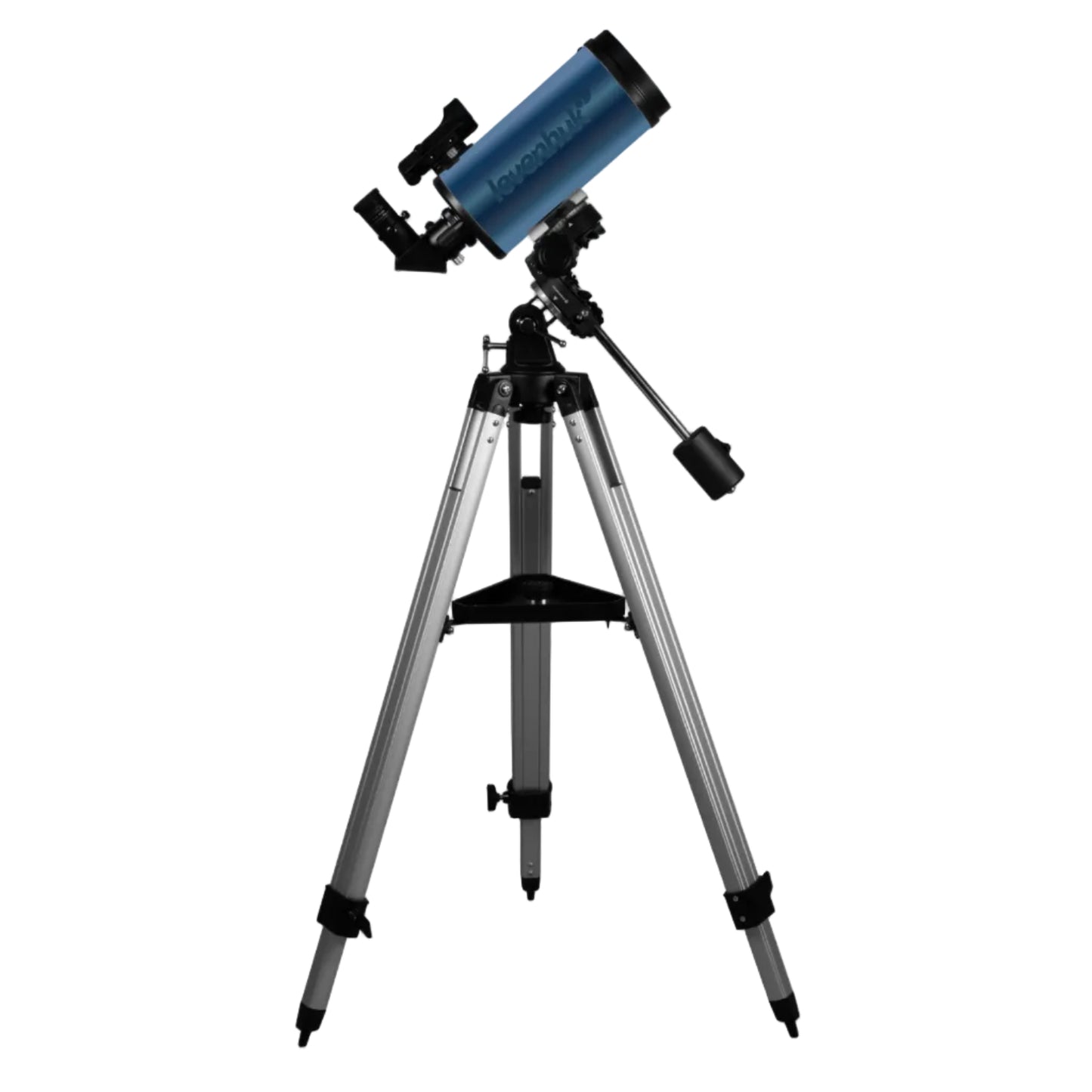
Levenhuk New Skyline PRO MAK 102/1300 SQ1 Telescope
Levenhuk New Skyline PRO MAK 102/1300 SQ1 Telescope
In stock
Couldn't load pickup availability
- SECURE PAYMENT
- FAST SHIPPING AVAILABLE
- EXPERT CONSULTING
Levenhuk New Skyline PRO MAK 102/1300 SQ1 Telescope
A compact catadioptric telescope for observing Solar System planets, the Moon, and deep-sky objects. Observe space with high fidelity
The Levenhuk New Skyline PRO MAK 102/1300 SQ1 is a compact catadioptric telescope. It is ideal for both urban observations and astronomical excursions to the countryside. Thanks to its optical design, it offers high-contrast images, and the dark background of the field of view helps reveal planetary details even under light pollution. The Moon, planets, and bright stars remain clearly visible even from the center of a large city. Its closed tube prevents dust and moisture from entering. Therefore, an open-air night will not harm the telescope.
What objects can you study with this telescope?
We recommend starting with the Moon. With the 10mm eyepiece, a magnification of up to 130x is achieved, and the Moon ceases to be a simple luminous disk to appear with an astonishing level of detail. You will be able to explore mountain ranges like the Apennines, the Alps, and the Carpathians. You will observe craters like Copernicus, Tycho, and Plato, along with the trio of Ptolemaeus, Alphonsus, and Arzachel. You can even contemplate lunar maria such as Oceanus Procellarum, the Sea of Tranquility, and the Sea of Serenity. And that's not all. You will also be able to observe details such as terraces, central peaks, rays, and rilles.
The planets of the solar system will also surprise you. Two to four cloud bands appear on Jupiter's disk. Nearby, you can see the Galilean moons: Io, Europa, Ganymede, and Callisto. Saturn's rings are clearly distinguishable from the planet. You can also observe Mercury and Venus through the eyepiece. They look like small spheres or crescents, depending on their phase. During oppositions, Mars shows an orange-reddish hue and its polar cap.
Away from city lights, you can observe the Orion Nebula and the Ring Nebula (M57) in Lyra. Also noteworthy are the Pleiades, the Beehive Clusters, and the Hercules Globular Cluster. Nearby galaxies, including Andromeda, appear as diffuse clouds. Thanks to its high-contrast optics, the telescope reveals hundreds of double and multiple star systems.
SQ1 equatorial mount
The optical tube is mounted on an SQ1 equatorial mount with manual control. Before use, it is necessary to set it up. Select the correct latitude and point the right ascension axis towards Polaris. From that moment on, the telescope will be ready for observation. The mount compensates for the Earth's daily rotation, allowing the object to be kept in the field of view by turning a single knob.
Aluminum tripod and accessories
A great advantage of the Levenhuk New Skyline PRO MAK 102/1300 SQ1 is its complete kit. It includes three SUPER eyepieces (10 mm, 20 mm, and 25 mm), a red dot finder, a counterweight, slow-motion controls, and a sturdy aluminum tripod with an accessory tray. You will have everything you need to start observing that same night. This telescope is an excellent addition to your astronomical hobby.
Key features:
Versatile: ideal for observing the Moon, Solar System planets, bright deep-sky objects, and even terrestrial objects.
Compact and robust, the optical tube is protected from dust and moisture, and its internal components rarely require collimation.
The Maksutov-Cassegrain design offers high contrast and sharp images. This is especially valuable when observing the Moon and planets.
The SQ1 equatorial mount allows easy and precise tracking of celestial objects at any magnification.
Complete kit: The box contains all the necessary accessories to get started quickly. No additional purchases are required.
Easy to transport to the field. The compact optical tube fits perfectly in a travel bag.
The kit includes:
Telescope optical tube
SQ1 equatorial mount
SUPER 10 mm, 1.25" eyepiece
SUPER 20 mm, 1.25" eyepiece
SUPER 25 mm, 1.25" eyepiece
90° diagonal mirror
Red dot finder
Slow-motion controls
Counterweight
Counterweight bar
Aluminum tripod
Accessory tray
User guide and warranty card
Specifications:
Optical design: catadioptric
Optical system: Maksutov-Cassegrain
Objective lens diameter (aperture), mm: 102
Focal length, mm: 1300
Useful maximum magnification, x: 204
Relative aperture: f/12.7
Resolution threshold, arc seconds: 1.14
Limiting stellar magnitude (approx.): 11.8
Eyepieces: SUPER 10 mm (130x), SUPER 20 mm (65x), SUPER 25 mm (52x)
Eyepiece barrel diameter, inches: 1.25
Barlow lens: −
Finder: red dot finder
Tripod: aluminum
Tripod height, mm: 685–1285
Accessory tray: +
Telescope control: manual
Mount: equatorial (SQ1)
Slow-motion controls: 2 slow-motion control knobs
Counterweights: +
Dovetail plate: +
User level: advanced users, professionals
Assembly and installation difficulty level: easy
Observed objects: Solar System planets, deep-sky objects, and terrestrial objects
Extensive set of accessories: +

⚠️ NOTAS DE ADVERTENCIA
GAFAS PARA LA OBSERVACIÓN DE ECLIPSE
- INSTRUCCIONES: Revise antes de cada uso. No utilice ni deseche si está dañado, rasgado, perforado o separado de alguna manera del marco. No lo use con otros dispositivos ópticos. No es un juguete. Los niños deben usarlo solo bajo la supervisión de un adulto. Limítese a 3 minutos de uso continuo, con interrupciones durante varias horas. No se mueva mientras usa este producto, no conduzca un vehículo ni opere maquinaria. No lo use si tiene un ojo enfermo o después de una operación ocular.
- ADVERTENCIA: Nunca mire directamente al sol sin protección ocular especial. Siempre use gafas de eclipse al observar el eclipse solar, especialmente si una parte del sol es visible. Mirar directamente al sol puede causar daños permanentes si no se toman las precauciones adecuadas. Se debe usar protección ocular adecuada, diseñada específicamente para la observación solar, para evitar que los rayos dañinos del sol lleguen a los ojos. Deséchelo después de 3 años y no lo utilice después de ese tiempo.
OBSERVACIÓN SOLAR CON TELESCOPIO
- Nunca mire al sol a través de un ocular/telescopio sin un filtro de protección verificado. Un filtro lunar nunca puede usarse para la observación solar. El filtro lunar solo es adecuado para la observación de la luna. El filtro solar debe montarse en la apertura del telescopio, no en el ocular. De lo contrario, el rayo de luz concentrado por la óptica destruirá inmediatamente la película del filtro, lo que provocará daños oculares graves e incluso ceguera total.
- Revise el filtro solar antes de cada observación solar y asegúrese de que no esté dañado. Manténgalo frente a una fuente de luz intensa para poder detectar posibles grietas y/o agujeros. No use el telescopio para la observación solar, incluso si el filtro solar está solo ligeramente dañado. En este caso, comuníquese con el fabricante para obtener las piezas de repuesto correspondientes.
- Siempre use el filtro solar cuando observe el sol. Asegúrese de que este filtro esté colocado correctamente en el telescopio según las instrucciones. El uso del filtro solar está destinado únicamente para su uso con este telescopio.
- Revise el ajuste del filtro solar antes de cada observación solar. Si se suelta accidentalmente de la abertura del objetivo, esto puede causar daños oculares inmediatos y permanentes, e incluso ceguera.
- Si el filtro solar no puede montarse de manera suficientemente firme en el tubo, mejore el ajuste colocando varias tiras de fieltro autoadhesivas o similares entre el filtro solar y la abertura del objetivo. Nunca use el filtro solar si no puede colocarse correctamente en el telescopio. En tal caso, siempre contacte primero con nuestro servicio al cliente.
- Tenga mucho cuidado al observar el sol. Incluso una mirada corta a través de la óptica sin protección puede causar daños oculares graves e incluso ceguera total.
- Los niños, incluso con el filtro montado correctamente, no deben mirar al sol a través del telescopio. Nunca deje a los niños sin supervisión.
- Nunca deje la óptica sin supervisión. Los niños y los adultos inexpertos podrían dirigir el telescopio hacia el sol sin las precauciones adecuadas y perder la vista.
- No realice observaciones solares sin la consulta previa de un médico después de una operación ocular o cualquier otra enfermedad ocular.
- Las ondas/pliegues en la película son normales y no constituyen un defecto del producto.
- No exponga el dispositivo a altas temperaturas.
ADVERTENCIAS Y SEGURIDAD DE LAS PILAS
- NO USE pilas falsas en los productos. Use solo las pilas proporcionadas. Use la pila EXCLUSIVAMENTE para el propósito previsto.
- Guarde las pilas fuera del alcance de los niños y mascotas.
- NO USE pilas que parezcan tener la carcasa dañada, inflada o modificada. No use pilas que hayan goteado, huelan, estén hinchadas o derretidas o presenten abolladuras, óxido, grietas o rayones.
- La pila NO debe ser desmontada, aplastada, perforada, triturada ni manipulada de ninguna otra forma.
- La pila NO debe exponerse a líquidos.
- No debe intentar secar una pila mojada o húmeda con un dispositivo o fuente de calor.
- El dispositivo o la pila NO deben ser colocados cerca de una fuente de calor o bajo la luz solar directa.
- La pila NO debe tocar objetos metálicos.
- La pila NO debe ser almacenada junto a materiales peligrosos o inflamables. Guarde la pila en un lugar fresco, seco y bien ventilado.
- La pila NO debe insertarse incorrectamente al cargarla.
- La pila NO debe cargarse bajo luz solar directa ni a temperaturas extremas. Cárguela a temperatura ambiente (20 °C – 26 °C).
- Evite dejar caer la pila o el producto. Si sospecha que la pila está dañada, reemplácela.
- Nunca deje su dispositivo conectado a la corriente más de 24 horas. Deje que la pila se agote y luego recárguela.
- Para obtener los mejores resultados, reemplace las pilas según el uso después de 12 meses o antes.
- Siga las regulaciones locales para la eliminación de las pilas usadas. NO arroje la pila al fuego ni al agua.