

Sky-Watcher
Sky-Watcher 150/750 Telescope on EQ3-2 Pro Go-To Black Diamond
Sky-Watcher 150/750 Telescope on EQ3-2 Pro Go-To Black Diamond
Couldn't load pickup availability
- SECURE PAYMENT
- AVAILABLE ON REQUEST
- ESTIMATED DELIVERY: 3 WEEKS
- Perfect instrument for beginners, scalable.
- Multipurpose planetary and deep sky initiation.
- German EQ3-2 Equatorial Mount
- Tracking included and GOTO auto-pointer included
- Transportable by one person.
With a 150mm primary mirror, the Sky-Watcher Newton 150 collects 73% more light than a 114mm telescope. Under very dark skies, it is possible to see many celestial objects that are barely visible with smaller diameter instruments. It promises many discoveries for beginners. In planetary observing, it will reveal many details on Jupiter, Saturn and the Moon using a Barlow lens or a short focal length eyepiece.
Its Newtonian design offers several advantages over other instrument families (Cassegrain telescopes and telescopes). Mirrors are more economical to manufacture for the same diameter, and its average focal length (750 mm) is very versatile. This means that, at an attractive price, you can benefit from a bright telescope that will allow you to observe a wide field of view. The central obstruction is also weaker than that of Cassegrain-type telescopes.
Unlike the cheaply made or small diameter Newtonian telescopes, the Sky-Watchers 150, 200, 254 and 300 mm Newtonian telescopes have a parabolic primary mirror. The mirrors are spherically ground and then trimmed to achieve a parabolic shape (which is more expensive and difficult to obtain). This is an essential selection criterion for instruments longer than 130 mm and with short f/D.
Focusing is achieved through a Crayford dual-flow eyepiece. A 31.75 mm adapter is supplied as standard for using 31.75 mm eyepieces from the 50.8 mm output. An adjustment screw located on the bottom of the eyepiece holder allows you to maintain focus by following the orientation of the optical tube.
To provide minimal obstruction, the secondary (planar) mirror mounting bracket has four thin branches, each 0.5 mm wide. These branches are sufficiently stiff, limiting diffraction spikes in bright stars and limiting excessive light loss. A 6x30 achromatic finderscope is also supplied as standard on its mount, as well as two Super Plössl eyepieces, 25 mm and 10 mm.
Everything you need to know about the Sky-Watcher EQ3-2 mount
For amateurs interested in visual observing with a telescope up to 150 mm in diameter, the EQ3-2 mount allows quality observations without excessive vibration. The more massive version, the HEQ5 Pro Go-To mount, will be preferable for those wanting to get started in long-exposure astrophotography. The EQ3-2 mount will support many beginner telescopes up to 150 mm in diameter (maximum 5.5 kg) or telescopes up to 100 mm in diameter. It features fine azimuth and latitude movements to facilitate positioning and to compensate for the Earth's rotation (to keep the object in the center of the eyepiece field).
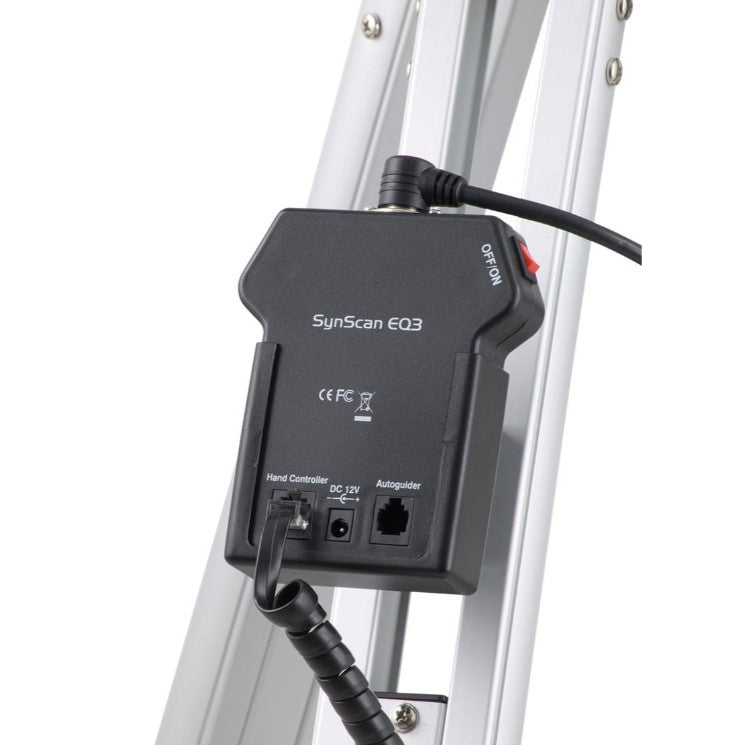
The optical tube is adapted using a Vixen-type female dovetail. An accessory tray ensures good rigidity of the assembly. The EQ3-2 mount can accommodate a polar finderscope (option SW0123) on the polar axis for quick station setup. The visual observer will appreciate the SynScan automatic GOTO pointing system delivered via an easy-to-use hand controller. In fact, it is not necessary to know the position of distant stars or deep-sky objects; the EQ3-2 mount's GoTo system takes care of moving the instrument towards the target you wish to observe.
Automated time attendance system
After calibration (setting up) with the polar finder on North Star, select mount alignment on one, two, or three stars. The database contains over 49,200 objects, including all major catalogs (Messier, NGC, IC, as well as the planets, the Moon, and the Sun). For maximum convenience, the mount moves quickly, up to 3.4°/sec, using the control panel. Easy to use, it helps you quickly point the instrument at any galaxy, nebula, cluster, or object in the solar system. Discover in detail the famous Andromeda Galaxy, the fabulous curtains surrounding the heart of Orion, the Hercules cluster M13 and its heart rich in thousands of stars. Saturn, Jupiter, and the Moon are also wonders to be examined without restraint.
The date, time, and observing location indication on the mount, combined with the "Tour" function, allows the EQ3-2 mount to target the most interesting objects throughout the night. Enjoy a guided tour of the sky at your observing location by clicking the "Enter" button based on the object presented in a drop-down list. This procedure, called "Backlash," requires measuring the time between two opposite mount movements. The operation is simple and, especially in astrophotography, saves precious time. The object you want to photograph is usually located in the center of the sensor... a real pleasure!
Specs
| Characteristics | Newton Sky-Watcher 150mm f/5 Telescope with EQ3-2 Pro GoTo Mount |
|---|---|
| Optical tube | |
| Optical formula |
Newton Parabolic primary mirror Flat secondary mirror |
| Focal length | 750 mm |
| focal ratio | f/5 |
| Construction |
Metal With dovetail and two fixing collars |
| Focuser | Crayford 50.8/31.75 mm |
| Dimensions (Diameter x Length) | 18.2 x 69 cm. |
| Weight | 4.9 kilos |
| Mount | |
| Gentle |
German Equatorial Mount EQ3-2 Dual motorized axes with automatic Go-To pointer Stepper motor resolution: 0.144 arc/sec Movement speed up to 3.4°/sec - Upgrade from 2x to 800x) |
| Access system |
SynScan control racket with 42,900 objects from common celestial catalogues Tracking mode: Sidereal, Lunar or Solar Function: Park, Sync, Backlash, ID, Tour... |
| Load capacity | 5.5 kilos |
| Guidance speed | 0.25x, 0.5x, 0.75x, 1x sidereal speed |
| Tripod | Aluminum tripod with adjustable height (from 71 cm to 123 cm) |
| Weight |
Frame: 5 kg Tripod: 3.8 kg |
| Counterweight | 2 counterweights are supplied: 3.5 kg and 1.5 kg |
| Food |
Cigarette lighter cable supplied Power supply 12V DC or optional battery |
| Ports | ST-4 Self-Guiding Included |
Items delivered
Newton Sky-Watcher 150mm f/5 optical tube
- 1 Sky-Watcher 150mm f/5 optical tube
- 1 x 50.8mm Crayford focuser and 31.75mm adapter
- 2 flowing eyepieces 31.75 mm: 10 mm and 25 mm Super Plössl
- 1 x 2 Barlow lens
- 1 Vixen type dovetail 21cm
- 2 fixing collars
- 1 male Vixen dovetail
- 1 Piggyback mount for Kodak camera on top of one of the mounting collars
- 1 straight finderscope 6x30
Sky-Watcher EQ3-2 Pro GoTo Mount
- 1 EQ3-2 equatorial mount
- 1 Pro Go-To Kit for EQ3-2 (to mount yourself on the stand)
- 1 SynScan Go-To handheld controller
- 1 counterweight of 3.5 kg
- 1 counterweight of 1.5 kg
- 1 height-adjustable steel tube tripod (71cm to 123cm)
- 1 accessory rack
- 1 power cable with cigarette lighter plug


⚠️ NOTAS DE ADVERTENCIA
GAFAS PARA LA OBSERVACIÓN DE ECLIPSE
- INSTRUCCIONES: Revise antes de cada uso. No utilice ni deseche si está dañado, rasgado, perforado o separado de alguna manera del marco. No lo use con otros dispositivos ópticos. No es un juguete. Los niños deben usarlo solo bajo la supervisión de un adulto. Limítese a 3 minutos de uso continuo, con interrupciones durante varias horas. No se mueva mientras usa este producto, no conduzca un vehículo ni opere maquinaria. No lo use si tiene un ojo enfermo o después de una operación ocular.
- ADVERTENCIA: Nunca mire directamente al sol sin protección ocular especial. Siempre use gafas de eclipse al observar el eclipse solar, especialmente si una parte del sol es visible. Mirar directamente al sol puede causar daños permanentes si no se toman las precauciones adecuadas. Se debe usar protección ocular adecuada, diseñada específicamente para la observación solar, para evitar que los rayos dañinos del sol lleguen a los ojos. Deséchelo después de 3 años y no lo utilice después de ese tiempo.
OBSERVACIÓN SOLAR CON TELESCOPIO
- Nunca mire al sol a través de un ocular/telescopio sin un filtro de protección verificado. Un filtro lunar nunca puede usarse para la observación solar. El filtro lunar solo es adecuado para la observación de la luna. El filtro solar debe montarse en la apertura del telescopio, no en el ocular. De lo contrario, el rayo de luz concentrado por la óptica destruirá inmediatamente la película del filtro, lo que provocará daños oculares graves e incluso ceguera total.
- Revise el filtro solar antes de cada observación solar y asegúrese de que no esté dañado. Manténgalo frente a una fuente de luz intensa para poder detectar posibles grietas y/o agujeros. No use el telescopio para la observación solar, incluso si el filtro solar está solo ligeramente dañado. En este caso, comuníquese con el fabricante para obtener las piezas de repuesto correspondientes.
- Siempre use el filtro solar cuando observe el sol. Asegúrese de que este filtro esté colocado correctamente en el telescopio según las instrucciones. El uso del filtro solar está destinado únicamente para su uso con este telescopio.
- Revise el ajuste del filtro solar antes de cada observación solar. Si se suelta accidentalmente de la abertura del objetivo, esto puede causar daños oculares inmediatos y permanentes, e incluso ceguera.
- Si el filtro solar no puede montarse de manera suficientemente firme en el tubo, mejore el ajuste colocando varias tiras de fieltro autoadhesivas o similares entre el filtro solar y la abertura del objetivo. Nunca use el filtro solar si no puede colocarse correctamente en el telescopio. En tal caso, siempre contacte primero con nuestro servicio al cliente.
- Tenga mucho cuidado al observar el sol. Incluso una mirada corta a través de la óptica sin protección puede causar daños oculares graves e incluso ceguera total.
- Los niños, incluso con el filtro montado correctamente, no deben mirar al sol a través del telescopio. Nunca deje a los niños sin supervisión.
- Nunca deje la óptica sin supervisión. Los niños y los adultos inexpertos podrían dirigir el telescopio hacia el sol sin las precauciones adecuadas y perder la vista.
- No realice observaciones solares sin la consulta previa de un médico después de una operación ocular o cualquier otra enfermedad ocular.
- Las ondas/pliegues en la película son normales y no constituyen un defecto del producto.
- No exponga el dispositivo a altas temperaturas.
ADVERTENCIAS Y SEGURIDAD DE LAS PILAS
- NO USE pilas falsas en los productos. Use solo las pilas proporcionadas. Use la pila EXCLUSIVAMENTE para el propósito previsto.
- Guarde las pilas fuera del alcance de los niños y mascotas.
- NO USE pilas que parezcan tener la carcasa dañada, inflada o modificada. No use pilas que hayan goteado, huelan, estén hinchadas o derretidas o presenten abolladuras, óxido, grietas o rayones.
- La pila NO debe ser desmontada, aplastada, perforada, triturada ni manipulada de ninguna otra forma.
- La pila NO debe exponerse a líquidos.
- No debe intentar secar una pila mojada o húmeda con un dispositivo o fuente de calor.
- El dispositivo o la pila NO deben ser colocados cerca de una fuente de calor o bajo la luz solar directa.
- La pila NO debe tocar objetos metálicos.
- La pila NO debe ser almacenada junto a materiales peligrosos o inflamables. Guarde la pila en un lugar fresco, seco y bien ventilado.
- La pila NO debe insertarse incorrectamente al cargarla.
- La pila NO debe cargarse bajo luz solar directa ni a temperaturas extremas. Cárguela a temperatura ambiente (20 °C – 26 °C).
- Evite dejar caer la pila o el producto. Si sospecha que la pila está dañada, reemplácela.
- Nunca deje su dispositivo conectado a la corriente más de 24 horas. Deje que la pila se agote y luego recárguela.
- Para obtener los mejores resultados, reemplace las pilas según el uso después de 12 meses o antes.
- Siga las regulaciones locales para la eliminación de las pilas usadas. NO arroje la pila al fuego ni al agua.
Telescope accessories
-

Astronomy cameras
Astronomy cameras , specially designed to capture images from space, offer several...
-

Alignment Accessories
Collimation is the exact orientation of the optics within a telescope. It...


