
MAGUS
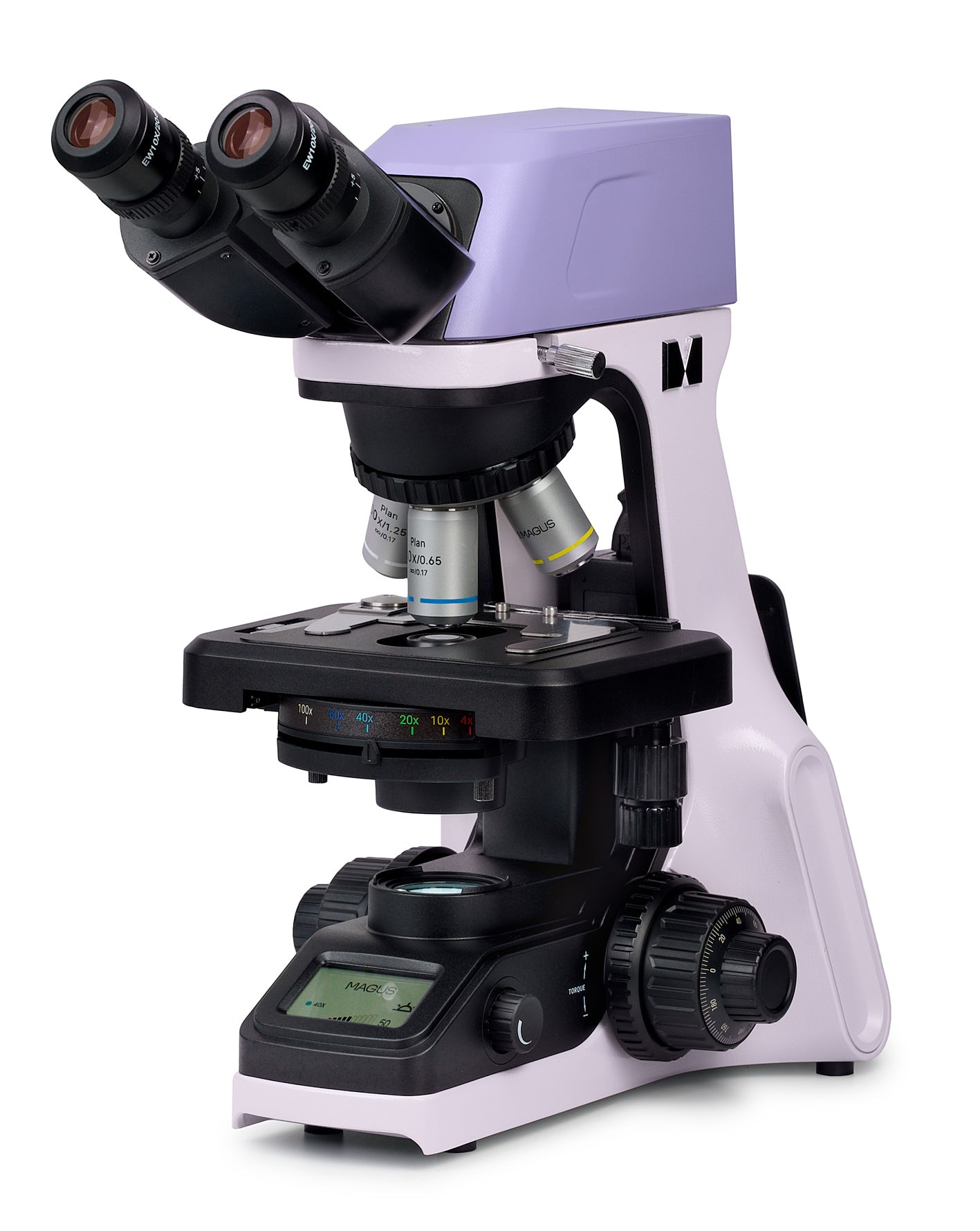
MAGUS Bio DH240 Digital Biological Microscope
MAGUS Bio DH240 Digital Biological Microscope
In stock
Couldn't load pickup availability
MAGUS Bio DH240 Digital Biological Microscope
Magnification: 40–1000x. Binocular head with built-in 8MP digital camera, encoded revolving nosepiece, plan achromatic objectives, 3W LED illuminator, smart illumination control system
The MAGUS Bio DH240 microscope is designed for working with transparent and translucent biological samples using the brightfield method. The instrument is equipped with a binocular head with a built-in digital camera. The 4-objective revolving nosepiece is equipped with a smart illumination control system. Selected operating settings are displayed on the built-in LCD screen.
The MAGUS Bio DH240 model is quite compact. It is lightweight and small in size, and the ergonomic design of the body makes it easy to store and transport. All wires and the power adapter are hidden at the back of the microscope, and you can use the side openings in the stand as handles for carrying it.
The binocular head also contributes to the design: the digital camera is integrated into it and does not take up extra space. Both tubes rotate 360° around their axis, so you can adjust the interpupillary distance to suit your needs. The microscope is equipped with 10x/20mm eyepieces, and rubber eyecups are included, which will be practical for eyeglass wearers to prevent the lenses from touching the eyepieces and avoiding damage. The optical elements are infinity-corrected. There are diopter adjustment rings on the microscope tubes that adjust to the user's visual acuity.
A digital camera built on an 8MP matrix produces images with 4K resolution (3840x2160 px). It perfectly conveys all the nuances of the observation object. The optimal combination is obtained with 4x and 10x objectives. The camera can take photos or videos of static and inactive specimens. It can be used to adjust the microscope's focus. You can transfer images to your computer via Wi-Fi.
The MAGUS Bio DH240 revolving nosepiece is designed for 4 objectives. It is oriented "inward": the working objective is directly in front of the user, while the others point in the opposite direction. This design frees up space in front of the user, making work more comfortable. Encoded revolving nosepiece: when changing objectives, the sample illumination changes automatically. Since objectives with different magnifications have different light transmission, when switching objectives, the illumination intensity in the eyepiece fluctuates greatly. This tires the eyes, and the researcher has to spend time adjusting the light brightness each time. The smart illumination system remembers the user's settings for each objective, and when the revolving nosepiece is rotated, the light automatically adjusts to the appropriate intensity. This is especially convenient if you frequently change the microscope's magnification during your work.
The microscope uses a 3W LED as a light source. The illuminator creates transmitted light with the ability to change the color temperature: The user can set the desired value in the range of 3000–7000K. The LED is designed to last 50,000 hours.
Two focusing knobs are located on the same axis on opposite sides of the microscope and are used for coarse and fine adjustment. In addition, the microscope is equipped with a coarse focus lock lever, which is used after changing the objective, and a ring for adjusting the tension of the coarse focus travel. All adjustment mechanisms are located at the bottom of the microscope body. To operate it, the user can rest their hands on the table and adopt a comfortable posture, which is especially important during prolonged study.
The sample stage is particularly ergonomic. It is equipped with a belt-drive mechanism, so the sample moves smoothly across the stage surface. The sample holder is fixed with two screws and can be easily removed. There is no positioning rack.
The Abbe condenser of this model also has some features. It is fixed at the required height and located in the center of the microscope's optical axis: it cannot be accidentally moved, which is especially important for the work of novice researchers in a common space. To adjust the iris diaphragm, a knob is used that adjusts according to the markings on the condenser. Each mark corresponds to a specific objective magnification, and the rotary switch must be moved to the position corresponding to the working objective.
You can track all settings on the built-in LCD screen, which is another feature of this MAGUS microscope model. The screen displays the selected illuminator brightness and its color temperature, the working objective magnification, and the operating mode; most of these functions are configured via the screen.
Key features:
Works with transparent and translucent samples using the brightfield method
The binocular head has an integrated digital camera
Both tubes rotate 360° and have a diopter adjustment system
Revolving nosepiece for 4 objectives with smart illumination control system
Selected operating parameters are displayed on the LCD screen
Compact and lightweight device with an ergonomic body: cables and adapter are hidden, and the body design is convenient for storage and transport
Sample stage with belt-drive mechanism that does not have a positioning rack
The condenser does not require additional adjustment; the aperture diaphragm is adjusted according to the objective magnification markings
The kit includes:
Stand with transmitted light source, focusing mechanism, stage, condenser mount, and revolving nosepiece
Abbe condenser
Binocular head with built-in digital camera
Infinity-corrected plan achromatic objective: 4x/0.10
Infinity-corrected plan achromatic objective: 10x/0.25
Infinity-corrected plan achromatic objective: 40x/0.65 (with spring mechanism)
Infinity-corrected plan achromatic objective: 100x/1.25 oil (with spring mechanism)
10x/20 mm eyepiece with long eye relief (2 units)
Eyecup (2 units)
Light filter
Microscope power adapter and power cord
Dust cover
User manual and warranty card
Available upon request:
Digital camera
Calibration slide
C-mount adapter
Monitor
⚠️ NOTAS DE ADVERTENCIA
GAFAS PARA LA OBSERVACIÓN DE ECLIPSE
- INSTRUCCIONES: Revise antes de cada uso. No utilice ni deseche si está dañado, rasgado, perforado o separado de alguna manera del marco. No lo use con otros dispositivos ópticos. No es un juguete. Los niños deben usarlo solo bajo la supervisión de un adulto. Limítese a 3 minutos de uso continuo, con interrupciones durante varias horas. No se mueva mientras usa este producto, no conduzca un vehículo ni opere maquinaria. No lo use si tiene un ojo enfermo o después de una operación ocular.
- ADVERTENCIA: Nunca mire directamente al sol sin protección ocular especial. Siempre use gafas de eclipse al observar el eclipse solar, especialmente si una parte del sol es visible. Mirar directamente al sol puede causar daños permanentes si no se toman las precauciones adecuadas. Se debe usar protección ocular adecuada, diseñada específicamente para la observación solar, para evitar que los rayos dañinos del sol lleguen a los ojos. Deséchelo después de 3 años y no lo utilice después de ese tiempo.
OBSERVACIÓN SOLAR CON TELESCOPIO
- Nunca mire al sol a través de un ocular/telescopio sin un filtro de protección verificado. Un filtro lunar nunca puede usarse para la observación solar. El filtro lunar solo es adecuado para la observación de la luna. El filtro solar debe montarse en la apertura del telescopio, no en el ocular. De lo contrario, el rayo de luz concentrado por la óptica destruirá inmediatamente la película del filtro, lo que provocará daños oculares graves e incluso ceguera total.
- Revise el filtro solar antes de cada observación solar y asegúrese de que no esté dañado. Manténgalo frente a una fuente de luz intensa para poder detectar posibles grietas y/o agujeros. No use el telescopio para la observación solar, incluso si el filtro solar está solo ligeramente dañado. En este caso, comuníquese con el fabricante para obtener las piezas de repuesto correspondientes.
- Siempre use el filtro solar cuando observe el sol. Asegúrese de que este filtro esté colocado correctamente en el telescopio según las instrucciones. El uso del filtro solar está destinado únicamente para su uso con este telescopio.
- Revise el ajuste del filtro solar antes de cada observación solar. Si se suelta accidentalmente de la abertura del objetivo, esto puede causar daños oculares inmediatos y permanentes, e incluso ceguera.
- Si el filtro solar no puede montarse de manera suficientemente firme en el tubo, mejore el ajuste colocando varias tiras de fieltro autoadhesivas o similares entre el filtro solar y la abertura del objetivo. Nunca use el filtro solar si no puede colocarse correctamente en el telescopio. En tal caso, siempre contacte primero con nuestro servicio al cliente.
- Tenga mucho cuidado al observar el sol. Incluso una mirada corta a través de la óptica sin protección puede causar daños oculares graves e incluso ceguera total.
- Los niños, incluso con el filtro montado correctamente, no deben mirar al sol a través del telescopio. Nunca deje a los niños sin supervisión.
- Nunca deje la óptica sin supervisión. Los niños y los adultos inexpertos podrían dirigir el telescopio hacia el sol sin las precauciones adecuadas y perder la vista.
- No realice observaciones solares sin la consulta previa de un médico después de una operación ocular o cualquier otra enfermedad ocular.
- Las ondas/pliegues en la película son normales y no constituyen un defecto del producto.
- No exponga el dispositivo a altas temperaturas.
ADVERTENCIAS Y SEGURIDAD DE LAS PILAS
- NO USE pilas falsas en los productos. Use solo las pilas proporcionadas. Use la pila EXCLUSIVAMENTE para el propósito previsto.
- Guarde las pilas fuera del alcance de los niños y mascotas.
- NO USE pilas que parezcan tener la carcasa dañada, inflada o modificada. No use pilas que hayan goteado, huelan, estén hinchadas o derretidas o presenten abolladuras, óxido, grietas o rayones.
- La pila NO debe ser desmontada, aplastada, perforada, triturada ni manipulada de ninguna otra forma.
- La pila NO debe exponerse a líquidos.
- No debe intentar secar una pila mojada o húmeda con un dispositivo o fuente de calor.
- El dispositivo o la pila NO deben ser colocados cerca de una fuente de calor o bajo la luz solar directa.
- La pila NO debe tocar objetos metálicos.
- La pila NO debe ser almacenada junto a materiales peligrosos o inflamables. Guarde la pila en un lugar fresco, seco y bien ventilado.
- La pila NO debe insertarse incorrectamente al cargarla.
- La pila NO debe cargarse bajo luz solar directa ni a temperaturas extremas. Cárguela a temperatura ambiente (20 °C – 26 °C).
- Evite dejar caer la pila o el producto. Si sospecha que la pila está dañada, reemplácela.
- Nunca deje su dispositivo conectado a la corriente más de 24 horas. Deje que la pila se agote y luego recárguela.
- Para obtener los mejores resultados, reemplace las pilas según el uso después de 12 meses o antes.
- Siga las regulaciones locales para la eliminación de las pilas usadas. NO arroje la pila al fuego ni al agua.