

Sky-Watcher
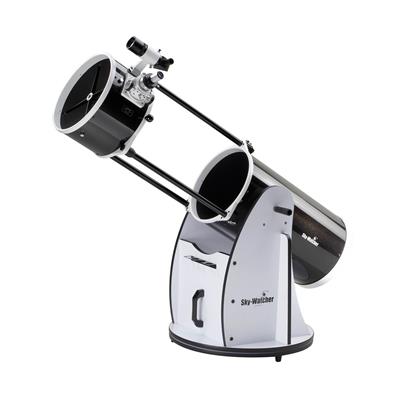
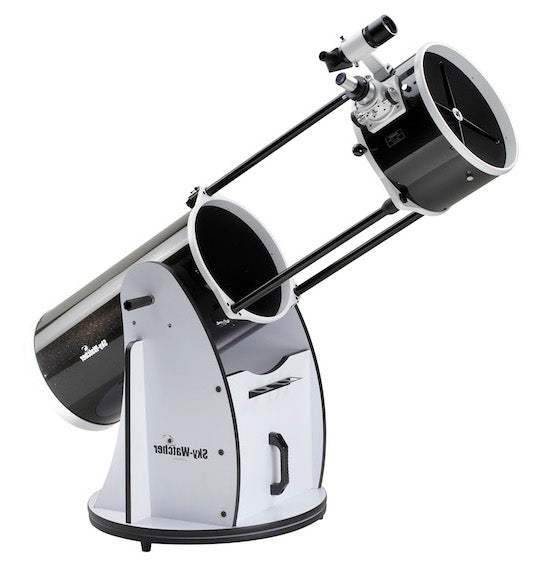
Sky-Watcher 300mm FlexTube Dobsonian Telescope
Sky-Watcher 300mm FlexTube Dobsonian Telescope
Couldn't load pickup availability
- SECURE PAYMENT
- AVAILABLE ON REQUEST
- ESTIMATED DELIVERY: 3 WEEKS
- Large diameter perfect for observing the deep sky (galaxies, nebulae)
- Good for planetary and lunar observation.
- Foldable to prevent complete disassembly and collimation.
- Transportable by one person.
In recent years, Dobsonian craze has increasingly gripped amateur astronomers, who are aware that the most intense experiences are experienced with large-diameter telescopes. Indeed, planetary observations are limited to Jupiter, Mars, Saturn (and the Moon), while clusters, nebulae, and galaxies are counted in the thousands on a 305 mm instrument. Without a motor or electronics, Dobsonians are in fact the instruments that provide the most light, within a given budget, compared to any other type of instrument (mostly motorized and Go-To).
However, the quest for diameter poses a major drawback: bulk! When you want to observe in the best conditions, to take full advantage of your instrument's potential, far from city lights, it's essential to transport your equipment in a vehicle and then assemble and disassemble it. Of course, you need space and, if possible, minimal back and forth when loading. Although Serrurier frames have been around for a long time, they have only recently become available in inexpensive Dobsonians and require permanent disassembly/reassembly and then re-collimation (a somewhat time-consuming operation that eventually becomes more common with experience).
Sky-Watcher, which has been designing solid-tube Dobsonians, popular with beginners and hobbyists, for many years, innovated in 2009 by completely redesigning its instruments. The Chinese-Canadian manufacturer sought to combine the advantages of the "complete assembly" of solid tubes with the reduced footprint of open tubes. The idea of the "telescopic telescope" is now a reality (at a price that remains very attractive) through the FlexTube range.
Following the principle that "the best instrument is the one used most often", SkyWatcher takes comfort even further with the FlexTube range so you don't hesitate for a moment to contemplate the sky and its wonders.
FlexTube: maximum comfort
The FlexTube's principle is simple; it's based on a Locksmith-style design, where three tubes solidly support the secondary mirror cage (which also holds the eyepiece and viewfinder). Except here, the tubes can't be removed because they're housed in a clamp that allows them to slide. By simply loosening three knobs, the tubes slide down until the instrument collapses. Three screws on the secondary cage then allow it to be locked to the primary body. Everything is much smaller and fits easily, vertically, in the trunk of any car (maximum height of 920 mm for the 305 mm model). With a 630x740 mm base, you'll even have room for several accessories.
The key to such a setup is maintaining collimation (alignment between the two mirrors). According to the manufacturer, FlexTube maintains the position of the two optical elements (particularly the secondary mirror) with each folding/unfolding. Note: Alignment does not change overnight or depending on the position of the optical tube. Therefore, there is nothing easier than setting up such instruments. Using the handles (altitude adjustment knobs), remove the entire telescope (40 kg total for the largest model). Loosen the tube adjustment knobs (as well as the locking screws). Slide the mirror cage to the tube stop position. Tighten the knobs to finish.
Since there's no setup required, your telescope is ready for a night of observing filled with discoveries (if you haven't touched the eyepiece since your last outing, focusing will already be "ready"). In just a few seconds, you'll have completed/avoided the traditional steps: telescope removal/mounting/collimation. Save more time and enjoy unparalleled convenience!
Mechanical design
Sky-Watcher not only offers telescopes at very advantageous prices, but also easy-to-use instruments, as demonstrated by the tilt system fitted to all 150 to 305 mm Dobsonians. In fact, the Chinese-Canadian company has developed and patented (US Patent No. 6,940,642) a handle that allows the fork on the optical tube to be tightened or loosened. Thus, depending on the tube's tilt and the weight of the accessories in the eyepiece holder (binocular head, eyepieces with different fluxes), the observer can increase or decrease the friction. The tube is then sufficiently secured so as not to tilt downward, as is the case with other manufacturers, and free enough to easily point it at another location in the sky.
Unlike the cheaply made or small diameter Newtonian telescopes, the Sky-Watcher 203-400 mm Newtonian (Dobsonian) telescopes have a parabolic primary mirror. The mirrors are spherically ground and then trimmed to achieve a parabolic shape (which is more expensive and difficult to obtain). This is an essential selection criterion for instruments longer than 130 mm and with short f/D.
As for the primary mirror material, the 203/254/305/355/406 mm ones are made of Pyrex, which reduces the effects of expansion due to thermal changes. In fact, the coefficient of thermal expansion is lower than that of standard glass, reducing warm-up time and ensuring better image quality. Like the secondary mirror, the primary mirror is covered with layers of titanium dioxide (SiO2) and quartz (SiO4) for effective protection.
An achromatic finder scope is also included as standard. With a large 50 mm diameter and 9x magnification, it reveals objects invisible to even the smallest researchers, making them much easier to find. Two 25 mm and 10 mm focal length eyepieces will allow you to initially have a good range of magnifications compatible with all possible objectives.
Focuser for Dobsonian FlexTube 203, 254 and 305 mm
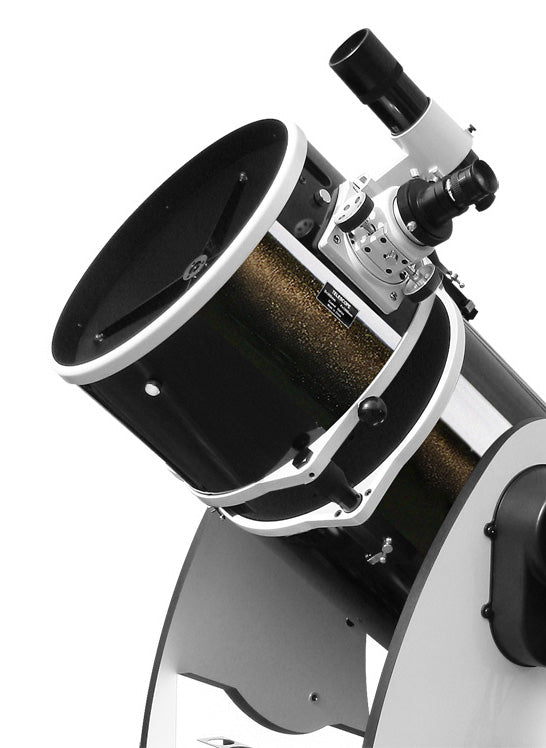
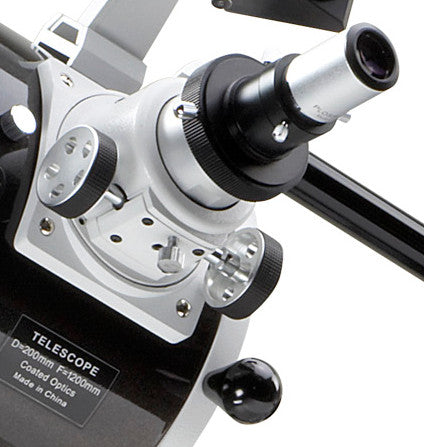
Focusing is achieved through a Crayford dual-flow eyepiece. A 31.75 mm adapter is supplied as standard for using 31.75 mm eyepieces from the 50.8 mm output. An adjustment screw located on the bottom of the eyepiece holder allows you to maintain focus by following the orientation of the optical tube.
Features Dobsonian Sky-Watcher FlexTube 305 mm f/5
- Newton's optical formula
- Useful diameter 305 mm
- Focal length 1500 mm
- F/D ratio 5
- Separating the power 0.39 arc seconds
- Clarity 2584x
- Recommended maximum magnification 400x
- Crayford Skygazer Eyepiece Holder 50.8/31.75mm
- Optical tube length (folded/unfolded) 920 mm/1400 mm
- Optical tube weight 21kg
- Dobsonian Azimuth Mount - Motorization not compatible
⚠️ NOTAS DE ADVERTENCIA
GAFAS PARA LA OBSERVACIÓN DE ECLIPSE
- INSTRUCCIONES: Revise antes de cada uso. No utilice ni deseche si está dañado, rasgado, perforado o separado de alguna manera del marco. No lo use con otros dispositivos ópticos. No es un juguete. Los niños deben usarlo solo bajo la supervisión de un adulto. Limítese a 3 minutos de uso continuo, con interrupciones durante varias horas. No se mueva mientras usa este producto, no conduzca un vehículo ni opere maquinaria. No lo use si tiene un ojo enfermo o después de una operación ocular.
- ADVERTENCIA: Nunca mire directamente al sol sin protección ocular especial. Siempre use gafas de eclipse al observar el eclipse solar, especialmente si una parte del sol es visible. Mirar directamente al sol puede causar daños permanentes si no se toman las precauciones adecuadas. Se debe usar protección ocular adecuada, diseñada específicamente para la observación solar, para evitar que los rayos dañinos del sol lleguen a los ojos. Deséchelo después de 3 años y no lo utilice después de ese tiempo.
OBSERVACIÓN SOLAR CON TELESCOPIO
- Nunca mire al sol a través de un ocular/telescopio sin un filtro de protección verificado. Un filtro lunar nunca puede usarse para la observación solar. El filtro lunar solo es adecuado para la observación de la luna. El filtro solar debe montarse en la apertura del telescopio, no en el ocular. De lo contrario, el rayo de luz concentrado por la óptica destruirá inmediatamente la película del filtro, lo que provocará daños oculares graves e incluso ceguera total.
- Revise el filtro solar antes de cada observación solar y asegúrese de que no esté dañado. Manténgalo frente a una fuente de luz intensa para poder detectar posibles grietas y/o agujeros. No use el telescopio para la observación solar, incluso si el filtro solar está solo ligeramente dañado. En este caso, comuníquese con el fabricante para obtener las piezas de repuesto correspondientes.
- Siempre use el filtro solar cuando observe el sol. Asegúrese de que este filtro esté colocado correctamente en el telescopio según las instrucciones. El uso del filtro solar está destinado únicamente para su uso con este telescopio.
- Revise el ajuste del filtro solar antes de cada observación solar. Si se suelta accidentalmente de la abertura del objetivo, esto puede causar daños oculares inmediatos y permanentes, e incluso ceguera.
- Si el filtro solar no puede montarse de manera suficientemente firme en el tubo, mejore el ajuste colocando varias tiras de fieltro autoadhesivas o similares entre el filtro solar y la abertura del objetivo. Nunca use el filtro solar si no puede colocarse correctamente en el telescopio. En tal caso, siempre contacte primero con nuestro servicio al cliente.
- Tenga mucho cuidado al observar el sol. Incluso una mirada corta a través de la óptica sin protección puede causar daños oculares graves e incluso ceguera total.
- Los niños, incluso con el filtro montado correctamente, no deben mirar al sol a través del telescopio. Nunca deje a los niños sin supervisión.
- Nunca deje la óptica sin supervisión. Los niños y los adultos inexpertos podrían dirigir el telescopio hacia el sol sin las precauciones adecuadas y perder la vista.
- No realice observaciones solares sin la consulta previa de un médico después de una operación ocular o cualquier otra enfermedad ocular.
- Las ondas/pliegues en la película son normales y no constituyen un defecto del producto.
- No exponga el dispositivo a altas temperaturas.
ADVERTENCIAS Y SEGURIDAD DE LAS PILAS
- NO USE pilas falsas en los productos. Use solo las pilas proporcionadas. Use la pila EXCLUSIVAMENTE para el propósito previsto.
- Guarde las pilas fuera del alcance de los niños y mascotas.
- NO USE pilas que parezcan tener la carcasa dañada, inflada o modificada. No use pilas que hayan goteado, huelan, estén hinchadas o derretidas o presenten abolladuras, óxido, grietas o rayones.
- La pila NO debe ser desmontada, aplastada, perforada, triturada ni manipulada de ninguna otra forma.
- La pila NO debe exponerse a líquidos.
- No debe intentar secar una pila mojada o húmeda con un dispositivo o fuente de calor.
- El dispositivo o la pila NO deben ser colocados cerca de una fuente de calor o bajo la luz solar directa.
- La pila NO debe tocar objetos metálicos.
- La pila NO debe ser almacenada junto a materiales peligrosos o inflamables. Guarde la pila en un lugar fresco, seco y bien ventilado.
- La pila NO debe insertarse incorrectamente al cargarla.
- La pila NO debe cargarse bajo luz solar directa ni a temperaturas extremas. Cárguela a temperatura ambiente (20 °C – 26 °C).
- Evite dejar caer la pila o el producto. Si sospecha que la pila está dañada, reemplácela.
- Nunca deje su dispositivo conectado a la corriente más de 24 horas. Deje que la pila se agote y luego recárguela.
- Para obtener los mejores resultados, reemplace las pilas según el uso después de 12 meses o antes.
- Siga las regulaciones locales para la eliminación de las pilas usadas. NO arroje la pila al fuego ni al agua.
Telescope accessories
-

Astronomy cameras
Astronomy cameras , specially designed to capture images from space, offer several...
-

Alignment Accessories
Collimation is the exact orientation of the optics within a telescope. It...


