
Omegon
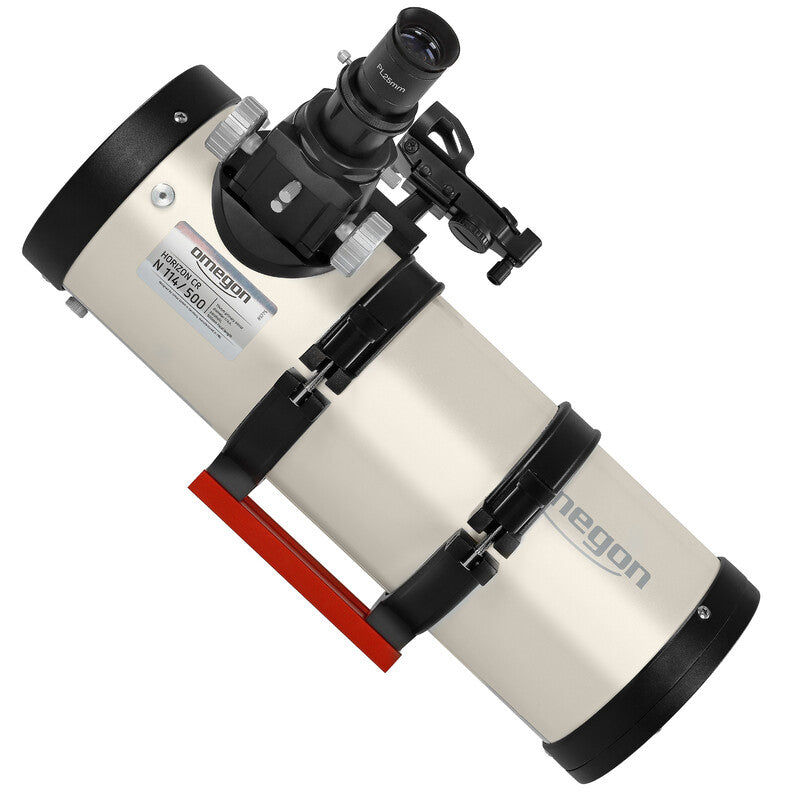
Horizon N 114/500 Telescope
Horizon N 114/500 Telescope
Couldn't load pickup availability
- SECURE PAYMENT
- AVAILABLE ON REQUEST
- ESTIMATED DELIVERY: 3 WEEKS
N 114/500: wide-angle telescope for sky-cruising
This telescope is a master of wide fields of view. Its short focal length delivers impressive "rich-field" observations of extensive star clusters, nebulae, and the Milky Way. Thanks to high-quality parabolic mirrors, you will enjoy unparalleled sharpness in its class. A telescope for all those who prefer to enjoy the sky on a grand scale.
Advantages at a glance:
- Parabolic primary mirrors: sharp stars right to the edge of the field of view
- Wide field of view: the short 500mm focal length makes the telescope a specialist for observing large, extended celestial objects.
- Bright and compact: despite its 114mm aperture, the tube is very short, lightweight, and easy to transport.
- Butter-smooth focusing: the Crayford focuser ensures precise, vibration-free focusing of the objects you observe.
- Quick to set up: the telescope is quickly assembled and adjusted, so you can spend more time observing and less time preparing.
The sky in panoramic format: the Rich Field experience
What does "rich field" mean? It means you can see a huge section of the sky at once. Telescopes with a long focal length work like a telephoto lens: they magnify a lot. The Omegon N 114/500, on the other hand, is like a wide-angle lens. With it, you can cruise through the star fields of the Milky Way and admire open star clusters like the Pleiades in all their glory. Tip: However, the field of view also depends heavily on the eyepiece. Therefore, if you need high magnification, you will achieve it with a short focal length eyepiece.
Quality you can see: the parabolic mirrors
Even with this wide-angle specialist, we make no compromises on quality. The heart of the telescope is a precisely manufactured parabolic primary mirror. Unlike the simple spherical mirrors of many other beginner telescopes, this one reflects light accurately to a single point. The result is sharp stars throughout the enormous field of view. You will immediately notice the difference: the stars are fine, defined points.
Precise focusing: the Crayford focuser
The telescope features a modern Crayford focuser. It helps you perfectly adjust the sharpness of the high-quality mirrors. Thanks to ball bearings, it moves smoothly and without vibrations. This makes focusing easy and pleasant – a great advantage, for example, when photographing the moon. In addition, all 1.25" eyepieces are compatible, whether from this manufacturer or another.
Omegon accessory box: What good is the best telescope without the right accessories?
With the Omegon accessory box, you get a coordinated kit that makes your first steps as easy as possible. Instead of laboriously searching for individual eyepieces and adapters, here you will find everything you need for your first observations and even for your first photos of the Moon. And all of it in above-standard quality. What do you need to get started? Something with which you can make impressive observations immediately. This includes two eyepieces for low and medium magnifications. Sometimes you want to get even closer to the action. That's what the included 2x Barlow lens is for. It is simply placed between the eyepiece and the telescope and doubles the magnification of the corresponding eyepiece. An LED finder is very important for quickly searching for and finding objects. A bright red dot in the dark shows you the exact way. You'll soon realize that this inconspicuous component is as important as your telescope. And with the extension sleeve, you can always reach the correct focal plane.
Your smartphone becomes an astronomy camera
Perhaps the most exciting part of the accessory set is the smartphone adapter. With it, you can attach your own mobile phone directly to the eyepiece and take pictures of what you are observing. Capture the cratered landscapes of the Moon or photograph Jupiter with its moons. The included Bluetooth shutter control ensures vibration-free images. Share your fascination for the starry sky with your family and friends. It couldn't be easier.
Scope of delivery:
- Telescope
- LED finder with two brightness levels, battery included
- 1.25'' Plössl eyepiece, 25mm
- 1.25'' Plössl eyepiece, 10mm
- 1.25'' 2x Barlow lens with filter thread on the telescope side and 1.25'' connection and T2 thread on the other side
- 1.25'' extender with filter thread on the telescope side and 1.25'' connection and T2 thread on the other side
- Smartphone adapter
- Bluetooth shutter control with battery included
⚠️ NOTAS DE ADVERTENCIA
GAFAS PARA LA OBSERVACIÓN DE ECLIPSE
- INSTRUCCIONES: Revise antes de cada uso. No utilice ni deseche si está dañado, rasgado, perforado o separado de alguna manera del marco. No lo use con otros dispositivos ópticos. No es un juguete. Los niños deben usarlo solo bajo la supervisión de un adulto. Limítese a 3 minutos de uso continuo, con interrupciones durante varias horas. No se mueva mientras usa este producto, no conduzca un vehículo ni opere maquinaria. No lo use si tiene un ojo enfermo o después de una operación ocular.
- ADVERTENCIA: Nunca mire directamente al sol sin protección ocular especial. Siempre use gafas de eclipse al observar el eclipse solar, especialmente si una parte del sol es visible. Mirar directamente al sol puede causar daños permanentes si no se toman las precauciones adecuadas. Se debe usar protección ocular adecuada, diseñada específicamente para la observación solar, para evitar que los rayos dañinos del sol lleguen a los ojos. Deséchelo después de 3 años y no lo utilice después de ese tiempo.
OBSERVACIÓN SOLAR CON TELESCOPIO
- Nunca mire al sol a través de un ocular/telescopio sin un filtro de protección verificado. Un filtro lunar nunca puede usarse para la observación solar. El filtro lunar solo es adecuado para la observación de la luna. El filtro solar debe montarse en la apertura del telescopio, no en el ocular. De lo contrario, el rayo de luz concentrado por la óptica destruirá inmediatamente la película del filtro, lo que provocará daños oculares graves e incluso ceguera total.
- Revise el filtro solar antes de cada observación solar y asegúrese de que no esté dañado. Manténgalo frente a una fuente de luz intensa para poder detectar posibles grietas y/o agujeros. No use el telescopio para la observación solar, incluso si el filtro solar está solo ligeramente dañado. En este caso, comuníquese con el fabricante para obtener las piezas de repuesto correspondientes.
- Siempre use el filtro solar cuando observe el sol. Asegúrese de que este filtro esté colocado correctamente en el telescopio según las instrucciones. El uso del filtro solar está destinado únicamente para su uso con este telescopio.
- Revise el ajuste del filtro solar antes de cada observación solar. Si se suelta accidentalmente de la abertura del objetivo, esto puede causar daños oculares inmediatos y permanentes, e incluso ceguera.
- Si el filtro solar no puede montarse de manera suficientemente firme en el tubo, mejore el ajuste colocando varias tiras de fieltro autoadhesivas o similares entre el filtro solar y la abertura del objetivo. Nunca use el filtro solar si no puede colocarse correctamente en el telescopio. En tal caso, siempre contacte primero con nuestro servicio al cliente.
- Tenga mucho cuidado al observar el sol. Incluso una mirada corta a través de la óptica sin protección puede causar daños oculares graves e incluso ceguera total.
- Los niños, incluso con el filtro montado correctamente, no deben mirar al sol a través del telescopio. Nunca deje a los niños sin supervisión.
- Nunca deje la óptica sin supervisión. Los niños y los adultos inexpertos podrían dirigir el telescopio hacia el sol sin las precauciones adecuadas y perder la vista.
- No realice observaciones solares sin la consulta previa de un médico después de una operación ocular o cualquier otra enfermedad ocular.
- Las ondas/pliegues en la película son normales y no constituyen un defecto del producto.
- No exponga el dispositivo a altas temperaturas.
ADVERTENCIAS Y SEGURIDAD DE LAS PILAS
- NO USE pilas falsas en los productos. Use solo las pilas proporcionadas. Use la pila EXCLUSIVAMENTE para el propósito previsto.
- Guarde las pilas fuera del alcance de los niños y mascotas.
- NO USE pilas que parezcan tener la carcasa dañada, inflada o modificada. No use pilas que hayan goteado, huelan, estén hinchadas o derretidas o presenten abolladuras, óxido, grietas o rayones.
- La pila NO debe ser desmontada, aplastada, perforada, triturada ni manipulada de ninguna otra forma.
- La pila NO debe exponerse a líquidos.
- No debe intentar secar una pila mojada o húmeda con un dispositivo o fuente de calor.
- El dispositivo o la pila NO deben ser colocados cerca de una fuente de calor o bajo la luz solar directa.
- La pila NO debe tocar objetos metálicos.
- La pila NO debe ser almacenada junto a materiales peligrosos o inflamables. Guarde la pila en un lugar fresco, seco y bien ventilado.
- La pila NO debe insertarse incorrectamente al cargarla.
- La pila NO debe cargarse bajo luz solar directa ni a temperaturas extremas. Cárguela a temperatura ambiente (20 °C – 26 °C).
- Evite dejar caer la pila o el producto. Si sospecha que la pila está dañada, reemplácela.
- Nunca deje su dispositivo conectado a la corriente más de 24 horas. Deje que la pila se agote y luego recárguela.
- Para obtener los mejores resultados, reemplace las pilas según el uso después de 12 meses o antes.
- Siga las regulaciones locales para la eliminación de las pilas usadas. NO arroje la pila al fuego ni al agua.
Telescope accessories
-

Astronomy cameras
Astronomy cameras , specially designed to capture images from space, offer several...
-

Alignment Accessories
Collimation is the exact orientation of the optics within a telescope. It...


