
Astronomical Events in September 2026
September arrives with planets, meteor showers, Moon encounters, and excellent nights for deep-sky observation. These are the essential dates for the Northern Hemisphere.
📅 Featured Dates
September 8 — Moon and Jupiter
The waning Moon will pass less than 1° from Jupiter. From some regions of the Northern Hemisphere, an occultation of the planet will even occur.
September 9 — Epsilon Persei ☄️
The most active shower of the month could reach about 8 meteors/hour, with very little lunar interference.
September 11 — New Moon 🌑
The best opportunity of the month for deep-sky observation. Good time to look for Andromeda (M31), M33, clusters, and nebulae.
September 14 — Venus Occultation
The Moon will occult Venus from certain areas of Europe, Africa, and Asia.
September 20 — Moon, Altair, and Deneb
The three celestial bodies will form a striking alignment of about 74° visible to the naked eye.
September 22 — Venus at its brightest ✨
It will reach magnitude -4.8. From the Northern Hemisphere, it will appear very low after sunset.
September 23 — Equinox 🍂
Astronomical autumn officially begins in the Northern Hemisphere and nights continue to lengthen.
September 26 — Harvest Moon 🌕
The full Moon will also coincide with the opposition of Neptune, although the planet will require a telescope.
🔭 Astro Telescopes Tip: take special advantage of the nights around September 11 to observe galaxies and other faint objects under a dark sky.
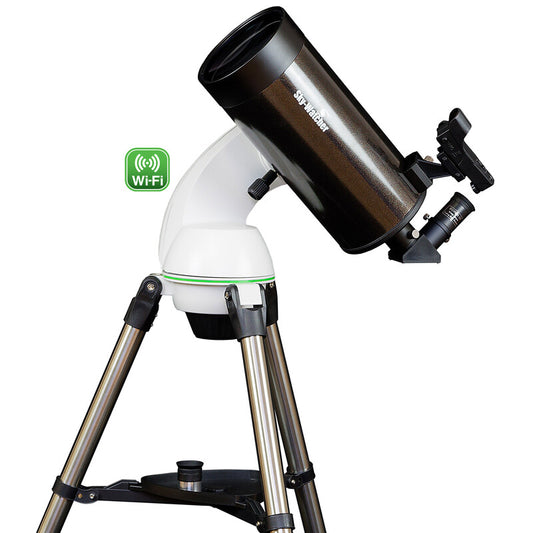
Astro Telescopes Recommendation: Maksutov 127 mm
Its high focal length and good contrast make it especially suitable for observing the Moon, the phases of Venus, Jupiter and its satellites, Mars, and Saturn's rings. In addition, its compact design makes it easy to transport to locations with better viewing conditions.


For meteor showers or large star fields, however, it is preferable to observe with the naked eye or use binoculars.