

Sky-Watcher
Sky-Watcher 200mm Dobsonian Telescope
Sky-Watcher 200mm Dobsonian Telescope
🟠 Supplier stock
✅ Orders accepted
🚚 Estimated delivery time: 30 days
Couldn't load pickup availability
Sky-Watcher Dobsonian Telescope with the best diameter/price ratio
- Ideal instrument to fully enjoy deep sky observation
- Versatile for planetary observation (Moon, planets) and deep sky observation (galaxies, nebulae)
- Easily transportable by one person (tube + base)
Everything you need to know about the Sky-Watcher 203 mm f/6 Dobsonian telescope
In recent years, the Dobson craze has increasingly spread among amateur astronomers who are aware that the most striking sensations are experienced with large-diameter telescopes. Indeed, planetary observation is limited to Jupiter, Mars, Saturn (and the Moon), while clusters, nebulae, and galaxies number in the hundreds with a 200 mm instrument (or thousands for larger diameters under a dark sky). Without motors or electronics, Dobsonians are indeed the instruments that provide the most light for a given budget, compared to any other type of instrument (mainly motorized and Go-To). Sky-Watcher has been designing solid-tube Dobsonians, appreciated by beginners and amateurs for many years, with a range extending from 150 mm to 305 mm.
Enthusiasts will appreciate the 200 mm and 254 mm models because they can show many more objects with greater detail. They fall into the category of instruments that can be kept for many years before reaching their limit . It is also possible to combine them with O-III or UHC filters to see the most beautiful nebulae from a different perspective (more contrast, less light pollution). The 305 mm offers excellent views of thousands of objects (NGC/Messier catalogs). Nebulae, globular clusters, and galaxies will be easily accessible.
For visual observation enthusiasts, this is the best price/performance ratio! Enjoy a "real" telescope without delay. Guaranteed excitement, minimal investment!
Optical Design
Newtonian design offers several advantages over other instrument families (refractors and Cassegrain telescopes). First, mirror manufacturing is more economical for an equal diameter, and their focal ratio is generally very low. You then benefit from a very attractive budget for a bright telescope that provides an almost coma-free field in the 200 mm model (the 254 mm and 305 mm models, with their short focal ratio, can be supplemented with a coma corrector). The central obstruction is weaker than Cassegrain-type telescopes; if collimation (mirror alignment) is respected, the image quality is good for planetary observation. The Dobsonian mount also significantly reduces the price of this telescope compared to motorized equatorial mounts.
Unlike very cheaply made or small-diameter Newtonian telescopes, the 150 mm, 203 mm, 254 mm, and 305 mm Sky-Watchers Newton (Dobsonians) have a parabolic primary mirror . The mirrors are spherically polished and then trimmed to achieve a paraboloid shape (more expensive and difficult to obtain). This is an essential selection criterion for instruments above 130 mm and with a short f/D .
Mechanical Concept
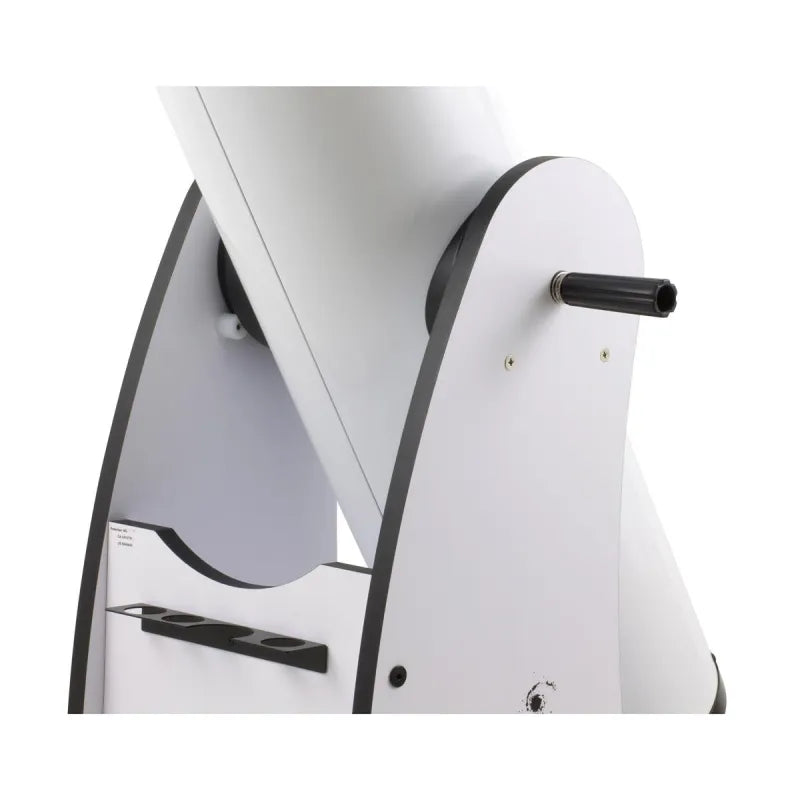
Sky-Watcher not only offers telescopes at very advantageous prices, but also user-friendly instruments, as demonstrated by the tilt system installed on all Dobsonians from 150 mm to 305 mm. In fact, the Chinese-Canadian firm has developed and patented (US Patent No. 6,940,642) a handle that allows you to tighten or loosen the fork on the optical tube. Thus, depending on the inclination of the tube and the weight of the accessories present in the focuser (binocular head, eyepieces of different angles), the observer can increase or decrease the friction. The tube is then sufficiently supported not to tilt downwards as happens with other constructions, and free enough to be easily oriented towards another part of the sky.
Focusing is achieved through a dual-speed focuser . A 31.75 mm adapter is supplied as standard for using eyepieces of the same format from the 50.8 mm output. A clamping screw located at the top of the focuser maintains the focus according to the orientation of the optical tube. A 9x50 achromatic finderscope is also delivered as standard in its holder. With a large diameter of 50 mm for a 9x magnification, it reveals objects invisible to smaller researchers.
Regarding the material used for the primary mirror, the 254 mm and 305 mm Dobsonians benefit from Pyrex glass which has the effect of reducing the effects of expansion due to thermal changes. In fact, its thermal expansion coefficient is lower than that of standard glass, which reduces its warm-up time and ensures better image quality.
The kit includes:
- 1 Sky-Watcher 203mm f/6 Newton optical tube
- 1 Dobsonian altazimuth mount
- 2 31.75 mm fluid eyepieces: Super 12.5 mm and Super 20 mm
- 1 9x50 finder scope
Specifications
| Optics | Newtonian |
|---|---|
| Clear aperture | 203 mm |
| Focal length | 1200 mm |
| F/D ratio | 6 |
| Separating power | 0.59 arcseconds |
| Limiting visual magnitude | 13.6 |
| Light gathering power | 1145x |
| Maximum recommended magnification | 250x |
| Eyepiece holder | Dual-speed 50.8/31.75 Sky-Watcher without microfocuser |
| Optical tube length | 1120 mm |
| Optical tube weight | 8.5 kg |
| Mount | Dobsonian Altazimuth - Motorization not compatible |
| Base dimensions (diameter, height) | 520 mm, 740 mm |
| Base weight | 11.5 kg |


Telescope accessories
-

Astronomy cameras
Astronomy cameras , specially designed to capture images from space, offer several...
-

Alignment Accessories
Collimation is the exact orientation of the optics within a telescope. It...