
November 2026 astronomical calendar: meteor showers, supermoon and planetary encounters
Share
November 2026 arrives with an astronomical calendar full of opportunities to enjoy the night sky. The Taurid and Leonid meteor showers, a spectacular supermoon, the opposition of Uranus, and several planetary conjunctions will be some of the month's highlights.
Whether you are just starting out in astronomy or are already experienced in using a telescope, November offers good opportunities to head out and observe. Many phenomena can be enjoyed with the naked eye, while others will be especially interesting through binoculars or telescopes.
Moon Phases in November 2026
Knowing the moon phases is essential for planning an astronomical observation session. Nights near the new moon are especially favorable for observing galaxies, nebulae, and star clusters, while the intermediate phases allow you to appreciate the moon's topography with greater contrast.
These are the main phases of the month:
Date| Moon Phase
- November 1| Last Quarter
- November 9| New Moon
- November 17| First Quarter
- November 24| Full Moon (Supermoon)
The full moon on November 24 will be known as the Beaver Moon and will coincide with a supermoon, as it will occur near perigee, the point in its orbit closest to Earth.
Although the difference in apparent size compared to other full moons is relatively small, it will be an excellent opportunity to practice lunar photography.
Meteor Showers: Taurids and Leonids
November will feature two meteor showers that deserve special attention.
Taurids: November 5 and 12
The Taurids are characterized by relatively low activity, but also by the possibility of producing especially bright fireballs capable of illuminating a large part of the sky for a few moments.
The Southern Taurids will reach their peak around November 5, while the Northern Taurids will reach theirs approximately on the 12th.
You do not need any optical instruments to observe them. The best thing to do is find a dark location, away from light pollution, and scan a wide area of the sky.
Leonids: November 17 and 18
The Leonids are one of the best-known meteor showers. Their particles come from comet 55P/Tempel-Tuttle and enter Earth's atmosphere at extraordinarily high speeds.
Under ideal conditions, their usual activity can reach approximately 15 meteors per hour, although the number actually visible will depend on the darkness of the sky and the altitude of the radiant.
The best opportunities for observation usually come in the early morning hours, when the constellation Leo rises higher.
Mars and Jupiter: a planetary conjunction on November 16
One of the month's most interesting events will take place on November 16, when Mars and Jupiter will reach an apparent separation of approximately 1.2 degrees.
Both planets can be located with the naked eye before dawn, in the direction of the constellation Leo.
Jupiter will stand out for its intense brightness, while Mars will show its characteristic orange hue.
With binoculars, you can view both planets within a wide field of view. With a telescope, on the other hand, you can observe details of Jupiter, such as its main cloud bands and some of its Galilean moons.
Uranus in Opposition: November 25
On November 25, Uranus will reach opposition, positioning itself approximately opposite the Sun from our perspective on Earth.
This event marks one of the best times of the year to observe the planet, as it will remain visible for much of the night.
Uranus will be in the constellation Taurus and will have a brightness close to magnitude 5.6.
Although it can be detected with the naked eye from exceptionally dark skies, it is recommended to use binoculars or a telescope to locate it more easily.
With a telescope with sufficient aperture and appropriate magnification, Uranus can be viewed as a tiny blue-green disk.
Beaver Supermoon: November 24
The full moon on November 24 will be another of the month's major astronomical attractions.
Because it will occur near perigee, our satellite will have a slightly larger apparent diameter than usual.
It will be an interesting occasion to photograph the moon, especially as it rises above the horizon, when it can be incorporated into compositions with mountains, buildings, or natural landscapes.
However, to observe lunar craters and mountains with greater contrast, it is best to take advantage of the first and last quarter phases, when the shadows near the terminator highlight the relief of its surface.
November 30: exceptional conjunction of the Moon, Jupiter, Mars, and Regulus
November will end with one of its most striking events.
On November 30, the waning moon, Jupiter, Mars, and Regulus—the brightest star in Leo—will appear gathered in a small region of the sky.
In their most compact geocentric configuration, the four objects will span approximately 5.2 degrees, a separation that will allow you to view them together with the naked eye and, from certain locations, with wide-field binoculars.
This is a rare combination of bright objects. According to an analysis of ephemerides for the period between 1900 and 2099, only seven conjunctions occur under the same criteria of brightness and separation.
The best time to observe them will depend on the geographical location. In Spain, the hours leading up to dawn on November 30 will be especially interesting.
What other objects can we observe in November?
In addition to the main events on the calendar, November offers excellent opportunities to explore the deep sky.
In the Northern Hemisphere, the following stand out:
- The Pleiades (M45): an open star cluster in Taurus, spectacular through binoculars.
- The Andromeda Galaxy (M31): visible from dark locations and one of the classic introductory targets.
- The Perseus Double Cluster: two concentrations of stars especially attractive through wide-field telescopes.
- The Hyades: an extensive star cluster that can be viewed with the naked eye.
In the Southern Hemisphere, the Magellanic Clouds, the globular cluster 47 Tucanae, and the Sculptor Galaxy (NGC 253) will be some of the most interesting targets.
What telescope do you need to observe the November sky?
Not all astronomical phenomena require a telescope. Meteor showers are best enjoyed with the naked eye, while binoculars are excellent for exploring large regions of the sky and star clusters.
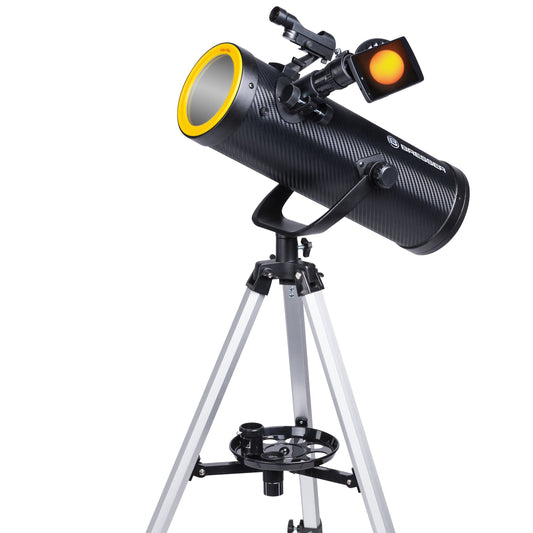
If you want to observe the lunar surface, the planets, or some deep-sky objects, an astronomical telescope will allow you to discover many more details.
For beginners, a starter telescope with an aperture between 70 mm and 130 mm can offer good lunar and planetary observation experiences. Larger aperture telescopes capture more light, which is especially important for exploring faint deep-sky objects.
At Astro Telescopios, you will find telescopes, binoculars, and astronomical observation accessories for different experience levels.
A Month to Enjoy the Universe
November 2026 combines some of the most attractive phenomena for astronomy enthusiasts: bright meteors, planetary conjunctions, a supermoon, and the opportunity to observe one of the farthest planets in the Solar System.
It does not matter whether you observe from a garden, a terrace, or a location away from cities. With a little planning, a clear sky, and the right instrument, every night can offer something different.
Check our astronomical calendar, prepare your next observation session, and enjoy the November sky.
Note: event dates are expressed primarily in universal time and may vary depending on the location and time zone. Visibility will also depend on weather conditions and light pollution.