
Explore Scientific
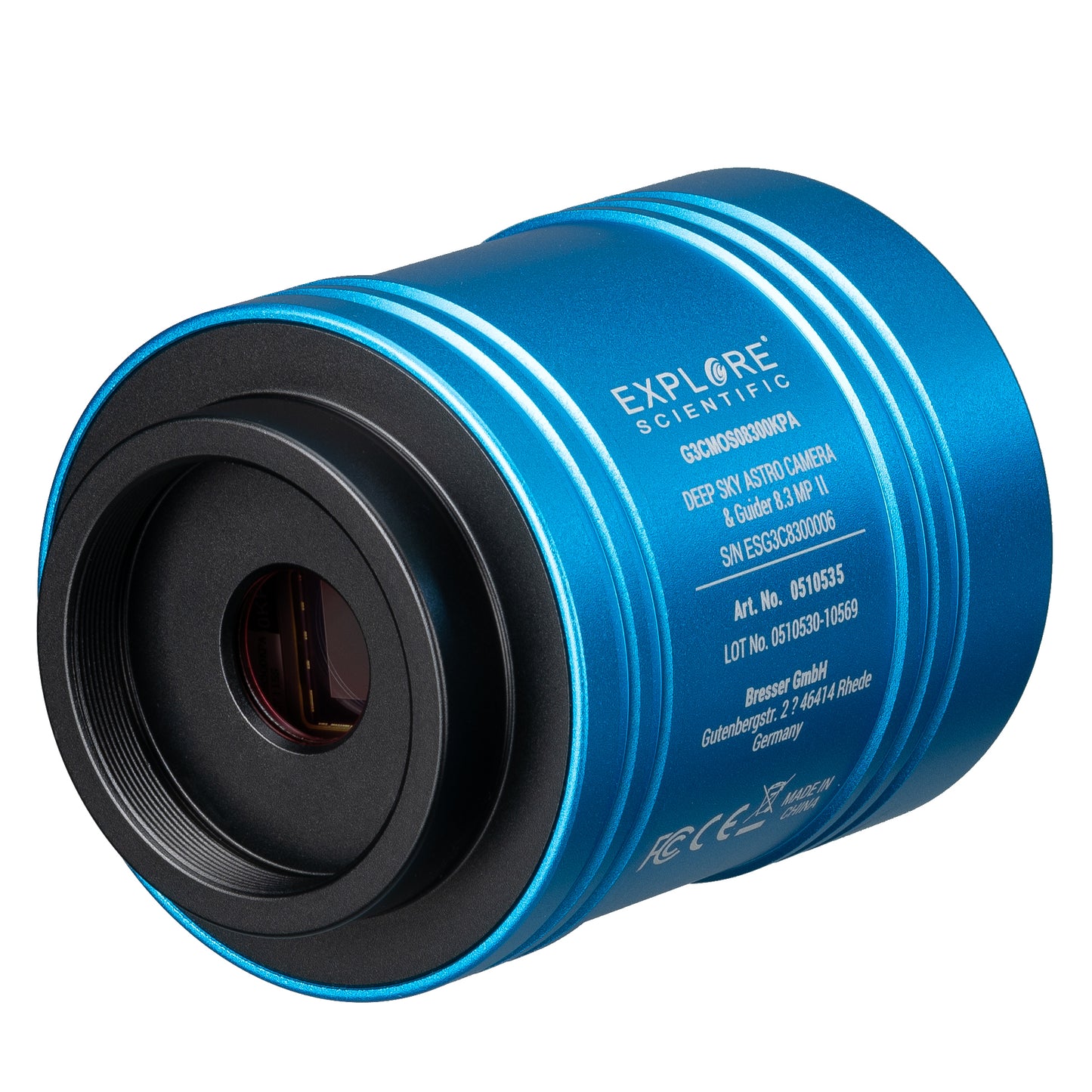
Camera & Guider 8.3 MP II EXPLORE SCIENTIFIC 4K DEEP SKY
Camera & Guider 8.3 MP II EXPLORE SCIENTIFIC 4K DEEP SKY
Regular price
€599,00
Regular price
Sale price
€599,00
Taxes included.
Shipping calculated at checkout.
Low stock
Quantity
Couldn't load pickup availability
Dive into the world of astrophotography now with the new EXPLORE SCIENTIFIC 4K DEEP SKY ASTRO camera plus ST-4 Autoguider function!
What's truly new: Equipped with the new and sensitive IMX585 Exmor CMOS color sensor, this astronomy camera, even with simple telescope equipment, delivers astonishing image results in extremely short exposure times. Furthermore, this ultra-modern camera can also be used as an autoguider, for example, to actively track the main astro camera with SLR or CCD. Therefore, it is an all-rounder camera that provides super sharp and high-resolution planetary images. The high 4K resolution of 3840x2160 pixels ensures the best possible image results.
Sensor
The secret to the high light sensitivity lies in the new back-illuminated Exmor CMOS sensor. This boosts the quantum efficiency up to 77% at 533 nm, which means extremely high light output and thus particularly bright and high-contrast photos. In addition, the particularly low noise level of this new chip generation provides exceptionally high brilliance, and active cooling is not required. However, this astro camera has an elaborate internal aluminum structure for heat dissipation and a fan that can be activated by software. The high native pixel resolution of 3840x2160 allows detailed planetary images as well as very beautiful overview images of the moon in combination with suitable telescopes.
Solar Photography
This camera is also highly recommended for solar photography. In particular, Lunt LS40 THa solar telescopes with their short focal length, in combination with this planetary camera with a large sensor, allow excellent overview images of the sun.
Important note: Always use a suitable solar filter or a special solar telescope for observing and photographing the sun. Otherwise, there is a risk of immediate blindness and damage to the camera.
Software
The included professional Explore-Capture software not only offers the necessary basic functions for image and video recording, but also many useful special functions for post-capture image processing and guider setup. Functions such as live viewing, exposure settings, white balance, dark frame subtraction, stacking, time-lapse recordings, and much more can be individually configured. It is precisely the very mature software that truly facilitates your entry into astrophotography. With the automatic settings, you can already generate absolutely presentable results without extensive prior knowledge. If you wish, simply disable the automatic settings and gradually experiment with individual professional settings.
Automatic Tracking Control
Connect the camera directly to the ST4 port of your telescope mount, and you will have fully automatic tracking control. In this way, multi-minute exposures are possible without the stars generating unwanted streaks due to the always-present tracking fluctuations of a telescope mount. An appropriate ST-4 connection cable is even included with the astronomy camera. Due to the high light sensitivity of the camera, you will always find a suitable guide star, even with very short exposure times.
Connections
For connecting to telescopes, guide scopes or off-axis guiders, the camera has a 1.25" barrel with a 1.25" filter thread (M28.5x0.6) and a large T2 connection thread (M42x0.75) directly on the body.
Notes
Not a standalone camera. A computer with Windows 10 or 11 is required for photography and autoguiding.
Autoguiding software is not included. PHD2 Guiding, GuideDog, Metaguide, Guidemaster (free) or AstroArt, MaxIm DL (paid) can be used, among others.
Example Photos
Created by Lóránd Fényes in Hungary:
https://fenyeslorand.hu/naprendszerunk/
https://fenyeslorand.hu/explore_scientific_4k_review/
https://fenyeslorand.hu/asztrofotok/
FEATURES
INCLUDED
What's truly new: Equipped with the new and sensitive IMX585 Exmor CMOS color sensor, this astronomy camera, even with simple telescope equipment, delivers astonishing image results in extremely short exposure times. Furthermore, this ultra-modern camera can also be used as an autoguider, for example, to actively track the main astro camera with SLR or CCD. Therefore, it is an all-rounder camera that provides super sharp and high-resolution planetary images. The high 4K resolution of 3840x2160 pixels ensures the best possible image results.
Sensor
The secret to the high light sensitivity lies in the new back-illuminated Exmor CMOS sensor. This boosts the quantum efficiency up to 77% at 533 nm, which means extremely high light output and thus particularly bright and high-contrast photos. In addition, the particularly low noise level of this new chip generation provides exceptionally high brilliance, and active cooling is not required. However, this astro camera has an elaborate internal aluminum structure for heat dissipation and a fan that can be activated by software. The high native pixel resolution of 3840x2160 allows detailed planetary images as well as very beautiful overview images of the moon in combination with suitable telescopes.
Solar Photography
This camera is also highly recommended for solar photography. In particular, Lunt LS40 THa solar telescopes with their short focal length, in combination with this planetary camera with a large sensor, allow excellent overview images of the sun.
Important note: Always use a suitable solar filter or a special solar telescope for observing and photographing the sun. Otherwise, there is a risk of immediate blindness and damage to the camera.
Software
The included professional Explore-Capture software not only offers the necessary basic functions for image and video recording, but also many useful special functions for post-capture image processing and guider setup. Functions such as live viewing, exposure settings, white balance, dark frame subtraction, stacking, time-lapse recordings, and much more can be individually configured. It is precisely the very mature software that truly facilitates your entry into astrophotography. With the automatic settings, you can already generate absolutely presentable results without extensive prior knowledge. If you wish, simply disable the automatic settings and gradually experiment with individual professional settings.
Automatic Tracking Control
Connect the camera directly to the ST4 port of your telescope mount, and you will have fully automatic tracking control. In this way, multi-minute exposures are possible without the stars generating unwanted streaks due to the always-present tracking fluctuations of a telescope mount. An appropriate ST-4 connection cable is even included with the astronomy camera. Due to the high light sensitivity of the camera, you will always find a suitable guide star, even with very short exposure times.
Connections
For connecting to telescopes, guide scopes or off-axis guiders, the camera has a 1.25" barrel with a 1.25" filter thread (M28.5x0.6) and a large T2 connection thread (M42x0.75) directly on the body.
Notes
Not a standalone camera. A computer with Windows 10 or 11 is required for photography and autoguiding.
Autoguiding software is not included. PHD2 Guiding, GuideDog, Metaguide, Guidemaster (free) or AstroArt, MaxIm DL (paid) can be used, among others.
DOWNLOAD PHD2-Guiding: https://openphdguiding.org/
DOWNLOAD GuideDog: http://barkosoftware.com/GuideDog/index.html
DOWNLOAD the latest camera software and drivers: https://www.touptek-astro.com/downloads
Example Photos
Created by Lóránd Fényes in Hungary:
https://fenyeslorand.hu/naprendszerunk/
https://fenyeslorand.hu/explore_scientific_4k_review/
https://fenyeslorand.hu/asztrofotok/
FEATURES
- Highly light-sensitive 4K USB 3.0 color camera
- Camera type: EXPLORE SCIENTIFIC G3CMOS08300KPA color
- Sensor: IMX585 Exmor CMOS, back-illuminated
- Sensor size: 11.14 x 6.26 mm
- Image diagonal: 12.86 mm
- Pixel size: 2.9 µm x 2.9 µm
- Megapixels: 8.3 MP
- ST-4 compatible autoguider: Yes
- Housing: Aluminum, CNC machined
- Camera connection: 1.25'' (31.7 mm)
- Camera connection thread: T2 (M42x0.75 mm) and 1.25'' filter thread
- PC connection: USB 3.0
- Camera weight: 0.3 kg
- Software: EXPLORE Capture included
- Camera drivers and ASCOM, and SDK included
- Operating system: WINDOWS 10/11
INCLUDED
- 4K Astro Camera
- Camera Cover
- 2m USB 3.0 Cable
- 2m ST-4 Autoguiding Cable
- EXPLORE Capture Software
- Drivers and SDK
- Manual in English and German
SEGURIDAD PRODUCTOS
Fabricante: Bresser Iberia SLU | Valdemorillo, 1 - nave B | 28925 Alcorcón ESPAÑA | https://www.bresser-iberia.es/
⚠️ NOTAS DE ADVERTENCIA
GAFAS PARA LA OBSERVACIÓN DE ECLIPSE
- INSTRUCCIONES: Revise antes de cada uso. No utilice ni deseche si está dañado, rasgado, perforado o separado de alguna manera del marco. No lo use con otros dispositivos ópticos. No es un juguete. Los niños deben usarlo solo bajo la supervisión de un adulto. Limítese a 3 minutos de uso continuo, con interrupciones durante varias horas. No se mueva mientras usa este producto, no conduzca un vehículo ni opere maquinaria. No lo use si tiene un ojo enfermo o después de una operación ocular.
- ADVERTENCIA: Nunca mire directamente al sol sin protección ocular especial. Siempre use gafas de eclipse al observar el eclipse solar, especialmente si una parte del sol es visible. Mirar directamente al sol puede causar daños permanentes si no se toman las precauciones adecuadas. Se debe usar protección ocular adecuada, diseñada específicamente para la observación solar, para evitar que los rayos dañinos del sol lleguen a los ojos. Deséchelo después de 3 años y no lo utilice después de ese tiempo.
OBSERVACIÓN SOLAR CON TELESCOPIO
- Nunca mire al sol a través de un ocular/telescopio sin un filtro de protección verificado. Un filtro lunar nunca puede usarse para la observación solar. El filtro lunar solo es adecuado para la observación de la luna. El filtro solar debe montarse en la apertura del telescopio, no en el ocular. De lo contrario, el rayo de luz concentrado por la óptica destruirá inmediatamente la película del filtro, lo que provocará daños oculares graves e incluso ceguera total.
- Revise el filtro solar antes de cada observación solar y asegúrese de que no esté dañado. Manténgalo frente a una fuente de luz intensa para poder detectar posibles grietas y/o agujeros. No use el telescopio para la observación solar, incluso si el filtro solar está solo ligeramente dañado. En este caso, comuníquese con el fabricante para obtener las piezas de repuesto correspondientes.
- Siempre use el filtro solar cuando observe el sol. Asegúrese de que este filtro esté colocado correctamente en el telescopio según las instrucciones. El uso del filtro solar está destinado únicamente para su uso con este telescopio.
- Revise el ajuste del filtro solar antes de cada observación solar. Si se suelta accidentalmente de la abertura del objetivo, esto puede causar daños oculares inmediatos y permanentes, e incluso ceguera.
- Si el filtro solar no puede montarse de manera suficientemente firme en el tubo, mejore el ajuste colocando varias tiras de fieltro autoadhesivas o similares entre el filtro solar y la abertura del objetivo. Nunca use el filtro solar si no puede colocarse correctamente en el telescopio. En tal caso, siempre contacte primero con nuestro servicio al cliente.
- Tenga mucho cuidado al observar el sol. Incluso una mirada corta a través de la óptica sin protección puede causar daños oculares graves e incluso ceguera total.
- Los niños, incluso con el filtro montado correctamente, no deben mirar al sol a través del telescopio. Nunca deje a los niños sin supervisión.
- Nunca deje la óptica sin supervisión. Los niños y los adultos inexpertos podrían dirigir el telescopio hacia el sol sin las precauciones adecuadas y perder la vista.
- No realice observaciones solares sin la consulta previa de un médico después de una operación ocular o cualquier otra enfermedad ocular.
- Las ondas/pliegues en la película son normales y no constituyen un defecto del producto.
- No exponga el dispositivo a altas temperaturas.
ADVERTENCIAS Y SEGURIDAD DE LAS PILAS
- NO USE pilas falsas en los productos. Use solo las pilas proporcionadas. Use la pila EXCLUSIVAMENTE para el propósito previsto.
- Guarde las pilas fuera del alcance de los niños y mascotas.
- NO USE pilas que parezcan tener la carcasa dañada, inflada o modificada. No use pilas que hayan goteado, huelan, estén hinchadas o derretidas o presenten abolladuras, óxido, grietas o rayones.
- La pila NO debe ser desmontada, aplastada, perforada, triturada ni manipulada de ninguna otra forma.
- La pila NO debe exponerse a líquidos.
- No debe intentar secar una pila mojada o húmeda con un dispositivo o fuente de calor.
- El dispositivo o la pila NO deben ser colocados cerca de una fuente de calor o bajo la luz solar directa.
- La pila NO debe tocar objetos metálicos.
- La pila NO debe ser almacenada junto a materiales peligrosos o inflamables. Guarde la pila en un lugar fresco, seco y bien ventilado.
- La pila NO debe insertarse incorrectamente al cargarla.
- La pila NO debe cargarse bajo luz solar directa ni a temperaturas extremas. Cárguela a temperatura ambiente (20 °C – 26 °C).
- Evite dejar caer la pila o el producto. Si sospecha que la pila está dañada, reemplácela.
- Nunca deje su dispositivo conectado a la corriente más de 24 horas. Deje que la pila se agote y luego recárguela.
- Para obtener los mejores resultados, reemplace las pilas según el uso después de 12 meses o antes.
- Siga las regulaciones locales para la eliminación de las pilas usadas. NO arroje la pila al fuego ni al agua.