
MAGUS
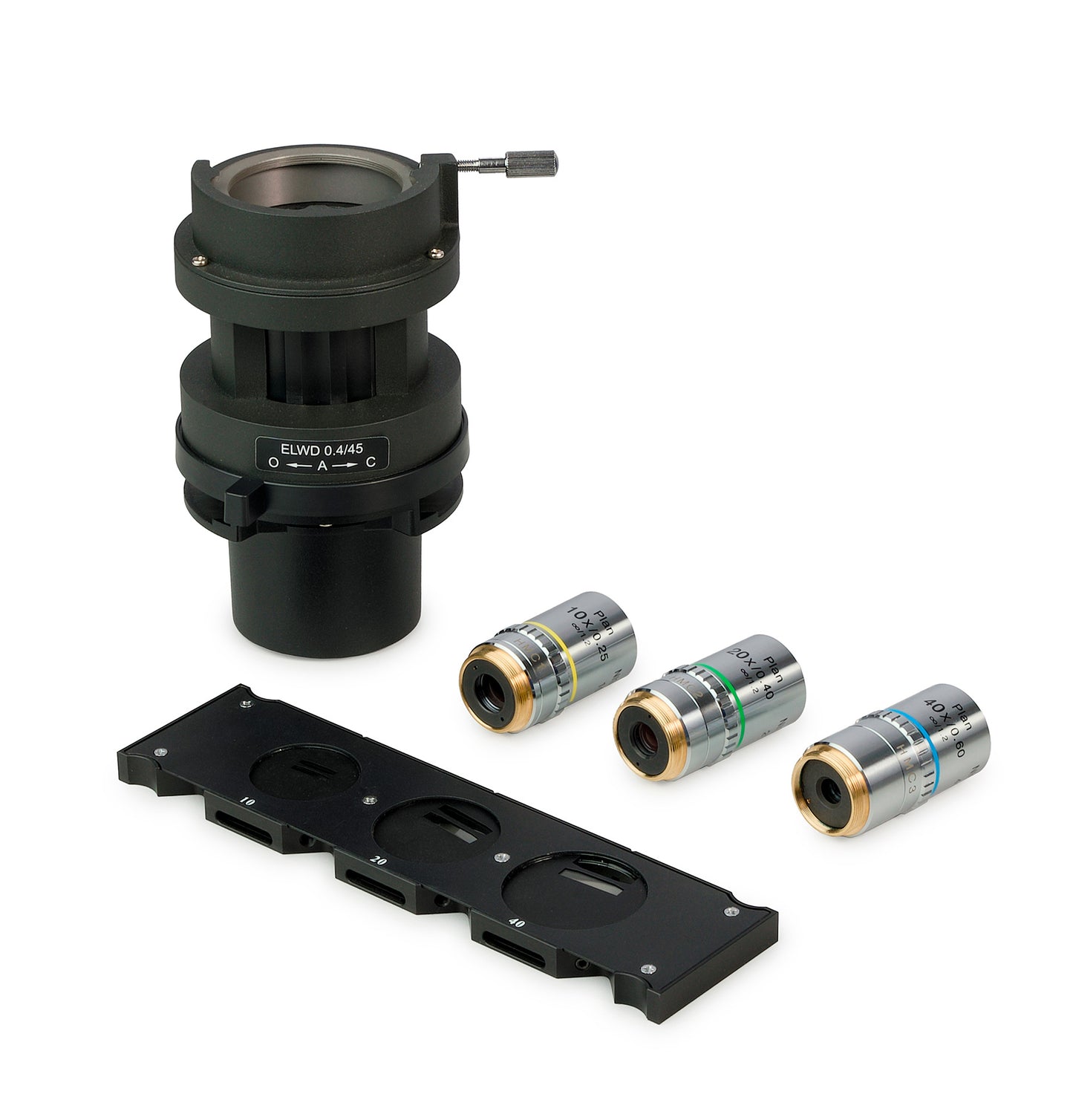
MAGUS HCM360 device for working with Hoffman modulation contrast, with objective set
MAGUS HCM360 device for working with Hoffman modulation contrast, with objective set
Low stock
Couldn't load pickup availability
MAGUS HCM360 device for working with Hoffman modulation contrast, with objective kit
For inverted microscope. The kit includes: plan achromatic objective kit, condenser, and sliding compensator
The MAGUS HCM360 device consists of a plan achromatic objective kit, a condenser, and a sliding compensator designed for Hoffman modulation contrast microscopy. The objective modulator is aligned with the slot apertures of the sliding compensator using a centering telescope from the microscope kit.
The Hoffman modulation contrast technique produces high-resolution relief images of living objects. It provides good visibility and contrast of samples with high-resolution details and no diffraction halos, allowing the use of long working distances and high numerical apertures.
The technique does not degrade image quality when using glass and plastic laboratory plates and is therefore widely applied for observation and photographic recording of cultures, cells, and tissues cultured in vessels, Petri dishes, and flasks.
One of the most common applications of Hoffman modulation contrast is in in vitro fertilization (IVF). The technique allows for real-time study of dynamic processes and helps to gain valuable insights into cell behavior and interaction.
Objective kits
Hoffman objectives differ from standard objectives by having a spatial amplitude filter (modulator) in the back focal plane. The modulator has three zones: the first transmits 1% of the light (dark zone), the second, 15% (gray zone), and the third, 100% (transparent zone). The Hoffman objective ring is used to rotate the modulator and place it in the working position.
Unlike the phase ring of a phase objective, the modulator of a Hoffman objective does not change the phase of light, but only affects its intensity. The modulator produces an image with a pseudo-relief effect.
Hoffman plan achromatic objectives form an image that has the same focus at the center and at the edges, and therefore distortion is negligible. Chromatic aberrations are corrected for blue and red, spherical aberration for green, and field curvature is corrected for 90% of the field of view diameter. The objectives can be used for working with plates with a bottom thickness of 1.2 mm and are designed for an infinity-corrected tube length. The parfocal distance is 60 mm.
Hoffman condenser
The Hoffman condenser is installed in place of the usual brightfield condenser. It has a slot for the Hoffman modulation contrast slide, an aperture diaphragm, and a polarizer to control the slit aperture. The polarizer can rotate 360°. It is rotated by the rotating ring located above the aperture control.
Hoffman sliding compensator
The Hoffman sliding compensator is inserted into the slot of the Hoffman condenser. The sliding compensator is a plate with three round inserts for 10x, 20x, and 40x objectives. The insert mark matches the objective being used. There are two slots in each insert: one is free and the other is closed by a polarizer. The sliding compensator inserts can be rotated 360° and centered.
Microscope adjustment to enable the Hoffman modulation contrast technique:
- The Hoffman condenser and objectives are installed on the microscope.
- The objective in the optical path is focused on the sample in brightfield.
- The Hoffman sliding compensator is inserted into the condenser slot and the insert is selected based on the objective magnification. The condenser aperture must be fully open.
- One of the eyepieces is removed from the microscope head and replaced with a centering telescope from the microscope kit. The telescope is used to align the objective modulator with the sliding compensator slots. The modulator zones and the slots should be parallel to each other when one of the slots is completely projected into the gray zone and the other into the transparent zone. If the ring movement is not sufficient to install the modulator in the desired position, remove the sliding compensator from the condenser, rotate the insert with a slot, reinstall the sliding compensator in the slot, and then readjust.
- By rotating the condenser, a slot aperture in the transparent zone is blocked. One can be fully or partially closed or fully open.
- The Hoffman sliding compensator must be removed from the condenser to return to the brightfield technique. It is not necessary to remove the objectives and condenser, as they are suitable for brightfield observations. However, to obtain the best image quality in brightfield, we recommend using MAGUS 10PL60V, 20PL60V, and 40PL60V objectives, and a standard condenser from the microscope kit.
⚠️ NOTAS DE ADVERTENCIA
GAFAS PARA LA OBSERVACIÓN DE ECLIPSE
- INSTRUCCIONES: Revise antes de cada uso. No utilice ni deseche si está dañado, rasgado, perforado o separado de alguna manera del marco. No lo use con otros dispositivos ópticos. No es un juguete. Los niños deben usarlo solo bajo la supervisión de un adulto. Limítese a 3 minutos de uso continuo, con interrupciones durante varias horas. No se mueva mientras usa este producto, no conduzca un vehículo ni opere maquinaria. No lo use si tiene un ojo enfermo o después de una operación ocular.
- ADVERTENCIA: Nunca mire directamente al sol sin protección ocular especial. Siempre use gafas de eclipse al observar el eclipse solar, especialmente si una parte del sol es visible. Mirar directamente al sol puede causar daños permanentes si no se toman las precauciones adecuadas. Se debe usar protección ocular adecuada, diseñada específicamente para la observación solar, para evitar que los rayos dañinos del sol lleguen a los ojos. Deséchelo después de 3 años y no lo utilice después de ese tiempo.
OBSERVACIÓN SOLAR CON TELESCOPIO
- Nunca mire al sol a través de un ocular/telescopio sin un filtro de protección verificado. Un filtro lunar nunca puede usarse para la observación solar. El filtro lunar solo es adecuado para la observación de la luna. El filtro solar debe montarse en la apertura del telescopio, no en el ocular. De lo contrario, el rayo de luz concentrado por la óptica destruirá inmediatamente la película del filtro, lo que provocará daños oculares graves e incluso ceguera total.
- Revise el filtro solar antes de cada observación solar y asegúrese de que no esté dañado. Manténgalo frente a una fuente de luz intensa para poder detectar posibles grietas y/o agujeros. No use el telescopio para la observación solar, incluso si el filtro solar está solo ligeramente dañado. En este caso, comuníquese con el fabricante para obtener las piezas de repuesto correspondientes.
- Siempre use el filtro solar cuando observe el sol. Asegúrese de que este filtro esté colocado correctamente en el telescopio según las instrucciones. El uso del filtro solar está destinado únicamente para su uso con este telescopio.
- Revise el ajuste del filtro solar antes de cada observación solar. Si se suelta accidentalmente de la abertura del objetivo, esto puede causar daños oculares inmediatos y permanentes, e incluso ceguera.
- Si el filtro solar no puede montarse de manera suficientemente firme en el tubo, mejore el ajuste colocando varias tiras de fieltro autoadhesivas o similares entre el filtro solar y la abertura del objetivo. Nunca use el filtro solar si no puede colocarse correctamente en el telescopio. En tal caso, siempre contacte primero con nuestro servicio al cliente.
- Tenga mucho cuidado al observar el sol. Incluso una mirada corta a través de la óptica sin protección puede causar daños oculares graves e incluso ceguera total.
- Los niños, incluso con el filtro montado correctamente, no deben mirar al sol a través del telescopio. Nunca deje a los niños sin supervisión.
- Nunca deje la óptica sin supervisión. Los niños y los adultos inexpertos podrían dirigir el telescopio hacia el sol sin las precauciones adecuadas y perder la vista.
- No realice observaciones solares sin la consulta previa de un médico después de una operación ocular o cualquier otra enfermedad ocular.
- Las ondas/pliegues en la película son normales y no constituyen un defecto del producto.
- No exponga el dispositivo a altas temperaturas.
ADVERTENCIAS Y SEGURIDAD DE LAS PILAS
- NO USE pilas falsas en los productos. Use solo las pilas proporcionadas. Use la pila EXCLUSIVAMENTE para el propósito previsto.
- Guarde las pilas fuera del alcance de los niños y mascotas.
- NO USE pilas que parezcan tener la carcasa dañada, inflada o modificada. No use pilas que hayan goteado, huelan, estén hinchadas o derretidas o presenten abolladuras, óxido, grietas o rayones.
- La pila NO debe ser desmontada, aplastada, perforada, triturada ni manipulada de ninguna otra forma.
- La pila NO debe exponerse a líquidos.
- No debe intentar secar una pila mojada o húmeda con un dispositivo o fuente de calor.
- El dispositivo o la pila NO deben ser colocados cerca de una fuente de calor o bajo la luz solar directa.
- La pila NO debe tocar objetos metálicos.
- La pila NO debe ser almacenada junto a materiales peligrosos o inflamables. Guarde la pila en un lugar fresco, seco y bien ventilado.
- La pila NO debe insertarse incorrectamente al cargarla.
- La pila NO debe cargarse bajo luz solar directa ni a temperaturas extremas. Cárguela a temperatura ambiente (20 °C – 26 °C).
- Evite dejar caer la pila o el producto. Si sospecha que la pila está dañada, reemplácela.
- Nunca deje su dispositivo conectado a la corriente más de 24 horas. Deje que la pila se agote y luego recárguela.
- Para obtener los mejores resultados, reemplace las pilas según el uso después de 12 meses o antes.
- Siga las regulaciones locales para la eliminación de las pilas usadas. NO arroje la pila al fuego ni al agua.