

Levenhuk
Levenhuk 740T Trinocular Microscope
Levenhuk 740T Trinocular Microscope
🔴 Out of stock
Please see the compatible product recommendations at the bottom of the page or contact customerservice@astrotelescopios.es for more information.
Couldn't load pickup availability
Levenhuk 740T Microscope: A three-eyepiece microscope that allows you to perform classic biological studies and utilize modern technology in your observations. Its three-eyepiece head allows you to mount any digital camera adapted to the 23.2 mm optical tube.
The microscope features bottom illumination, which means only transparent samples can be observed. Light intensity can be adjusted over a wide range. An Abbe condenser repeatedly amplifies the light beam and directs it precisely to the area of investigation. The microscope allows observations in brightfield mode. The oil immersion method is also available.
The rotating nosepiece is designed to accommodate four objectives. By combining them with interchangeable eyepieces of different magnifications, you can achieve a wide range of fixed magnifications from 40x to 2000x. All eyepieces supplied with the equipment are paired eyepieces.
The three-eyepiece head is inclined at 45° and rotates 360° around its axis. This is particularly practical for group work, when you need a large audience to view your samples; in this case, simply rotate the microscope head instead of having to move the entire instrument.
Samples are secured to the stage using two handy clamps. The stage moves vertically and horizontally, allowing you to precisely select the area to be analyzed and focus on a small portion of the sample. The focusing mechanism allows for coarse and fine focusing. Most non-professional microscope models do not have this convenient feature.
This microscope is delivered with a special case, very practical for storing the microscope.
Characteristics:
- 4-target rotary revolver
- Immersion oil
- Abbe condenser with adjustable diameter diaphragm and filter
- Trinocular head
- Possibility of connecting a digital camera (not included)
- Magnification: 40–2000x
- Metallic body
- LED lighting with adjustable brightness
- Practical plate that moves vertically and horizontally
- Coaxial coarse and fine focusing mechanism
The kit includes:
- Microscope stand with base
- Trinocular head
- Achromatic objectives: 4x, 10x, 40x and 100x (oil)
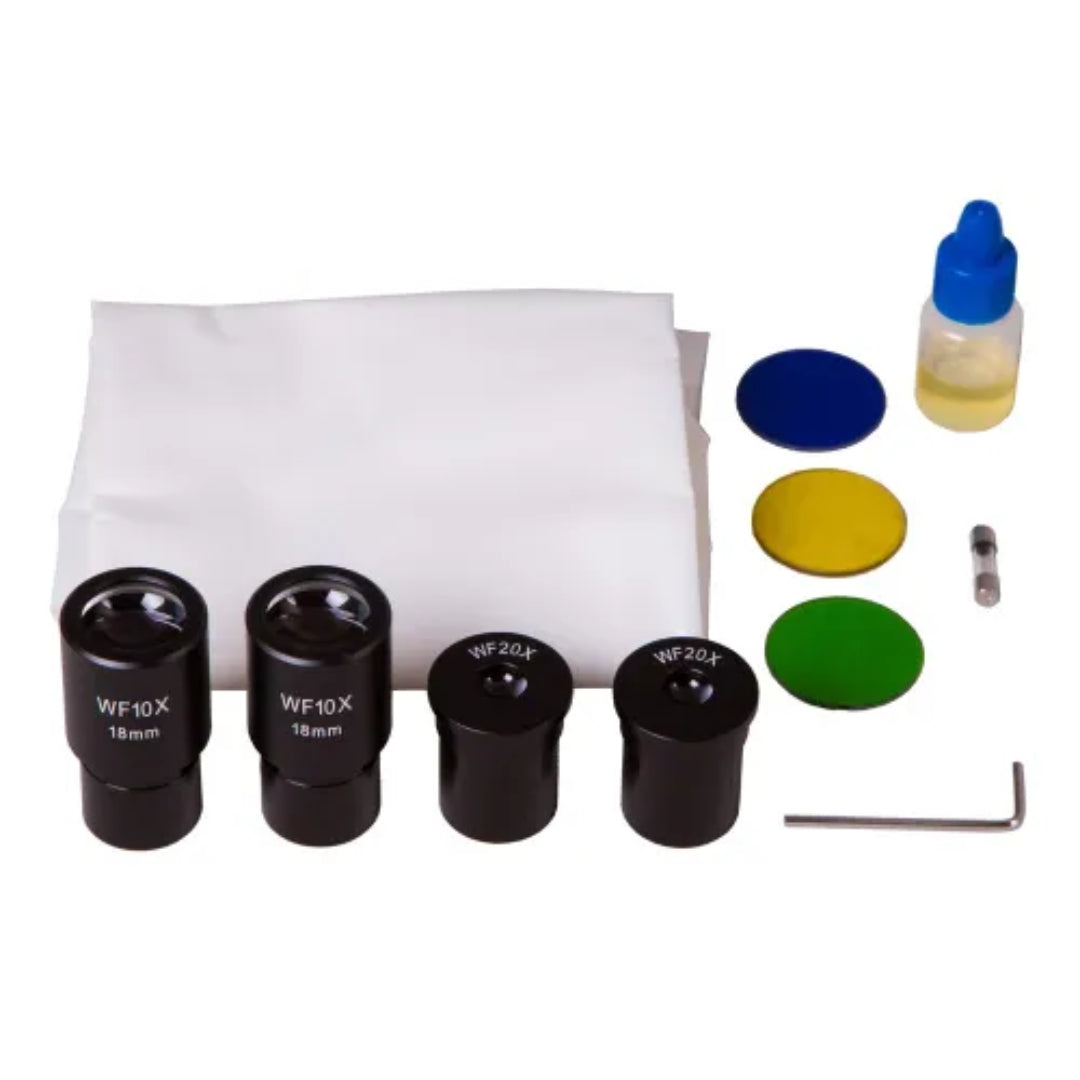
- Eyepieces: WF10x and H20x
- Blue filter
- Bottle of immersion oil
- Dust cover
- User Manual
- Lifetime Warranty
Caution: Check the specifications table for the correct voltage and never plug a 110V device into a 220V outlet or vice versa without using an adapter. Remember that the voltage in the United States and Canada is 110V, and in most European countries it's 220–240V.
Some of the things that can be seen under a microscope:


The Levenhuk 740T trinocular microscope is compatible with Levenhuk digital cameras (sold separately). Levenhuk cameras mount onto the eyepiece tube instead of the eyepiece tube.
| Guy | biological, light/optical |
| Microscope head type | trinocular |
| Optical material | optical glass |
| Head | 360° rotating |
| Head tilt angle | 45° |
| Magnification, x | 40 — 2000 |
| Eyepiece tube diameter, mm | 23.2 |
| Eyepieces | WF10x/18 mm, WFH20x |
| Goals | Achromatic: 4x, 10x, 40xs, 100xs (oil immersion) |
| Revolver | for 4 objectives |
| Interpupillary distance, mm | 54 — 75 |
| Platina, mm | 140x130 |
| Stage travel range, mm | 75/24 |
| Platen | mechanical, two-layer |
| Dioptric adjustment | ±6 |
| Condenser | Abbe NA 1.25 |
| Diaphragm | iris |
| Approach | coaxial; approximate (22 mm), precise (0.002 mm) |
| Body | metal |
| Lightning | LED |
| Adjusting the brightness | ✓ |
| Feeding | 220 V/50 Hz |
| Type of lighting source | 3W LED |
| Light filters | blue, green, yellow |
| Additional | eyepiece tube length: 160 mm sample movement range: 75x55 mm |
| User level | experienced users |
| Assembly and installation difficulty level | easy |
| Application | laboratory/medical |
| Lighting location | lower |
| Research method | bright field |
| Case/briefcase/bag included in the kit | protective cover |


⚠️ NOTAS DE ADVERTENCIA
GAFAS PARA LA OBSERVACIÓN DE ECLIPSE
- INSTRUCCIONES: Revise antes de cada uso. No utilice ni deseche si está dañado, rasgado, perforado o separado de alguna manera del marco. No lo use con otros dispositivos ópticos. No es un juguete. Los niños deben usarlo solo bajo la supervisión de un adulto. Limítese a 3 minutos de uso continuo, con interrupciones durante varias horas. No se mueva mientras usa este producto, no conduzca un vehículo ni opere maquinaria. No lo use si tiene un ojo enfermo o después de una operación ocular.
- ADVERTENCIA: Nunca mire directamente al sol sin protección ocular especial. Siempre use gafas de eclipse al observar el eclipse solar, especialmente si una parte del sol es visible. Mirar directamente al sol puede causar daños permanentes si no se toman las precauciones adecuadas. Se debe usar protección ocular adecuada, diseñada específicamente para la observación solar, para evitar que los rayos dañinos del sol lleguen a los ojos. Deséchelo después de 3 años y no lo utilice después de ese tiempo.
OBSERVACIÓN SOLAR CON TELESCOPIO
- Nunca mire al sol a través de un ocular/telescopio sin un filtro de protección verificado. Un filtro lunar nunca puede usarse para la observación solar. El filtro lunar solo es adecuado para la observación de la luna. El filtro solar debe montarse en la apertura del telescopio, no en el ocular. De lo contrario, el rayo de luz concentrado por la óptica destruirá inmediatamente la película del filtro, lo que provocará daños oculares graves e incluso ceguera total.
- Revise el filtro solar antes de cada observación solar y asegúrese de que no esté dañado. Manténgalo frente a una fuente de luz intensa para poder detectar posibles grietas y/o agujeros. No use el telescopio para la observación solar, incluso si el filtro solar está solo ligeramente dañado. En este caso, comuníquese con el fabricante para obtener las piezas de repuesto correspondientes.
- Siempre use el filtro solar cuando observe el sol. Asegúrese de que este filtro esté colocado correctamente en el telescopio según las instrucciones. El uso del filtro solar está destinado únicamente para su uso con este telescopio.
- Revise el ajuste del filtro solar antes de cada observación solar. Si se suelta accidentalmente de la abertura del objetivo, esto puede causar daños oculares inmediatos y permanentes, e incluso ceguera.
- Si el filtro solar no puede montarse de manera suficientemente firme en el tubo, mejore el ajuste colocando varias tiras de fieltro autoadhesivas o similares entre el filtro solar y la abertura del objetivo. Nunca use el filtro solar si no puede colocarse correctamente en el telescopio. En tal caso, siempre contacte primero con nuestro servicio al cliente.
- Tenga mucho cuidado al observar el sol. Incluso una mirada corta a través de la óptica sin protección puede causar daños oculares graves e incluso ceguera total.
- Los niños, incluso con el filtro montado correctamente, no deben mirar al sol a través del telescopio. Nunca deje a los niños sin supervisión.
- Nunca deje la óptica sin supervisión. Los niños y los adultos inexpertos podrían dirigir el telescopio hacia el sol sin las precauciones adecuadas y perder la vista.
- No realice observaciones solares sin la consulta previa de un médico después de una operación ocular o cualquier otra enfermedad ocular.
- Las ondas/pliegues en la película son normales y no constituyen un defecto del producto.
- No exponga el dispositivo a altas temperaturas.
ADVERTENCIAS Y SEGURIDAD DE LAS PILAS
- NO USE pilas falsas en los productos. Use solo las pilas proporcionadas. Use la pila EXCLUSIVAMENTE para el propósito previsto.
- Guarde las pilas fuera del alcance de los niños y mascotas.
- NO USE pilas que parezcan tener la carcasa dañada, inflada o modificada. No use pilas que hayan goteado, huelan, estén hinchadas o derretidas o presenten abolladuras, óxido, grietas o rayones.
- La pila NO debe ser desmontada, aplastada, perforada, triturada ni manipulada de ninguna otra forma.
- La pila NO debe exponerse a líquidos.
- No debe intentar secar una pila mojada o húmeda con un dispositivo o fuente de calor.
- El dispositivo o la pila NO deben ser colocados cerca de una fuente de calor o bajo la luz solar directa.
- La pila NO debe tocar objetos metálicos.
- La pila NO debe ser almacenada junto a materiales peligrosos o inflamables. Guarde la pila en un lugar fresco, seco y bien ventilado.
- La pila NO debe insertarse incorrectamente al cargarla.
- La pila NO debe cargarse bajo luz solar directa ni a temperaturas extremas. Cárguela a temperatura ambiente (20 °C – 26 °C).
- Evite dejar caer la pila o el producto. Si sospecha que la pila está dañada, reemplácela.
- Nunca deje su dispositivo conectado a la corriente más de 24 horas. Deje que la pila se agote y luego recárguela.
- Para obtener los mejores resultados, reemplace las pilas según el uso después de 12 meses o antes.
- Siga las regulaciones locales para la eliminación de las pilas usadas. NO arroje la pila al fuego ni al agua.
Telescope accessories
-

Astronomy cameras
Astronomy cameras , specially designed to capture images from space, offer several...
-

Alignment Accessories
Collimation is the exact orientation of the optics within a telescope. It...


