

Sky-Watcher
Sky-Watcher StarGate 500mm Dobsonian Telescope
Sky-Watcher StarGate 500mm Dobsonian Telescope
🔴 Out of stock
Please see the compatible product recommendations at the bottom of the page or contact customerservice@astrotelescopios.es for more information.
Couldn't load pickup availability
The largest Dobsonian SkyWatcher
- StarGate range with very large diameter, 508 mm, transportable by 1 person
- Perfect for deep sky observation (galaxies, nebulae)
- Focal ratio of only f/3.9 (wide field)
- 50.8mm Dual Speed Focuser, 10:1 Reduction
- Automatic pointing (GOTO) and motorized tracking
After revolutionizing the concept and accessing the Dobsons several times, Sky-Watcher is expanding to very large diameters (>400mm) . The FlexTube were the first folding Dobsonian telescopes and offered greater ease of storage and movement. Then the arrival of a motor to the FlexTube Go-To made the Dobsons extremely attractive. In fact, for several years it has been possible to have of a large diameter instrument (300, 350, even 400 mm) with automatic pointing at an affordable price.
Everything you need to know about the Dobsonian Sky-Watcher StarGate 508 mm (20") f/3.9 GoTo
The famous Chinese manufacturer, world leader in telescope manufacturing , now offers 18" (458 mm) and 20" (508 mm) instruments, StarGate range , for the most amateurs, public observatories or astronomy clubs. These diameters require a total redesign of the design to make them transportable by a single person . In fact, the FlexTube 350 and 406 mm are already too heavy to transport without the help of an additional person (even the base alone!). The latter is also completely modified to resemble ultra-compact Dobsons from other manufacturers.
With a mirror of this type, a 508 mm instrument collects 23% more light compared to a 458 mm instrument , observing the deep sky is a pure delight. The most disordered objects are easily observed, galaxies can finally be observed in detail (and not only locatable). The addition of highly selective filters such as O-III or H-beta does not cause excessive loss of brightness. The most beautiful nebulae and clusters can be observed in an incredible amount of detail . The instrument is then no longer a limit... it is the time dedicated to it that will be the obstacle to the discovery of new objectives! With a focal ratio of f/3.9 and wide-field eyepieces, observe vast expanses of stars despite such a large diameter: a 2000mm focal length equal to that of a 203mm (8") Schmidt-Cassegrain or less than that of a Mak180 (7" ).
Planetary level during nights with little atmospheric turbulence, and obviously with very good collimation The results will be spectacular with such a diameter . Jupiter will show nuances of color in its cloud bands very easily. Saturn will reveal its rings like never before. The Moon will be rediscovered even by the most knowledgeable. Mars, a fascinating but difficult object to observe, will reveal many details.
Locksmith type construction.
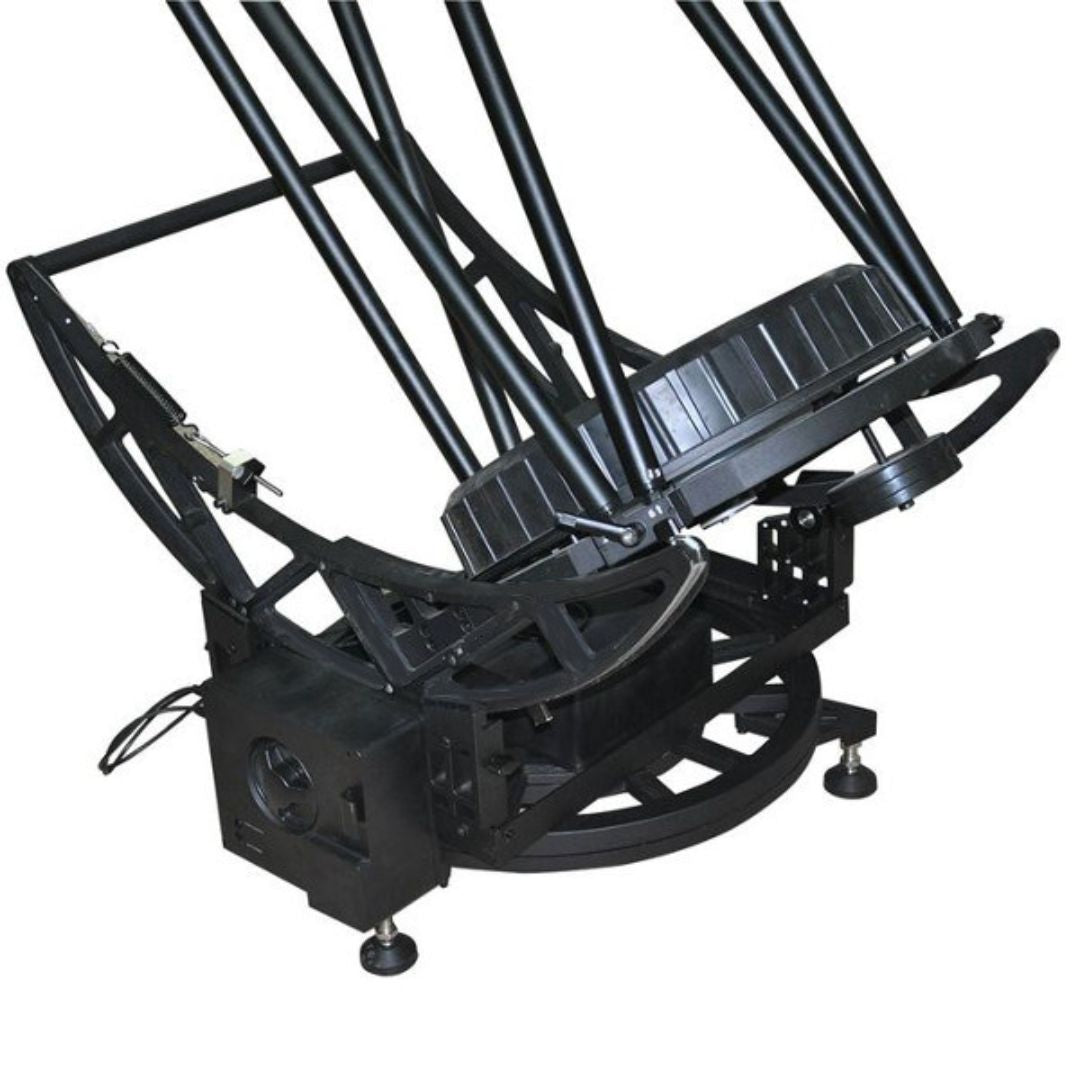
The main idea of the StarGate range is to have an instrument that can be carried by 1 person… without anything too heavy. The structure is Locksmith type , equipped with 6 removable "V" tubes that connect a "cage" holding the secondary mirror and a "cage" around the primary mirror. The main “cage” rests on a base that allows the assembly to rotate 360°. Regarding transportation, the total weight is 85kg... but the heaviest element is the 20kg primary mirror . Setup time is approximately 25 to 30 minutes after a few nights of observations.
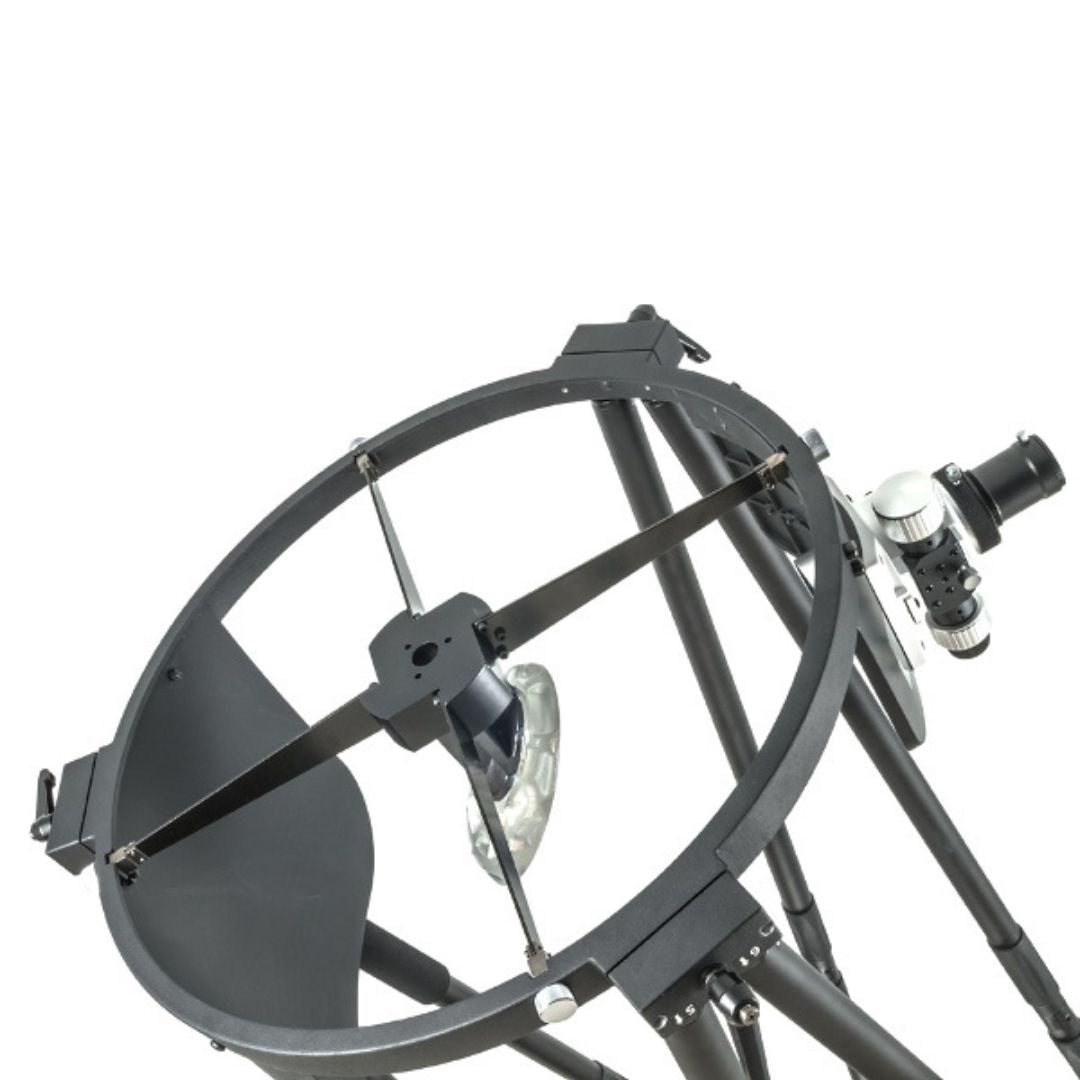
The secondary cage is lightweight (less than 6kg) thanks to a single ring that holds both the secondary spider and the focuser. A rigid shield, located on the opposite side, limits stray light intrusion near the focuser. Fixing the tubes is easily done using small handles that are comfortable to handle. Three small counterweights allow you to always find the right balance depending on the chosen eyepieces (see binocular head).
In terms of movement, the curved panels "glide" on Teflon pads making movements very smooth. The same goes for the base rotation. So whatever eyepiece/magnification is used, you can easily move the StarGate 18" to find or follow a target.
Optical design
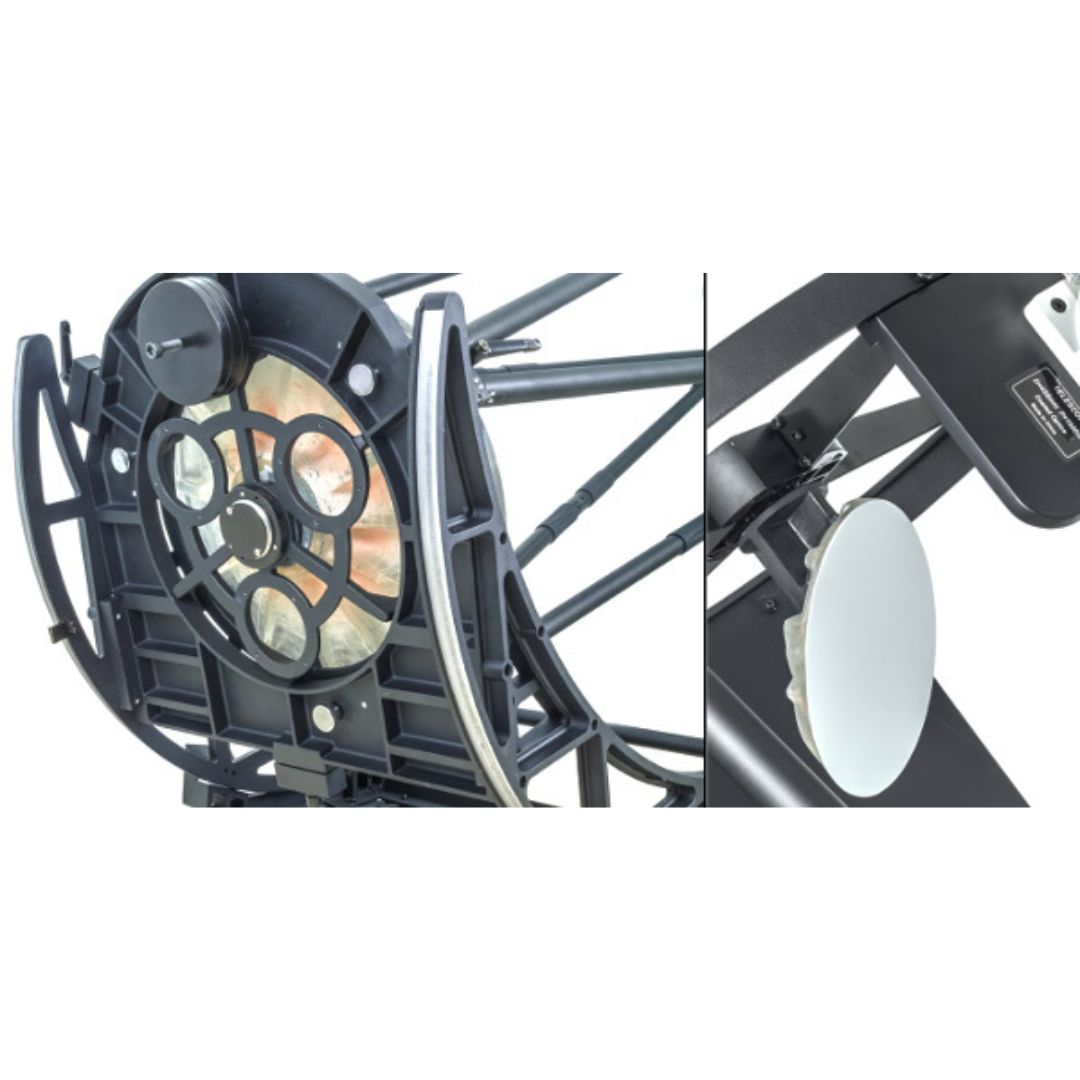
The primary mirror is thus "open" to the outside with a minimum of elements to protect it. Strictly speaking, there is no such thing as an “elementary school cage.” The primary support, the barrel, is the main part on which the curved panels for the tilt change and the locksmith tubes are fixed. The height at the zenith is 2 m for the focuser , which usually involves the use of a step.
To lighten the metal structures, Sky-Watcher opted for special mirrors. In BK7 borosilicate (low thermal expansion glass), the primary is parabolic, conical and cast... a Sky-Watcher exclusive . The fused design allows for a thinner mirror construction providing faster cooling and lighter weight. The tapered shape allows for a simpler barrel and easier adjustment when collimating. The secondary one has an alveolar structure (for the same purposes).
Focuser with Dual Speed 10:1 focusing
Focusing is achieved using a dual-flow Crayford eyepiece. Much more precise than a basic mount, it offers more comfort when it comes to achieving focus (more delicate and sensitive to obtain because the telescope has a short f/D). Allows to obtain fine focus thanks to 1:10 reduction , a very noticeable plus when observed with high magnifications. It can withstand heavy loads. An adjustment screw located at the bottom of the eyepiece holder allows you to maintain focus by following the orientation of the optical tube. In fact, a 31.75mm adapter is supplied as standard to use eyepieces of the same format from the 50.8mm output.
An achromatic finderscope on its support is also delivered as standard. With a large diameter of 50 mm and 9x magnification, it reveals objects invisible to the smallest researchers, making their search much easier. Another important accessory: a protective skirt is included to limit the intrusion of stray lights. Made of nylon, it is elastic, light and easily adaptable to the instrument.
Motorized GoTo system (auto-aim)
To offer more comfort to the user, Sky-Watcher has decided to equip its Dobsonian range with a dual-axis motorization (equivalent to a motorized altazimuthal mount) with a control panel capable of pointing and tracking. So that It is not necessary to know the position of stars or distant bodies in the deep sky , the AZ GOTO Dobsonian mount is responsible for moving the instrument towards the target you want to observe.
After calibration (setup), orienting the optical tube to North and leveling, select the mount alignment to one or two stars. More than 42,900 objects are registered in the database, including the main catalogs (Messier, NGC, IC, as well as the planets, the Moon and the Sun). For maximum convenience, the stand moves quickly using the SynScan control panel. Easy to use, it helps to quickly point the instrument towards any galaxy, nebula, cluster or object in the solar system. Discover in detail the famous Andromeda galaxy, the fabulous curtains surrounding the heart of Orion, the Hercules cluster M13 and its heart rich in thousands of stars. Saturn, Jupiter and the Moon are also wonders that must be examined without moderation.
The indication on the racket of the date, time and place of observation combined with "Tour" function allows AZ GOTO to point towards the most interesting objects throughout the night . Enjoy a guided sky tour at your viewing location by clicking the "Enter" button based on the object presented in a drop-down list. The ability to track any object avoids the need for systematic manual capture (practical during observation nights with the general public). The object remains in the center of the field , making it easier to discover details, especially on planets.
Freedom Find™ technology includes 2 additional encoders that allow you to assist with manual pointing (without activating motorization). It is an aiming aid that indicates the coordinates and direction where you need to move the instrument towards the desired target.
Specifications
| Characteristics | Dobsonian Sky-Watcher StarGate 508 mm (20") f/3.9 GoTo |
|---|---|
| optical tube | |
| Optical formula | Newton |
| Useful diameter | 508mm |
| Focal length | 2000mm |
| F/D ratio | 3.94 |
| primary mirror | Parabolic: lightweight construction (conical/fused) |
| secondary mirror | 136 mm diameter (central obstruction 26.8%) |
| Eyepiece holder | Crayford 50.8/31.75mm Sky-Watcher with Microfocuser (Dual Speed 1:10) |
| zenith height | 2m00 |
| Optical tube length | 2.1m |
| Optical tube width | 600mm |
| Total weight (without counterweight) | 85kg |
| Primary mirror weight (heaviest item) | 20kg |
| Base weight (after assembly + motor) | 35kg |
| Primary cage weight (after assembly) | 40kg |
| Secondary cage weight | 5.5 kilos |
| Assembly time for one person. | Approximately 25-30 minutes |
| Mount | |
| Mount |
Azimuth Dobsonian GoTo Motorized dual axles with automatic Go-To pointing |
| Motorization |
Aiming precision of DC servo motors: 5 arc minutes |
| Transmission | Worm + Belt + 0.9° Hybrid Stepper Motor with 64 Microsteps |
| Reduction coefficient |
Azimuth: 400 Altitude: 1523.796 |
| Access system |
SynScan control rack with 42,900 objects from common celestial catalogs Tracking mode: sidereal, lunar or solar |
| Wireless connection | Integrated WiFi card |
| Power supply not included) | 12-15V DC 5A mini, 2.1mm plug (positive pole in the center) |
| Additional ports | SNAP port to control your camera body |


⚠️ NOTAS DE ADVERTENCIA
GAFAS PARA LA OBSERVACIÓN DE ECLIPSE
- INSTRUCCIONES: Revise antes de cada uso. No utilice ni deseche si está dañado, rasgado, perforado o separado de alguna manera del marco. No lo use con otros dispositivos ópticos. No es un juguete. Los niños deben usarlo solo bajo la supervisión de un adulto. Limítese a 3 minutos de uso continuo, con interrupciones durante varias horas. No se mueva mientras usa este producto, no conduzca un vehículo ni opere maquinaria. No lo use si tiene un ojo enfermo o después de una operación ocular.
- ADVERTENCIA: Nunca mire directamente al sol sin protección ocular especial. Siempre use gafas de eclipse al observar el eclipse solar, especialmente si una parte del sol es visible. Mirar directamente al sol puede causar daños permanentes si no se toman las precauciones adecuadas. Se debe usar protección ocular adecuada, diseñada específicamente para la observación solar, para evitar que los rayos dañinos del sol lleguen a los ojos. Deséchelo después de 3 años y no lo utilice después de ese tiempo.
OBSERVACIÓN SOLAR CON TELESCOPIO
- Nunca mire al sol a través de un ocular/telescopio sin un filtro de protección verificado. Un filtro lunar nunca puede usarse para la observación solar. El filtro lunar solo es adecuado para la observación de la luna. El filtro solar debe montarse en la apertura del telescopio, no en el ocular. De lo contrario, el rayo de luz concentrado por la óptica destruirá inmediatamente la película del filtro, lo que provocará daños oculares graves e incluso ceguera total.
- Revise el filtro solar antes de cada observación solar y asegúrese de que no esté dañado. Manténgalo frente a una fuente de luz intensa para poder detectar posibles grietas y/o agujeros. No use el telescopio para la observación solar, incluso si el filtro solar está solo ligeramente dañado. En este caso, comuníquese con el fabricante para obtener las piezas de repuesto correspondientes.
- Siempre use el filtro solar cuando observe el sol. Asegúrese de que este filtro esté colocado correctamente en el telescopio según las instrucciones. El uso del filtro solar está destinado únicamente para su uso con este telescopio.
- Revise el ajuste del filtro solar antes de cada observación solar. Si se suelta accidentalmente de la abertura del objetivo, esto puede causar daños oculares inmediatos y permanentes, e incluso ceguera.
- Si el filtro solar no puede montarse de manera suficientemente firme en el tubo, mejore el ajuste colocando varias tiras de fieltro autoadhesivas o similares entre el filtro solar y la abertura del objetivo. Nunca use el filtro solar si no puede colocarse correctamente en el telescopio. En tal caso, siempre contacte primero con nuestro servicio al cliente.
- Tenga mucho cuidado al observar el sol. Incluso una mirada corta a través de la óptica sin protección puede causar daños oculares graves e incluso ceguera total.
- Los niños, incluso con el filtro montado correctamente, no deben mirar al sol a través del telescopio. Nunca deje a los niños sin supervisión.
- Nunca deje la óptica sin supervisión. Los niños y los adultos inexpertos podrían dirigir el telescopio hacia el sol sin las precauciones adecuadas y perder la vista.
- No realice observaciones solares sin la consulta previa de un médico después de una operación ocular o cualquier otra enfermedad ocular.
- Las ondas/pliegues en la película son normales y no constituyen un defecto del producto.
- No exponga el dispositivo a altas temperaturas.
ADVERTENCIAS Y SEGURIDAD DE LAS PILAS
- NO USE pilas falsas en los productos. Use solo las pilas proporcionadas. Use la pila EXCLUSIVAMENTE para el propósito previsto.
- Guarde las pilas fuera del alcance de los niños y mascotas.
- NO USE pilas que parezcan tener la carcasa dañada, inflada o modificada. No use pilas que hayan goteado, huelan, estén hinchadas o derretidas o presenten abolladuras, óxido, grietas o rayones.
- La pila NO debe ser desmontada, aplastada, perforada, triturada ni manipulada de ninguna otra forma.
- La pila NO debe exponerse a líquidos.
- No debe intentar secar una pila mojada o húmeda con un dispositivo o fuente de calor.
- El dispositivo o la pila NO deben ser colocados cerca de una fuente de calor o bajo la luz solar directa.
- La pila NO debe tocar objetos metálicos.
- La pila NO debe ser almacenada junto a materiales peligrosos o inflamables. Guarde la pila en un lugar fresco, seco y bien ventilado.
- La pila NO debe insertarse incorrectamente al cargarla.
- La pila NO debe cargarse bajo luz solar directa ni a temperaturas extremas. Cárguela a temperatura ambiente (20 °C – 26 °C).
- Evite dejar caer la pila o el producto. Si sospecha que la pila está dañada, reemplácela.
- Nunca deje su dispositivo conectado a la corriente más de 24 horas. Deje que la pila se agote y luego recárguela.
- Para obtener los mejores resultados, reemplace las pilas según el uso después de 12 meses o antes.
- Siga las regulaciones locales para la eliminación de las pilas usadas. NO arroje la pila al fuego ni al agua.
Telescope accessories
-

Astronomy cameras
Astronomy cameras , specially designed to capture images from space, offer several...
-

Alignment Accessories
Collimation is the exact orientation of the optics within a telescope. It...


