

Levenhuk
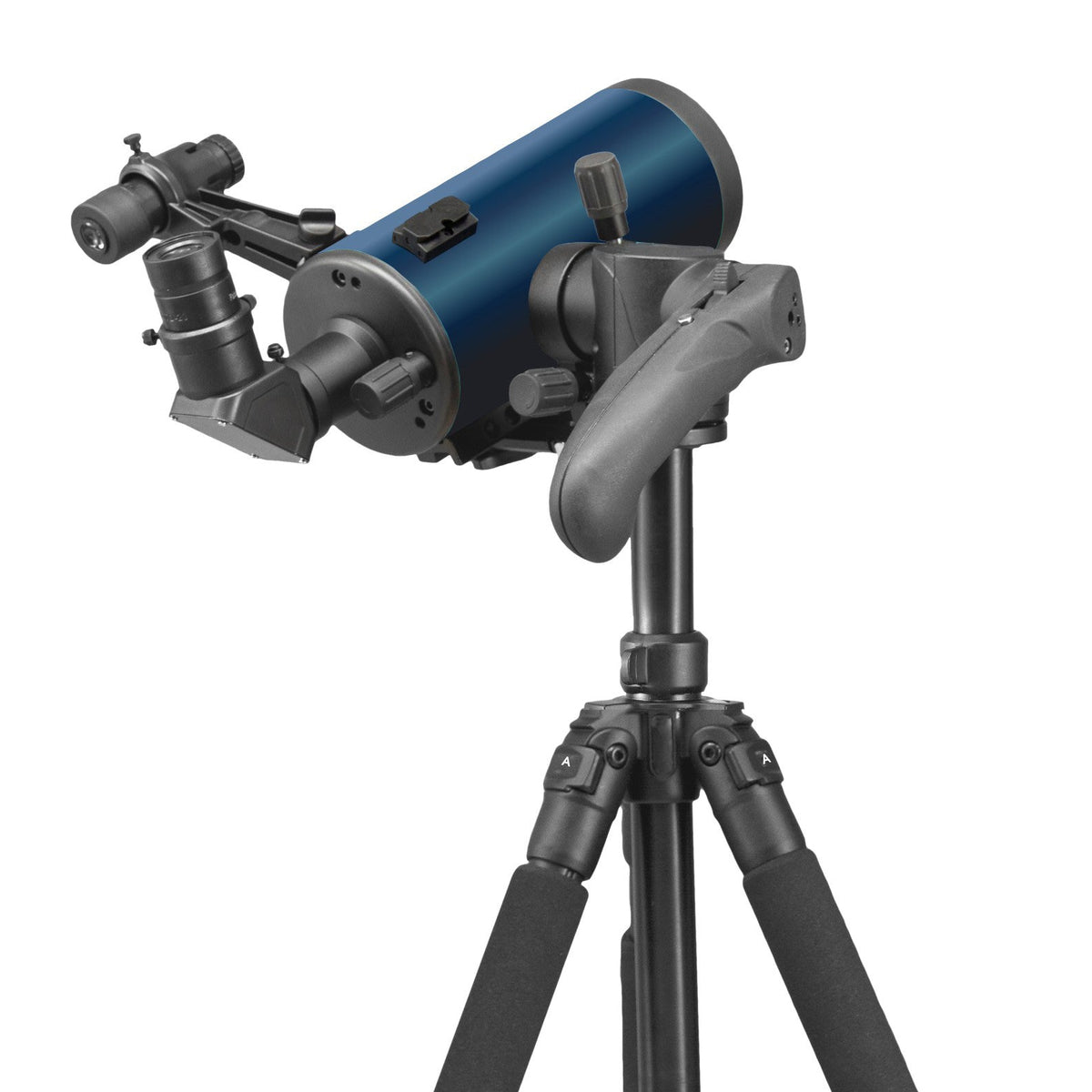
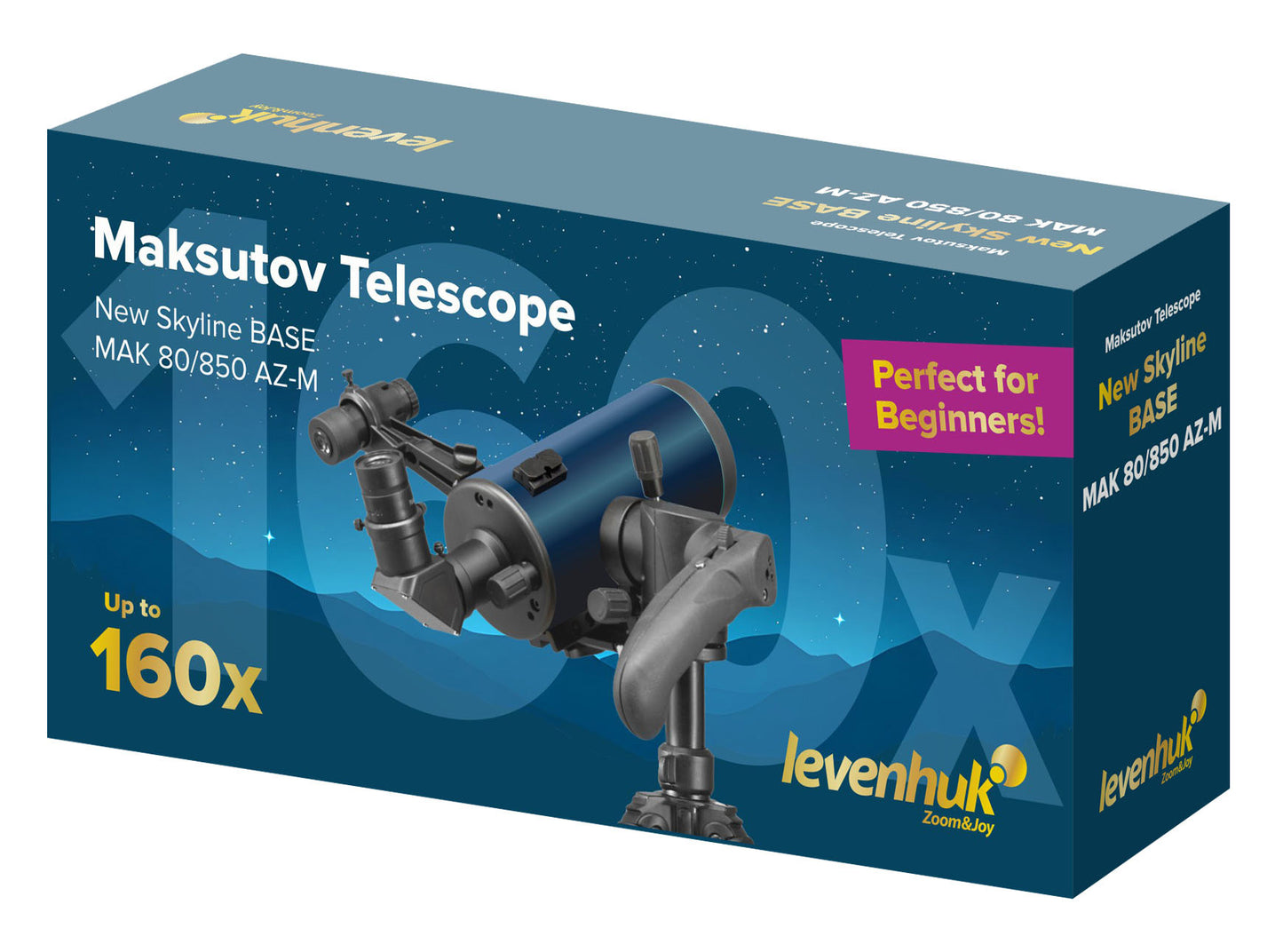
Levenhuk New Skyline BASE MAK 80/850 AZ-M Telescope
Levenhuk New Skyline BASE MAK 80/850 AZ-M Telescope
In stock
Couldn't load pickup availability
Levenhuk New Skyline BASE MAK 80/850 AZ-M Telescope
Maksutov-Cassegrain telescope. Objective lens diameter: 80 mm. Focal length: 850 mm
The Levenhuk New Skyline BASE MAK 80/850 AZ-M Telescope reveals the breathtaking beauty of the universe, even to a beginner astronomer. Its Maksutov-Cassegrain optical design, with an 80 mm aperture and 850 mm focal length, strikes the perfect balance between compactness and power. The optics deliver high-resolution, high-contrast images, free from chromatic distortion, allowing you to observe many of the cosmos’ highlights.
This telescope is ideal for detailed studies of the lunar surface: you can explore craters (such as Tycho, Copernicus, and Plato) and their ray systems, mountain ranges, dark seas, rilles, and headlands. Under good atmospheric conditions, you will be able to distinguish Jupiter's disk and its main cloud belts. At magnifications over 80x, the famous Galilean moons appear as small bright stars near the planet. Saturn reveals its rings. Although the telescope is designed for observing objects closer to Earth, it can also reveal nearby star clusters such as the Pleiades, the Beehive Cluster, and the Hyades as fields of bright pinpoints of light. For the best detailed views, it is recommended to observe away from city lights.
Another advantage of this telescope over similar models is that it delivers a correctly oriented "terrestrial" image: up-down and left-right in the eyepiece match reality. This means you can also use it for terrestrial observations: studying landscape details, spotting distant targets, and much more.
The optical elements of the Levenhuk New Skyline BASE MAK 80/850 AZ-M are made of optical glass with a double coating: an aluminum layer and a broadband anti-reflective layer. The first increases the telescope's reflectivity, while the second eliminates parasitic reflections and increases light transmission across a wide range of wavelengths (from UV to IR).
The telescope sits on an alt-azimuth mount, which in turn is affixed to the included aluminum tripod. The mount features a large, ergonomic sweep handle with a convenient lock located right under your hand, making telescope pointing easier and more precise. You can also use the classic control method with two slow-motion control knobs.
The package includes all the essential accessories you need to start observing right out of the box. So, if you are giving it as a gift, the recipient will undoubtedly be delighted. The set contains an optical 6x21 finder with correct image, 10 mm and 20 mm eyepieces, a 90° erecting prism, a smartphone adapter, and two storage bags for the optical tube and the tripod.
Key features:
An ideal choice for beginners who want to explore the Solar System and terrestrial landscapes, both inside and outside the city
Double coating on the optics: aluminum and broadband anti-reflective for sharp, clear images without ghost reflections
Maximum useful system magnification: 160x
Alt-azimuth mount with an ergonomic sweep handle for intuitive control in any situation
Aluminum tripod with adjustable height from 56 cm to 150.5 cm
Two carry bags to protect the optical tube and tripod during transport and storage
The kit includes:
Telescope optical tube
Alt-azimuth mount
Optical 6x21 finder with correct image
90° erecting prism, 1.25"
PHOTO 10 mm eyepiece, 1.25"
PHOTO 20 mm eyepiece, 1.25"
Aluminum tripod
Vixen-type dovetail plate
Smartphone adapter
Carry bag for the optical tube
Carry bag for the tripod
User manual and warranty card
Specifications
Optical design: catadioptric
Optical system: Maksutov-Cassegrain
Optics material: optical glass
Optics coating: aluminum, broadband anti-reflective
Primary mirror diameter (aperture), mm: 80
Lens (mirror) shape: spherical
Focal length, mm: 850
Highest useful magnification, x: 160
Resolution threshold, arcseconds: 1.5
Limiting stellar magnitude (approximate): 11
Eyepieces: PHOTO 10 mm (85x), PHOTO 20 mm (43x)
Eyepiece barrel diameter, inches: 1.25
Barlow lens: –
Finder: optical, 6x21, with correct image
Tripod: aluminum
Tripod height, mm: 560–1505
Telescope control: manual
Mount: alt-azimuth
Slow-motion controls: 2 slow-motion control knobs
Load capacity, kg: 2.5
Other features: 90° erecting prism, with smartphone adapter included
Tube mounting: Vixen-type dovetail plate
Dovetail plate: +
User level: beginners
Assembly and installation difficulty level: easy
Observed objects: planets of the Solar System, terrestrial objects
Cover/case/bag included in kit: carry bag
Case/bag/backpack included in set: +
⚠️ NOTAS DE ADVERTENCIA
GAFAS PARA LA OBSERVACIÓN DE ECLIPSE
- INSTRUCCIONES: Revise antes de cada uso. No utilice ni deseche si está dañado, rasgado, perforado o separado de alguna manera del marco. No lo use con otros dispositivos ópticos. No es un juguete. Los niños deben usarlo solo bajo la supervisión de un adulto. Limítese a 3 minutos de uso continuo, con interrupciones durante varias horas. No se mueva mientras usa este producto, no conduzca un vehículo ni opere maquinaria. No lo use si tiene un ojo enfermo o después de una operación ocular.
- ADVERTENCIA: Nunca mire directamente al sol sin protección ocular especial. Siempre use gafas de eclipse al observar el eclipse solar, especialmente si una parte del sol es visible. Mirar directamente al sol puede causar daños permanentes si no se toman las precauciones adecuadas. Se debe usar protección ocular adecuada, diseñada específicamente para la observación solar, para evitar que los rayos dañinos del sol lleguen a los ojos. Deséchelo después de 3 años y no lo utilice después de ese tiempo.
OBSERVACIÓN SOLAR CON TELESCOPIO
- Nunca mire al sol a través de un ocular/telescopio sin un filtro de protección verificado. Un filtro lunar nunca puede usarse para la observación solar. El filtro lunar solo es adecuado para la observación de la luna. El filtro solar debe montarse en la apertura del telescopio, no en el ocular. De lo contrario, el rayo de luz concentrado por la óptica destruirá inmediatamente la película del filtro, lo que provocará daños oculares graves e incluso ceguera total.
- Revise el filtro solar antes de cada observación solar y asegúrese de que no esté dañado. Manténgalo frente a una fuente de luz intensa para poder detectar posibles grietas y/o agujeros. No use el telescopio para la observación solar, incluso si el filtro solar está solo ligeramente dañado. En este caso, comuníquese con el fabricante para obtener las piezas de repuesto correspondientes.
- Siempre use el filtro solar cuando observe el sol. Asegúrese de que este filtro esté colocado correctamente en el telescopio según las instrucciones. El uso del filtro solar está destinado únicamente para su uso con este telescopio.
- Revise el ajuste del filtro solar antes de cada observación solar. Si se suelta accidentalmente de la abertura del objetivo, esto puede causar daños oculares inmediatos y permanentes, e incluso ceguera.
- Si el filtro solar no puede montarse de manera suficientemente firme en el tubo, mejore el ajuste colocando varias tiras de fieltro autoadhesivas o similares entre el filtro solar y la abertura del objetivo. Nunca use el filtro solar si no puede colocarse correctamente en el telescopio. En tal caso, siempre contacte primero con nuestro servicio al cliente.
- Tenga mucho cuidado al observar el sol. Incluso una mirada corta a través de la óptica sin protección puede causar daños oculares graves e incluso ceguera total.
- Los niños, incluso con el filtro montado correctamente, no deben mirar al sol a través del telescopio. Nunca deje a los niños sin supervisión.
- Nunca deje la óptica sin supervisión. Los niños y los adultos inexpertos podrían dirigir el telescopio hacia el sol sin las precauciones adecuadas y perder la vista.
- No realice observaciones solares sin la consulta previa de un médico después de una operación ocular o cualquier otra enfermedad ocular.
- Las ondas/pliegues en la película son normales y no constituyen un defecto del producto.
- No exponga el dispositivo a altas temperaturas.
ADVERTENCIAS Y SEGURIDAD DE LAS PILAS
- NO USE pilas falsas en los productos. Use solo las pilas proporcionadas. Use la pila EXCLUSIVAMENTE para el propósito previsto.
- Guarde las pilas fuera del alcance de los niños y mascotas.
- NO USE pilas que parezcan tener la carcasa dañada, inflada o modificada. No use pilas que hayan goteado, huelan, estén hinchadas o derretidas o presenten abolladuras, óxido, grietas o rayones.
- La pila NO debe ser desmontada, aplastada, perforada, triturada ni manipulada de ninguna otra forma.
- La pila NO debe exponerse a líquidos.
- No debe intentar secar una pila mojada o húmeda con un dispositivo o fuente de calor.
- El dispositivo o la pila NO deben ser colocados cerca de una fuente de calor o bajo la luz solar directa.
- La pila NO debe tocar objetos metálicos.
- La pila NO debe ser almacenada junto a materiales peligrosos o inflamables. Guarde la pila en un lugar fresco, seco y bien ventilado.
- La pila NO debe insertarse incorrectamente al cargarla.
- La pila NO debe cargarse bajo luz solar directa ni a temperaturas extremas. Cárguela a temperatura ambiente (20 °C – 26 °C).
- Evite dejar caer la pila o el producto. Si sospecha que la pila está dañada, reemplácela.
- Nunca deje su dispositivo conectado a la corriente más de 24 horas. Deje que la pila se agote y luego recárguela.
- Para obtener los mejores resultados, reemplace las pilas según el uso después de 12 meses o antes.
- Siga las regulaciones locales para la eliminación de las pilas usadas. NO arroje la pila al fuego ni al agua.