

Bresser
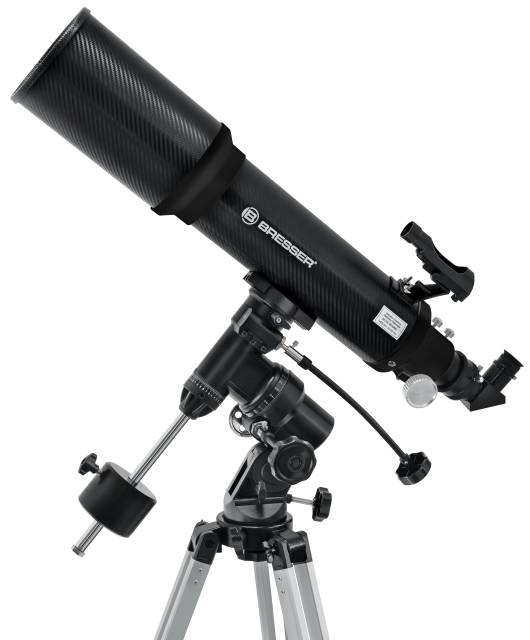
BRESSER Polaris-II 102/600 EQ3 Telescopes
BRESSER Polaris-II 102/600 EQ3 Telescopes
In stock
Couldn't load pickup availability
AR-102mm lens telescope
- Complete set of telescope, tripod, mount and accessories.
- Easy to Use Refractor Telescope for Beginners
- Telescope aperture: 102 mm / Focal length: 600 mm
- All-terrain telescope that observes the Moon, Sun, planets and deep sky objects
- Easy to carry and suitable as a travel telescope
- Many accessories for an immediate start.
- With secure opening solar filter
- Astrophotos with smartphone possible
With the included smartphone camera adapter, you can take pictures of your observations directly through the telescope's eyepiece.
Moon, planets, stars: the BRESSER Polaris-II 102/600 EQ3 lens telescope brings beginners much closer to the beauties of the universe. The complete set comes with everything you need to admire the night sky: the astronomical lens telescope with 102 mm aperture and 600 mm focal length, the equatorial mount, the tripod and a wide range of accessories for exciting astronomical observations. Explore the fascinating surface of the moon and marvel at the view of the planets. But you can go even further, because the basic telescope also shows you star clusters and gas nebulae in the deep sky range. The operation is very easy, so you will have a successful start in astronomy in no time.
Introduction to astronomy with a classic: the telescope
Effortless Handling, Stunning Images: As an easy-to-use Fraunhofer-type achromatic refractor, this classic lens telescope is the perfect first telescope for beginners and children. Thanks to its modern, precision-coated optics, it also offers good imaging properties.
The 102mm aperture already collects a lot of light from celestial objects. Additionally, the 102mm aperture and 600mm focal length result in an average focal ratio (ratio of aperture to focal length) of approximately 1 to 6 ( F/6 ). Due to this average focal ratio, the beginner's telescope is an all-rounder for all celestial objects. So notice interesting details about the moon and planets at high magnifications. Or choose medium to low magnification and admire the view of open star clusters like the Pleiades, globular clusters like M13, or gas nebulae like the Orion Nebula M42.
Speaking of magnification: How big will celestial objects appear through this beginner's telescope? The 102mm aperture achieves resolving power that easily allows magnifications up to approximately 200x with sharp images . Technically, the telescope can do more. However, as you increase the magnification, images may become blurry. And the telescope is not the only factor that determines the possible degree of magnification. Air turbulence in the atmosphere (observation conditions) also plays an important role.
Solid foundation for your celestial exploration: mount and tripod
Did you find the perfect viewing spot? Next, install the telescope on the height-adjustable aluminum tripod with equatorial mount. The advantage of equatorial mounts: unlike an azimuthal mount, you don't have to move both axes at the same time. Instead, one axis simply aligns parallel to the Earth's axis at first. In this so-called alignment, you point the axis in the direction of the North Star. After that, you can track celestial bodies only on this axis.
Another benefit of this mount: you move the axes via two flexible shafts with fine adjustment. Perfect for delicate and comfortable adjustment and tracking of the basic telescope. To make sure your accessories are always within reach during fascinating discoveries, there is an additional storage plate between the tripod legs.
Everything for your first steps in stargazing: the accessories
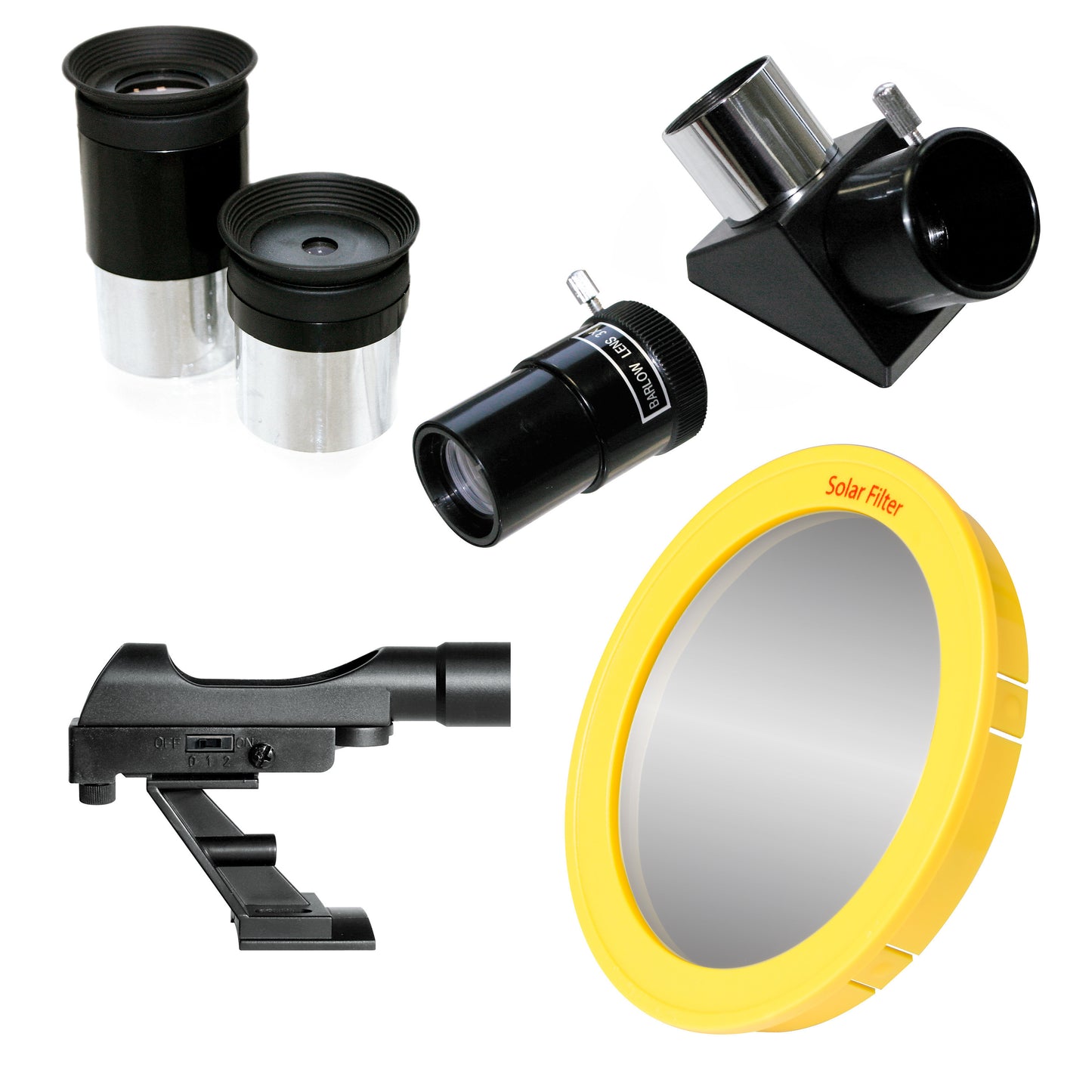
The astronomy set contains many accessories so you can immediately embark on your journey of discovery of the night sky. Use the LED finderscope to precisely align your beginner's telescope to find celestial objects more easily. Simply install the parallel direction finder on your telescope. It projects a red dot onto a small frosted glass screen that appears to be floating in front of the sky when you look through it. Since your telescope's aperture points in exactly the same direction, this helps you keep track of the night sky.
Two eyepieces (K-20mm, K-4mm) are included so you can admire celestial bodies at two different magnifications. Still not enough for you? Then simply triple the magnification of the eyepieces with the 3x Barlow lens . And if you ever want to change the perspective during your astronomical observations, the standard 1.25-inch (31.7 mm) tube diameter gives you a wide variety of additional eyepieces available.
The 90-degree star diagonal mirror , on the other hand, provides more convenience and a comfortable view. Even if your entry-level telescope points vertically upward, you can simply look from the side.
Discover the wonderful world of astronomy with the BRESSER Polaris-II 102/600 EQ3 lens telescope .
CHARACTERISTICS
- Beginner's telescope with 102mm aperture and 600mm focal length
- Fraunhofer type achromatic refractor
- Good for observing the Moon and planets, as well as deep sky objects such as star clusters and gas nebulae.
- Height-adjustable tripod with EQ3 equatorial mount
- Easy to use, very good for beginners.
- Objective solar filter for solar observation included
- Smartphone holder for photography through the telescope
- Focal ratio F/6, therefore well usable in all magnification ranges
- 50.8 mm (2 in) focuser with adapter to 31.7 mm (1.25 in)
- Two eyepieces and a Barlow lens with 31.7 mm (1.25 in) sockets for different magnifications
- Easy to transport and therefore very suitable as a travel telescope
SCOPE OF DELIVERY
- refractor telescope
- aluminum tripod
- EQ3 Equatorial Mount
- Eyepieces: 4mm and 20mm (1.25 inch sockets)
- 3x Barlow Lens (1.25 inch socket)
- Star diagonal mirror
- LED illuminated point finder
- Smartphone holder
- Objective solar filter
- Accessory tray
- Astronomy software to download.
- Manual
SPECIFICATIONS
| SCOPE | |
|---|---|
| Scope |
|
| TARGET AUDIENCES | |
| Target audiences | Beginners |
| PRODUCT FAMILY | |
| Product family | refractor telescope |
| OPTICAL SPECIFICATIONS | |
| Optical design | Achromatic refractor |
| Increase of | 24 |
| Increase to | 120 |
| Maximum useful magnification | 204 |
| Mirror/lens diameter | 102mm |
| Focal distance | 600mm |
| Focal ratio | 5.8 |
| Treatment type | Multi coated |
| Seeker | led red dot finder |
| GENERAL TECHNICAL DATA | |
| Material Optical tube | Aluminum |
| Color | black |
| fine movements | Manual (RA and DEC) |
| Tripod Material | Aluminum/plastic |
| Transportability | good |
| Focus system | 2" zipper focuser |
| Frame type | German/equatorial mount |
| Extended warranty (years) | 5 |


⚠️ NOTAS DE ADVERTENCIA
GAFAS PARA LA OBSERVACIÓN DE ECLIPSE
- INSTRUCCIONES: Revise antes de cada uso. No utilice ni deseche si está dañado, rasgado, perforado o separado de alguna manera del marco. No lo use con otros dispositivos ópticos. No es un juguete. Los niños deben usarlo solo bajo la supervisión de un adulto. Limítese a 3 minutos de uso continuo, con interrupciones durante varias horas. No se mueva mientras usa este producto, no conduzca un vehículo ni opere maquinaria. No lo use si tiene un ojo enfermo o después de una operación ocular.
- ADVERTENCIA: Nunca mire directamente al sol sin protección ocular especial. Siempre use gafas de eclipse al observar el eclipse solar, especialmente si una parte del sol es visible. Mirar directamente al sol puede causar daños permanentes si no se toman las precauciones adecuadas. Se debe usar protección ocular adecuada, diseñada específicamente para la observación solar, para evitar que los rayos dañinos del sol lleguen a los ojos. Deséchelo después de 3 años y no lo utilice después de ese tiempo.
OBSERVACIÓN SOLAR CON TELESCOPIO
- Nunca mire al sol a través de un ocular/telescopio sin un filtro de protección verificado. Un filtro lunar nunca puede usarse para la observación solar. El filtro lunar solo es adecuado para la observación de la luna. El filtro solar debe montarse en la apertura del telescopio, no en el ocular. De lo contrario, el rayo de luz concentrado por la óptica destruirá inmediatamente la película del filtro, lo que provocará daños oculares graves e incluso ceguera total.
- Revise el filtro solar antes de cada observación solar y asegúrese de que no esté dañado. Manténgalo frente a una fuente de luz intensa para poder detectar posibles grietas y/o agujeros. No use el telescopio para la observación solar, incluso si el filtro solar está solo ligeramente dañado. En este caso, comuníquese con el fabricante para obtener las piezas de repuesto correspondientes.
- Siempre use el filtro solar cuando observe el sol. Asegúrese de que este filtro esté colocado correctamente en el telescopio según las instrucciones. El uso del filtro solar está destinado únicamente para su uso con este telescopio.
- Revise el ajuste del filtro solar antes de cada observación solar. Si se suelta accidentalmente de la abertura del objetivo, esto puede causar daños oculares inmediatos y permanentes, e incluso ceguera.
- Si el filtro solar no puede montarse de manera suficientemente firme en el tubo, mejore el ajuste colocando varias tiras de fieltro autoadhesivas o similares entre el filtro solar y la abertura del objetivo. Nunca use el filtro solar si no puede colocarse correctamente en el telescopio. En tal caso, siempre contacte primero con nuestro servicio al cliente.
- Tenga mucho cuidado al observar el sol. Incluso una mirada corta a través de la óptica sin protección puede causar daños oculares graves e incluso ceguera total.
- Los niños, incluso con el filtro montado correctamente, no deben mirar al sol a través del telescopio. Nunca deje a los niños sin supervisión.
- Nunca deje la óptica sin supervisión. Los niños y los adultos inexpertos podrían dirigir el telescopio hacia el sol sin las precauciones adecuadas y perder la vista.
- No realice observaciones solares sin la consulta previa de un médico después de una operación ocular o cualquier otra enfermedad ocular.
- Las ondas/pliegues en la película son normales y no constituyen un defecto del producto.
- No exponga el dispositivo a altas temperaturas.
ADVERTENCIAS Y SEGURIDAD DE LAS PILAS
- NO USE pilas falsas en los productos. Use solo las pilas proporcionadas. Use la pila EXCLUSIVAMENTE para el propósito previsto.
- Guarde las pilas fuera del alcance de los niños y mascotas.
- NO USE pilas que parezcan tener la carcasa dañada, inflada o modificada. No use pilas que hayan goteado, huelan, estén hinchadas o derretidas o presenten abolladuras, óxido, grietas o rayones.
- La pila NO debe ser desmontada, aplastada, perforada, triturada ni manipulada de ninguna otra forma.
- La pila NO debe exponerse a líquidos.
- No debe intentar secar una pila mojada o húmeda con un dispositivo o fuente de calor.
- El dispositivo o la pila NO deben ser colocados cerca de una fuente de calor o bajo la luz solar directa.
- La pila NO debe tocar objetos metálicos.
- La pila NO debe ser almacenada junto a materiales peligrosos o inflamables. Guarde la pila en un lugar fresco, seco y bien ventilado.
- La pila NO debe insertarse incorrectamente al cargarla.
- La pila NO debe cargarse bajo luz solar directa ni a temperaturas extremas. Cárguela a temperatura ambiente (20 °C – 26 °C).
- Evite dejar caer la pila o el producto. Si sospecha que la pila está dañada, reemplácela.
- Nunca deje su dispositivo conectado a la corriente más de 24 horas. Deje que la pila se agote y luego recárguela.
- Para obtener los mejores resultados, reemplace las pilas según el uso después de 12 meses o antes.
- Siga las regulaciones locales para la eliminación de las pilas usadas. NO arroje la pila al fuego ni al agua.