
Explore Scientific
EXPLORE SCIENTIFIC Pop-Up Portable Observatory / telescope weather protection
EXPLORE SCIENTIFIC Pop-Up Portable Observatory / telescope weather protection
Regular price
€269,00
Regular price
Sale price
€269,00
Taxes included.
Shipping calculated at checkout.
In stock
Quantity
Couldn't load pickup availability
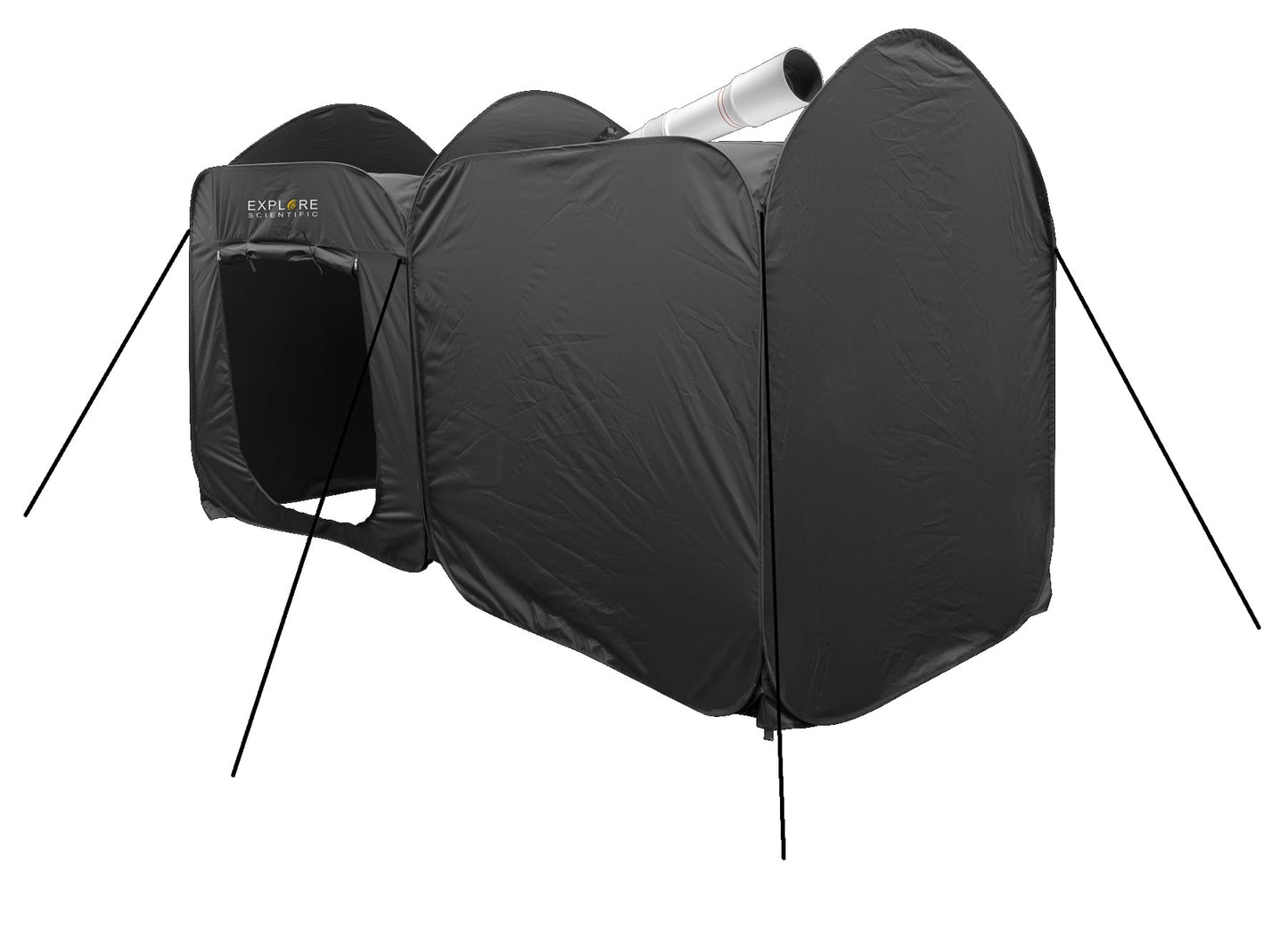
The EXPLORE SCIENTIFIC Pop-Up Two-Room Observatory is a practical weather tent that protects your valuable equipment from wind, dew, rain, and dust.
Most astronomy and astrophotography enthusiasts dream of owning an observatory to keep their telescope safe from dust, dew, and wind, and to shield the telescope's optics from stray light interference. However, due to the high cost of a roll-off roof building or an observatory dome, for many astronomers, owning an observatory remains just a dream. Added to this is the problem that a building used as an observatory requires a suitable fixed location for stargazing.
Portable, economical, and quick to set up
Good performance for a portable observatory tent. Compared to permanent versions, a tent is extremely economical and can be set up almost anywhere with a flat surface and an unobstructed view of the sky. Nevertheless, setting up a mobile observatory can be very laborious. Nobody wants to waste valuable observation time reading complicated instructions, trying to figure out where each pole goes. That's why we've used a robust "Pop Up" design. The EXPLORE SCIRE SCIENTIFIC Pop-Up Portable Observatory Tent can be set up in just a few minutes. By simply releasing the fastening strap, the tent unfolds in seconds. All you have to do is connect the two observatory rooms with a hook-and-loop seam and secure them to the ground. Thanks to this simple design, the EXPLORE SCIENTIFIC Pop-Up Portable Observatory Tent can be set up and taken down in just a few minutes, leaving you plenty of time to enjoy your astronomical weekend.
Plenty of space for your equipment and extremely compact when folded
With almost 5 square meters of total area and 1.52 meters of sidewall height, along with 1.83 meters of windbreak wall height in the EXPLORE SCIENTIFIC Pop-Up Observatory, you can set up your computer equipment in one room and the telescope in the other, or set up two complete different telescope systems. Each room measures 152 by 152 centimeters.
Compact portable observatory for transport
In addition to ease of assembly and disassembly, another advantage of the "Pop Up" design is that it can be stored easily, making it ideal for travel. The entire tent can be folded into a package 70 centimeters in diameter and 10 centimeters thick. This allows it to be transported in a small car or even on an airplane for expeditions to distant locations. And besides being able to go to your favorite observation spot at any time, portable observatories are often the preferred option for astronomers and astrophotographers when participating in stargazing events.
Modern materials offer optimal protection and are durable
The fact that the EXPLORE SCIENTIFIC Pop-Up Observatory Tent can be set up and stored easily and simply does not mean that it cannot withstand adverse weather conditions. The "Black Out" coated polyamide material is waterproof and offers excellent UV protection. This ensures reliable protection of your equipment and a long lifespan for the observatory tent.
Large doors for comfortable use
The doors for accessing the portable observatory and for moving from one room to another are very wide, measuring 102 centimeters in height and 92 centimeters in width, making it easy to enter and access your equipment. The doors can be rolled down to keep out moisture, and their heavy-duty zippers last for years.
The additional weather protection cover protects your equipment when not in use
With the large additional cover included, you can protect your equipment during the day from the heat of the sun or a sudden downpour. Or from night dew. The modern, coated, and waterproof material keeps your equipment protected from unwanted weather conditions.
The delivery includes guy lines and pegs for tensioning the tent. The structure also has attachment loops for using heavy-duty straps that can be purchased at local DIY stores.
PRODUCT VIDEO: https://youtu.be/1rL5PzPa-dQ
FEATURES
- Practical weather protection for telescopes
- Protects your equipment from wind, dew, rain, and dust
- Observatory tent: portable, quick to set up, and economical
- Compact transport dimensions, also suitable for air travel
- 5 square meters of space for your equipment and sufficient freedom of movement
- Interior dimensions: 152 x 304 cm
- Sidewall height 152 cm / Windbreak wall height 183 cm
- Large doors (102x92 cm) for comfortable use
- Includes additional weather protection cover
- Modern materials offer optimal protection and are durable
- Includes guy lines and pegs for tensioning the tent
- Includes additional attachment loops for heavy-duty straps
- Transport size and weight: diameter 70 cm, height 10 cm, 3 kg
- Tent material color: black
INCLUDES
- Two-room "Pop Up" observatory tent
- Weather protection cover
- Set of guy lines and pegs
SEGURIDAD PRODUCTOS
Fabricante: Bresser Iberia SLU | Valdemorillo, 1 - nave B | 28925 Alcorcón ESPAÑA | https://www.bresser-iberia.es/
⚠️ NOTAS DE ADVERTENCIA
GAFAS PARA LA OBSERVACIÓN DE ECLIPSE
- INSTRUCCIONES: Revise antes de cada uso. No utilice ni deseche si está dañado, rasgado, perforado o separado de alguna manera del marco. No lo use con otros dispositivos ópticos. No es un juguete. Los niños deben usarlo solo bajo la supervisión de un adulto. Limítese a 3 minutos de uso continuo, con interrupciones durante varias horas. No se mueva mientras usa este producto, no conduzca un vehículo ni opere maquinaria. No lo use si tiene un ojo enfermo o después de una operación ocular.
- ADVERTENCIA: Nunca mire directamente al sol sin protección ocular especial. Siempre use gafas de eclipse al observar el eclipse solar, especialmente si una parte del sol es visible. Mirar directamente al sol puede causar daños permanentes si no se toman las precauciones adecuadas. Se debe usar protección ocular adecuada, diseñada específicamente para la observación solar, para evitar que los rayos dañinos del sol lleguen a los ojos. Deséchelo después de 3 años y no lo utilice después de ese tiempo.
OBSERVACIÓN SOLAR CON TELESCOPIO
- Nunca mire al sol a través de un ocular/telescopio sin un filtro de protección verificado. Un filtro lunar nunca puede usarse para la observación solar. El filtro lunar solo es adecuado para la observación de la luna. El filtro solar debe montarse en la apertura del telescopio, no en el ocular. De lo contrario, el rayo de luz concentrado por la óptica destruirá inmediatamente la película del filtro, lo que provocará daños oculares graves e incluso ceguera total.
- Revise el filtro solar antes de cada observación solar y asegúrese de que no esté dañado. Manténgalo frente a una fuente de luz intensa para poder detectar posibles grietas y/o agujeros. No use el telescopio para la observación solar, incluso si el filtro solar está solo ligeramente dañado. En este caso, comuníquese con el fabricante para obtener las piezas de repuesto correspondientes.
- Siempre use el filtro solar cuando observe el sol. Asegúrese de que este filtro esté colocado correctamente en el telescopio según las instrucciones. El uso del filtro solar está destinado únicamente para su uso con este telescopio.
- Revise el ajuste del filtro solar antes de cada observación solar. Si se suelta accidentalmente de la abertura del objetivo, esto puede causar daños oculares inmediatos y permanentes, e incluso ceguera.
- Si el filtro solar no puede montarse de manera suficientemente firme en el tubo, mejore el ajuste colocando varias tiras de fieltro autoadhesivas o similares entre el filtro solar y la abertura del objetivo. Nunca use el filtro solar si no puede colocarse correctamente en el telescopio. En tal caso, siempre contacte primero con nuestro servicio al cliente.
- Tenga mucho cuidado al observar el sol. Incluso una mirada corta a través de la óptica sin protección puede causar daños oculares graves e incluso ceguera total.
- Los niños, incluso con el filtro montado correctamente, no deben mirar al sol a través del telescopio. Nunca deje a los niños sin supervisión.
- Nunca deje la óptica sin supervisión. Los niños y los adultos inexpertos podrían dirigir el telescopio hacia el sol sin las precauciones adecuadas y perder la vista.
- No realice observaciones solares sin la consulta previa de un médico después de una operación ocular o cualquier otra enfermedad ocular.
- Las ondas/pliegues en la película son normales y no constituyen un defecto del producto.
- No exponga el dispositivo a altas temperaturas.
ADVERTENCIAS Y SEGURIDAD DE LAS PILAS
- NO USE pilas falsas en los productos. Use solo las pilas proporcionadas. Use la pila EXCLUSIVAMENTE para el propósito previsto.
- Guarde las pilas fuera del alcance de los niños y mascotas.
- NO USE pilas que parezcan tener la carcasa dañada, inflada o modificada. No use pilas que hayan goteado, huelan, estén hinchadas o derretidas o presenten abolladuras, óxido, grietas o rayones.
- La pila NO debe ser desmontada, aplastada, perforada, triturada ni manipulada de ninguna otra forma.
- La pila NO debe exponerse a líquidos.
- No debe intentar secar una pila mojada o húmeda con un dispositivo o fuente de calor.
- El dispositivo o la pila NO deben ser colocados cerca de una fuente de calor o bajo la luz solar directa.
- La pila NO debe tocar objetos metálicos.
- La pila NO debe ser almacenada junto a materiales peligrosos o inflamables. Guarde la pila en un lugar fresco, seco y bien ventilado.
- La pila NO debe insertarse incorrectamente al cargarla.
- La pila NO debe cargarse bajo luz solar directa ni a temperaturas extremas. Cárguela a temperatura ambiente (20 °C – 26 °C).
- Evite dejar caer la pila o el producto. Si sospecha que la pila está dañada, reemplácela.
- Nunca deje su dispositivo conectado a la corriente más de 24 horas. Deje que la pila se agote y luego recárguela.
- Para obtener los mejores resultados, reemplace las pilas según el uso después de 12 meses o antes.
- Siga las regulaciones locales para la eliminación de las pilas usadas. NO arroje la pila al fuego ni al agua.