
October 2026 astronomical events: what to watch for in the sky
October 2026 brings excellent opportunities to enjoy astronomy from the Northern Hemisphere. The opposition of Saturn, several conjunctions of the Moon with bright planets and stars, Mercury's maximum elongation, and the peak of the Orionids make this one of the most interesting months of autumn.
In addition, the nights are getting longer, offering better conditions for taking out the telescope or simply observing the sky with binoculars.
In this guide, we review the main dates worth marking on the calendar.
October 3: Moon in last quarter
The month begins with the Moon reaching its last quarter on October 3.
During the following days, its illumination will gradually decrease, providing better conditions for observing deep-sky objects during the first part of the night.
It is a good time to look for star clusters, nebulae, and galaxies from places away from light pollution.
October 4: Saturn in opposition
One of the major astronomical events of the month.
On October 4, Saturn reaches opposition, positioning itself approximately opposite the Sun as seen from Earth.
This means that the planet will rise approximately at dusk, remain visible practically all night, and reach its highest point around midnight.
In addition, during the dates around opposition, Saturn is especially well positioned for observation.

Saturn in opposition. Stellerium Software simulation, October 4, 2026.
What will we be able to see?
To the naked eye, Saturn will appear as a bright point with a yellowish hue.
However, with a telescope, the experience changes completely. Even with small-aperture instruments, it is possible to clearly distinguish its ring system.
With larger apertures and good atmospheric conditions, we will also be able to observe more subtle details and some of its main satellites, especially Titan.
For planetary observation, it is recommended to use medium or high magnification, always adapting it to the atmospheric stability of each night.
October 4: the Moon near Pollux
During the early morning of October 4, the waning Moon will appear close to Pollux, one of the main stars of the constellation Gemini.
Both objects will be separated by approximately 3.7°.
It will be a beautiful conjunction to observe with the naked eye or through wide-field binoculars.
October 5: the Moon near Mars
The following morning, we will have another interesting encounter.
On October 5, the waning Moon will pass within just over 1° of Mars, offering a very close conjunction.
Mars' characteristic reddish hue will make it easier to identify next to the waxing Moon.
Both objects can be perfectly observed with the naked eye, although binoculars will allow you to frame them together in greater detail.
October 5: the Moon next to the Beehive Cluster
That same morning, the Moon will cross a particularly interesting region of the constellation Cancer and pass very close to the Beehive Cluster (M44).
Also known as Praesepe, M44 is one of the best-known open clusters in the sky.
In dark places, it can even be perceived with the naked eye as a small diffuse patch, but binoculars allow you to easily resolve numerous stars.
The proximity of the Moon will make it difficult to observe its fainter components, although the conjunction will offer an attractive field for binoculars.
October 6: spectacular encounter between the Moon and Jupiter
On October 6, a thin waning Moon will pass extraordinarily close to Jupiter.
The apparent separation will be just a few arcminutes at the moment of closest approach.
It will be one of the most visually striking encounters of the month.
From certain regions of the planet, a occultation of Jupiter by the Moon will also occur. In Spain, the phenomenon will be especially interesting from the Canary Islands, where the occultation can be observed.
For the rest of observers, the conjunction will continue to offer an excellent opportunity to contemplate both objects very close in the sky.

Conjunction of the Moon with Jupiter simulated from Spain (mainland) at 06:30 AM mainland time. Credit: Stellarium software
October 7: the Moon near Regulus
Continuing its journey through the morning sky, on October 7, the Moon will pass near Regulus, the brightest star in the constellation Leo.
The separation will be approximately half a degree, comparable to the apparent diameter of the Moon itself.
It will be an especially attractive conjunction with binoculars.
October 10: New Moon
The New Moon will take place on October 10, providing one of the best periods of the month for deep-sky observation.
The nights around this date will be especially interesting for observing from dark skies:
- galaxies;
- nebulae;
- open clusters;
- globular clusters;
- and faint objects that require little light pollution.
If you have a medium-aperture reflector telescope or some astronomical binoculars, the nights around the New Moon are the ones to reserve for an observation outing.
October 12: Mercury reaches its maximum eastern elongation
Mercury is one of the hardest planets to observe due to its apparent proximity to the Sun.
On October 12, it will reach an eastern elongation of approximately 25°, that is, its maximum apparent separation from the Sun during this evening appearance.
Therefore, we will have a good opportunity to try to locate it after Sunset.
It will have to be searched very low above the western horizon, preferably from a completely clear place.
Binoculars can greatly facilitate its location during twilight.
Important: we should never use binoculars or telescopes to look for Mercury while the Sun remains above the horizon. Accidental observation of the Sun without a proper filter can cause serious eye injuries.
October 12: Moon, Mercury, and Venus
The evening of October 12 will also offer an interesting celestial composition.
An extremely thin waxing Moon will appear in the same region of the sky as Mercury, while Venus will stand out for its intense brightness.
The Moon will have only a few days since the new phase, so locating it near the horizon can be complicated.
To observe this encounter, it will be essential to have a clear west-southwest horizon.

The planet Mercury is extremely difficult to observe. You can try to observe it with binoculars or a telescope right after sunset. The image shows its location at 18:30h (Spanish mainland time) through a simulation in Stellarium.
October 14: the Moon near Antares
On October 14, the waxing Moon will pass very close to Antares, the bright reddish star that marks the heart of Scorpio.
The apparent separation will reach less than half a degree.
Antares is a red supergiant and one of the most recognizable stars in the sky. Its intense orange-red color creates a beautiful contrast with the Moon.
It will be an excellent target to observe with the naked eye or through binoculars.
October 18: first quarter
On October 18, the Moon will reach its first quarter.
This phase is especially recommended for lunar observation with a telescope.
The area near the terminator —the boundary between the illuminated part and the dark part of the lunar surface— presents long shadows that allow you to appreciate craters, mountains, and other structures with great contrast.
We do not need a large telescope: even a small refractor allows you to perform spectacular lunar observations.
October 21: peak of the Orionids
The early morning of October 21 will bring the peak of activity of the Orionids, one of the best-known meteor showers of autumn.
In ideal conditions, around 20 meteors per hour can occur, although the actually observable amount will depend on the darkness of the sky, the position of the radiant, and the atmospheric conditions.
The Orionids are related to the famous comet 1P/Halley. Every year, Earth passes through particles left along its orbit, and some penetrate our atmosphere at high speed, producing the characteristic meteors.
How to observe the Orionids?
We do not need a telescope or binoculars.
The best thing is to go to a dark place, away from city lights, let our eyes adapt for about 20 or 30 minutes, and observe a wide area of the sky.
The radiant is located in the region of Orion, but it is not necessary to look directly at it. In fact, meteors usually show longer streaks at a certain distance from the radiant.
The second half of the early morning will generally offer better conditions as Orion gets higher and higher in the sky.
October 23: the Moon near Neptune
On October 23, the Moon, already very illuminated, will pass relatively close to Neptune.
Unlike the brighter planets, Neptune cannot be observed with the naked eye.
To identify it, we will need at least good binoculars under suitable conditions, although a telescope will be much more recommended.
Due to the intense lunar illumination, this will not exactly be the best night of the month to study Neptune, but it can serve as a reference to approximately locate the region of the sky where it is found.
October 26: full Moon — Hunter's Moon
On October 26, we will have a full Moon.
Traditionally, the first full Moon after the Harvest Moon is named the Hunter's Moon.
During this phase, practically the entire visible face of our satellite is directly illuminated by the Sun.
Although it is spectacular with the naked eye, the full Moon is not necessarily the best phase to observe details of its surface through a telescope. Frontal illumination reduces shadows and, with them, the contrast of many geographical features.
To study craters and mountains, the waxing and waning phases are generally preferable.
October 28: the Moon near Uranus
During the night of October 28, the Moon will be close to Uranus in the region of Taurus.
Uranus can reach magnitudes close to the limit of human eye perception under extraordinarily dark skies, but for practical observation, it is much better to use binoculars or a telescope.
With enough magnification, it will appear as a small disk with a blue-green hue, distinguishing itself from the surrounding stars.
October 28: the Moon next to the Pleiades
That same night we will have one of the most photogenic encounters of the month.
The Moon will pass within less than 1° of the Pleiades (M45), one of the best-known open star clusters in the sky.
The Pleiades can be perfectly observed with the naked eye from moderately dark skies and are spectacular through binoculars.
The high lunar illumination will hide some of the fainter stars of the cluster, but the proximity between both objects will offer a particularly attractive composition.

The image shows the sky of October 29 at 0h (Spanish mainland time). The square shows the location of the Pleiades, between Aldebaran and the Pleiades you can observe the planet Uranus with the help of telescopes with high magnification. Stellarium Software.
October 31: the Moon meets Pollux again
October will end in a similar way to how it began.
On October 31, the Moon will pass near Pollux again, in Gemini, with an approximate separation of 4°.
It will be a simple target to observe with the naked eye during the last nights of the month.
The best nights of October 2026 for observing
If we had to point out some especially interesting dates to prepare the telescope or perform an astronomical outing, October offers several outstanding opportunities.
October 4 — Saturn in opposition: one of the best nights of all 2026 to observe the planet of the rings.
October 6 — Moon and Jupiter: extremely close conjunction and occultation observable from certain regions, including the Canary Islands.
Around October 10 — New Moon: the best period of the month to look for deep-sky objects.
October 12 — Mercury: good opportunity to locate the elusive planet during the evening twilight.
October 21 — Orionids: one of the characteristic meteor showers of autumn.
October 28 — Moon and Pleiades: one of the most visually attractive encounters of the month.
What equipment to use to observe the sky in October?
Not all astronomical events need the same instrument.
For the Orionids and the great conjunctions, our own eyes are generally the best tool, as they allow you to cover a large area of the sky.
A pair of 7x50 binoculars, 10x50 or similar are excellent for scanning large star fields, observing the Pleiades, M44, and enjoying the lunar conjunctions.
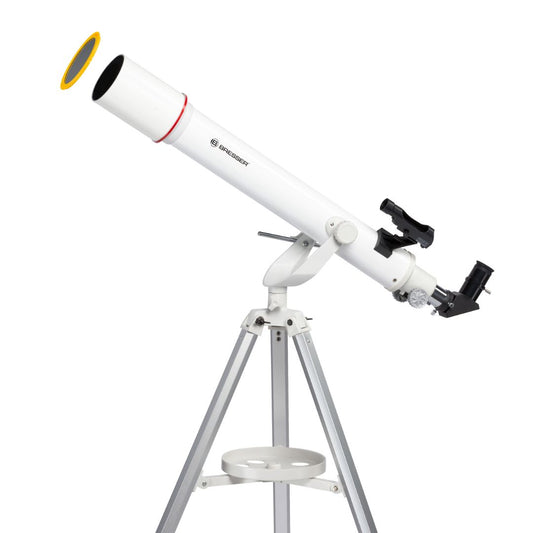
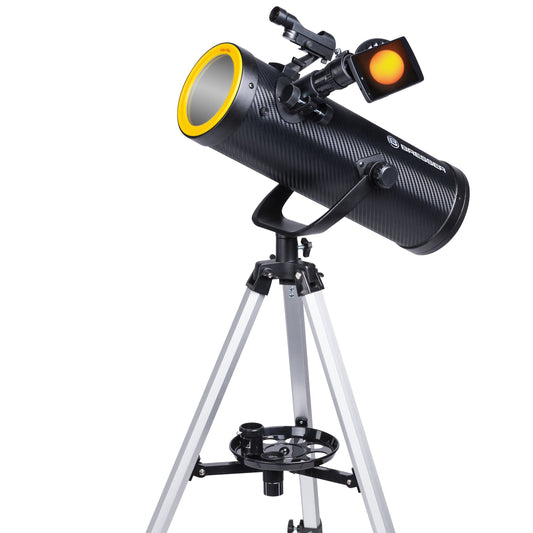
To observe Saturn, Jupiter, and the Moon, an astronomical telescope will allow you to appreciate many more details. Saturn will be especially recommended throughout the month thanks to its proximity to opposition.
And for those who want to take advantage of the nights near the new moon to explore nebulae, clusters, and galaxies, a telescope with a larger aperture will allow you to capture much fainter objects.
October 2026 brings together practically all types of astronomical observation: planets, the Moon, bright stars, clusters, and meteors.
All that remains is to wait for clear skies.
Astro Telescopios Tip: before each session, check the weather forecast, let the telescope reach room temperature, and plan the objects you want to observe in advance. Good preparation can make as much difference as the equipment itself.