
Protect your eyes during the solar eclipse
The upcoming eclipse on August 12 is a unique opportunity to observe one of the greatest astronomical spectacles visible to the naked eye. However, it can also be a source of serious problems if adequate precautions are not taken. This is what we need to keep in mind:
The Danger of Staring at the Sun
Looking directly at the Sun—whether during an eclipse or under normal conditions—can cause severe and irreversible eye damage, including blindness. The retina can burn without producing any pain, so the damage may go unnoticed at the time. This warning applies to the uneclipsed Sun as well as to the partially eclipsed Sun or an annular eclipse: even 1% of the visible solar surface emits enough radiation to permanently damage the eye's light receptors.
Symptoms of solar retinopathy—the eye injury caused by sun exposure—may not appear at the moment but hours or even days later. These include blurred vision, visual distortion, and the appearance of a central blind spot (scotoma) that makes everyday activities like reading difficult. In the most severe cases, exposure can lead to a macular hole requiring surgical intervention. Repeatedly looking for even a few seconds without protection can accumulate damage.
What Glasses to Use
The only glasses suitable for direct solar observation are those certified with the standard EN ISO 12312-2:2015, specifically for direct solar observation. This standard is different from ISO 12312-1 (ordinary sunglasses) and is the only one valid for this purpose. The glasses must reduce visible radiation by a minimum factor of 30,000 (allowing a maximum of 0.0032 % of light to pass through) and effectively block both ultraviolet and infrared radiation. Additionally, if marketed in the European Union, they must bear the CE mark, backed by laboratory tests.
How to Check if Glasses Are Safe
- The CE mark must be visible, legible, and indelible, and backed by laboratory tests, not just printed.
- The labeling must include the manufacturer's name, usage instructions, warnings, and, if applicable, an expiration date (expiration dates are 3 years after manufacturing).
- Physically examine the filter: it must not have scratches, lighter areas, creases, perforations, or any defects.
- Look for the inscription "EN ISO 12312-2:2015" on the glasses, their packaging, or instructions. If it only states "ISO 12312-1," they are not suitable.
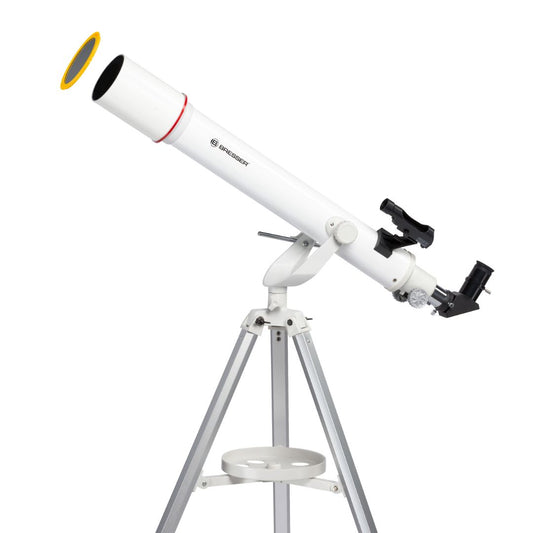
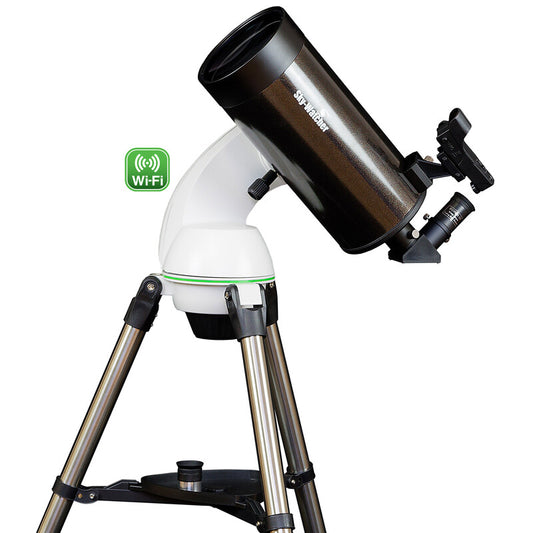
- See below for glasses recommended by Astro Telescopios for this type of observation. Here you can buy certified solar eclipse glasses and here you can buy solar filters for telescopes.
- Test them beforehand by looking at them against the light or in front of an incandescent bulb to detect defects.
How to Use Them Correctly
- Put them on before looking at the Sun and only take them off after looking away.
- Look briefly (a few seconds) and take breaks between observations.
- Do not use them if they are scratched, broken, perforated, bent, or deteriorated.
- Supervise correct use by children and dependents.
When to Take Off Glasses, Depending on the Type of Eclipse
Total Eclipses (2026 and 2027): It is safe to take off the glasses only during the minutes of absolute totality, when the Moon covers 100% of the Sun and it becomes dark. As soon as the first ray of light (the "diamond ring") appears, you must protect yourself again immediately. It is most advisable to keep them on at all times. In regions where the eclipse is only partial, it is never safe to observe the Sun without glasses.
Annular Eclipse (2028): It is NEVER safe to look without glasses. Even at the maximum moment of the eclipse (the "ring of fire"), the Sun still emits enough direct sunlight to damage eyesight. Glasses must be kept on at all times.
In any case, it is most advisable to keep them on at all times while observing the Sun. It is not recommended to do so for continuous periods longer than 3 minutes, even with safe glasses.
Filters and Homemade Methods: What to Use
Common sunglasses, smoked glass, X-rays, CDs, photographic films, cheap filters for binoculars or telescopes, and other homemade methods are completely inadvisable. None block radiation in the necessary range and quantity to protect the eye.
Optical Instruments: Extreme Danger
Never look at the Sun through binoculars, telescopes, or cameras without a professional solar filter placed on the front part (objective lens) of the device, never behind the eyepiece. The latter is a frequent and extremely dangerous mistake: the optics concentrate light and heat in such a way that they can melt the glasses and instantly burn the eye.
Sources: National Geographic Institute