
MAGUS
MAGUS Epi-FL06 Epifluorescence attachment, mercury lamp, B/G/UV/V/R/FITC/TRITC/DAPI fluorescence filter cubes
MAGUS Epi-FL06 Epifluorescence attachment, mercury lamp, B/G/UV/V/R/FITC/TRITC/DAPI fluorescence filter cubes
Low stock
Couldn't load pickup availability
MAGUS Epi-FL06 Epifluorescence attachment, mercury lamp, B/G/UV/V/R/FITC/TRITC/DAPI fluorescence filter cubes
For fluorescence observations
The epifluorescence attachment is used to employ the fluorescence technique.
The fluorescence technique is based on the ability of substances to emit light when exposed to light of a certain wavelength. Some samples exhibit autofluorescence, while others must be treated with fluorochromes.
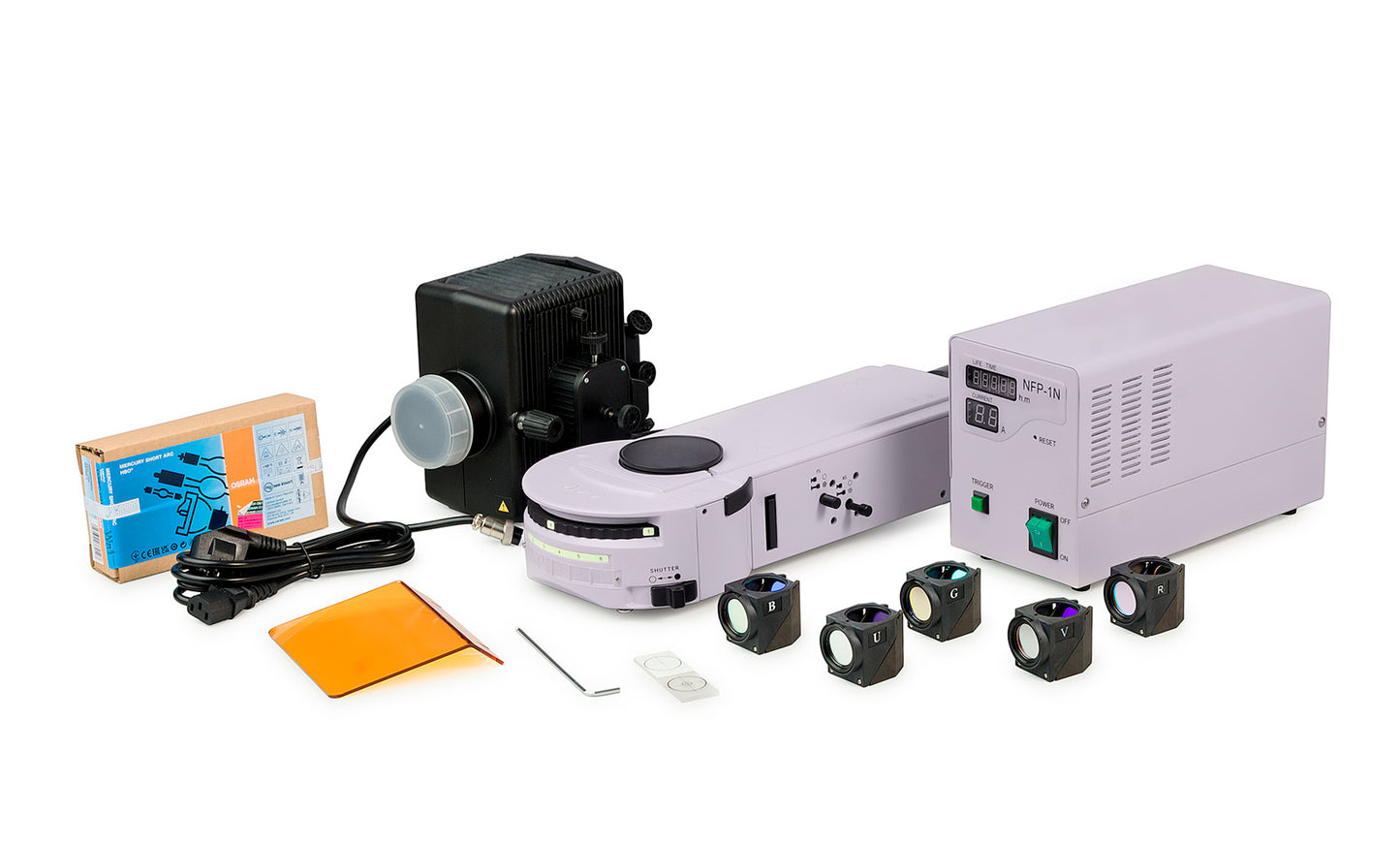
The attachment is installed in the optical path, between the microscope head and the stand. The attachment has a 6-position revolving nosepiece with fluorescence filters. Five fluorescence filter cubes can be installed on the nosepiece simultaneously (user-selectable). The required filter is introduced into the optical path by rotating the ring. One position of the nosepiece corresponds to brightfield observations. The side knobs are used to adjust the aperture of the field and aperture diaphragms. The set of fluorescence filter cubes includes filters for different fluorescence wavelengths: wideband blue (B), green (G), ultraviolet (UV), violet (V), narrowband red (R), and narrowband filters for DAPI, FITC, and TRITC fluorochromes.
The fluorescence excitation source is a mercury lamp. It has high brightness and a wide range of wavelengths. The lamp's spectrum is peak-like, which allows working with various fluorescent dyes. The mercury lamp is located in the lamphouse. The lamp housing dissipates heat, and the lamp does not overheat.
To use the fluorescence technique, use the MAGUS Epi-FL06 attachment in conjunction with the MAGUS PlanF S-Apo fluorescence objective set. The semi-apochromatic plan fluorescence objective improves the microscope's resolution and reduces chromatic and spherical aberrations. The image in the eyepieces and through the digital camera is sharper, has higher contrast, and is brighter than with a conventional achromatic plan objective.
The high numerical aperture of fluorescent objectives improves the microscope's resolution, but at the same time reduces the depth of field. Therefore, for observations with transmitted light, we recommend using regular objectives from the microscope set with a greater depth of field.
Compatibility:
MAGUS Bio 290T biological microscope
Package:
Epifluorescence attachment
B/G/UV/V/R/FITC/TRITC/DAPI fluorescence filter cubes
Mercury lamp with power supply
Protective screen for UV light
Specifications:
Excitation light source: mercury lamp
Fluorescence filters: filter type, excitation wavelength/dichroic mirror/emission wavelength: blue (B), 460–495 nm / 505 nm / 510 nm; green (G), 510–550 nm / 570 nm / 575 nm; ultraviolet (UV), 330–385 nm / 410 nm / 420 nm; violet (V), 400–410 nm / 455 nm / 460 nm; red (R), 620–650 nm / 660 nm / 670–750 nm
Fluorescence filters: fluorochrome, excitation wavelength/dichroic mirror/emission wavelength: DAPI, 360–390 nm / 415 nm / 435–485 nm; FITC, 460–495 nm / 505 nm / 510–550 nm; TRITC, 528–553 nm / 565 nm / 578–633 nm
⚠️ NOTAS DE ADVERTENCIA
GAFAS PARA LA OBSERVACIÓN DE ECLIPSE
- INSTRUCCIONES: Revise antes de cada uso. No utilice ni deseche si está dañado, rasgado, perforado o separado de alguna manera del marco. No lo use con otros dispositivos ópticos. No es un juguete. Los niños deben usarlo solo bajo la supervisión de un adulto. Limítese a 3 minutos de uso continuo, con interrupciones durante varias horas. No se mueva mientras usa este producto, no conduzca un vehículo ni opere maquinaria. No lo use si tiene un ojo enfermo o después de una operación ocular.
- ADVERTENCIA: Nunca mire directamente al sol sin protección ocular especial. Siempre use gafas de eclipse al observar el eclipse solar, especialmente si una parte del sol es visible. Mirar directamente al sol puede causar daños permanentes si no se toman las precauciones adecuadas. Se debe usar protección ocular adecuada, diseñada específicamente para la observación solar, para evitar que los rayos dañinos del sol lleguen a los ojos. Deséchelo después de 3 años y no lo utilice después de ese tiempo.
OBSERVACIÓN SOLAR CON TELESCOPIO
- Nunca mire al sol a través de un ocular/telescopio sin un filtro de protección verificado. Un filtro lunar nunca puede usarse para la observación solar. El filtro lunar solo es adecuado para la observación de la luna. El filtro solar debe montarse en la apertura del telescopio, no en el ocular. De lo contrario, el rayo de luz concentrado por la óptica destruirá inmediatamente la película del filtro, lo que provocará daños oculares graves e incluso ceguera total.
- Revise el filtro solar antes de cada observación solar y asegúrese de que no esté dañado. Manténgalo frente a una fuente de luz intensa para poder detectar posibles grietas y/o agujeros. No use el telescopio para la observación solar, incluso si el filtro solar está solo ligeramente dañado. En este caso, comuníquese con el fabricante para obtener las piezas de repuesto correspondientes.
- Siempre use el filtro solar cuando observe el sol. Asegúrese de que este filtro esté colocado correctamente en el telescopio según las instrucciones. El uso del filtro solar está destinado únicamente para su uso con este telescopio.
- Revise el ajuste del filtro solar antes de cada observación solar. Si se suelta accidentalmente de la abertura del objetivo, esto puede causar daños oculares inmediatos y permanentes, e incluso ceguera.
- Si el filtro solar no puede montarse de manera suficientemente firme en el tubo, mejore el ajuste colocando varias tiras de fieltro autoadhesivas o similares entre el filtro solar y la abertura del objetivo. Nunca use el filtro solar si no puede colocarse correctamente en el telescopio. En tal caso, siempre contacte primero con nuestro servicio al cliente.
- Tenga mucho cuidado al observar el sol. Incluso una mirada corta a través de la óptica sin protección puede causar daños oculares graves e incluso ceguera total.
- Los niños, incluso con el filtro montado correctamente, no deben mirar al sol a través del telescopio. Nunca deje a los niños sin supervisión.
- Nunca deje la óptica sin supervisión. Los niños y los adultos inexpertos podrían dirigir el telescopio hacia el sol sin las precauciones adecuadas y perder la vista.
- No realice observaciones solares sin la consulta previa de un médico después de una operación ocular o cualquier otra enfermedad ocular.
- Las ondas/pliegues en la película son normales y no constituyen un defecto del producto.
- No exponga el dispositivo a altas temperaturas.
ADVERTENCIAS Y SEGURIDAD DE LAS PILAS
- NO USE pilas falsas en los productos. Use solo las pilas proporcionadas. Use la pila EXCLUSIVAMENTE para el propósito previsto.
- Guarde las pilas fuera del alcance de los niños y mascotas.
- NO USE pilas que parezcan tener la carcasa dañada, inflada o modificada. No use pilas que hayan goteado, huelan, estén hinchadas o derretidas o presenten abolladuras, óxido, grietas o rayones.
- La pila NO debe ser desmontada, aplastada, perforada, triturada ni manipulada de ninguna otra forma.
- La pila NO debe exponerse a líquidos.
- No debe intentar secar una pila mojada o húmeda con un dispositivo o fuente de calor.
- El dispositivo o la pila NO deben ser colocados cerca de una fuente de calor o bajo la luz solar directa.
- La pila NO debe tocar objetos metálicos.
- La pila NO debe ser almacenada junto a materiales peligrosos o inflamables. Guarde la pila en un lugar fresco, seco y bien ventilado.
- La pila NO debe insertarse incorrectamente al cargarla.
- La pila NO debe cargarse bajo luz solar directa ni a temperaturas extremas. Cárguela a temperatura ambiente (20 °C – 26 °C).
- Evite dejar caer la pila o el producto. Si sospecha que la pila está dañada, reemplácela.
- Nunca deje su dispositivo conectado a la corriente más de 24 horas. Deje que la pila se agote y luego recárguela.
- Para obtener los mejores resultados, reemplace las pilas según el uso después de 12 meses o antes.
- Siga las regulaciones locales para la eliminación de las pilas usadas. NO arroje la pila al fuego ni al agua.