
MAGUS
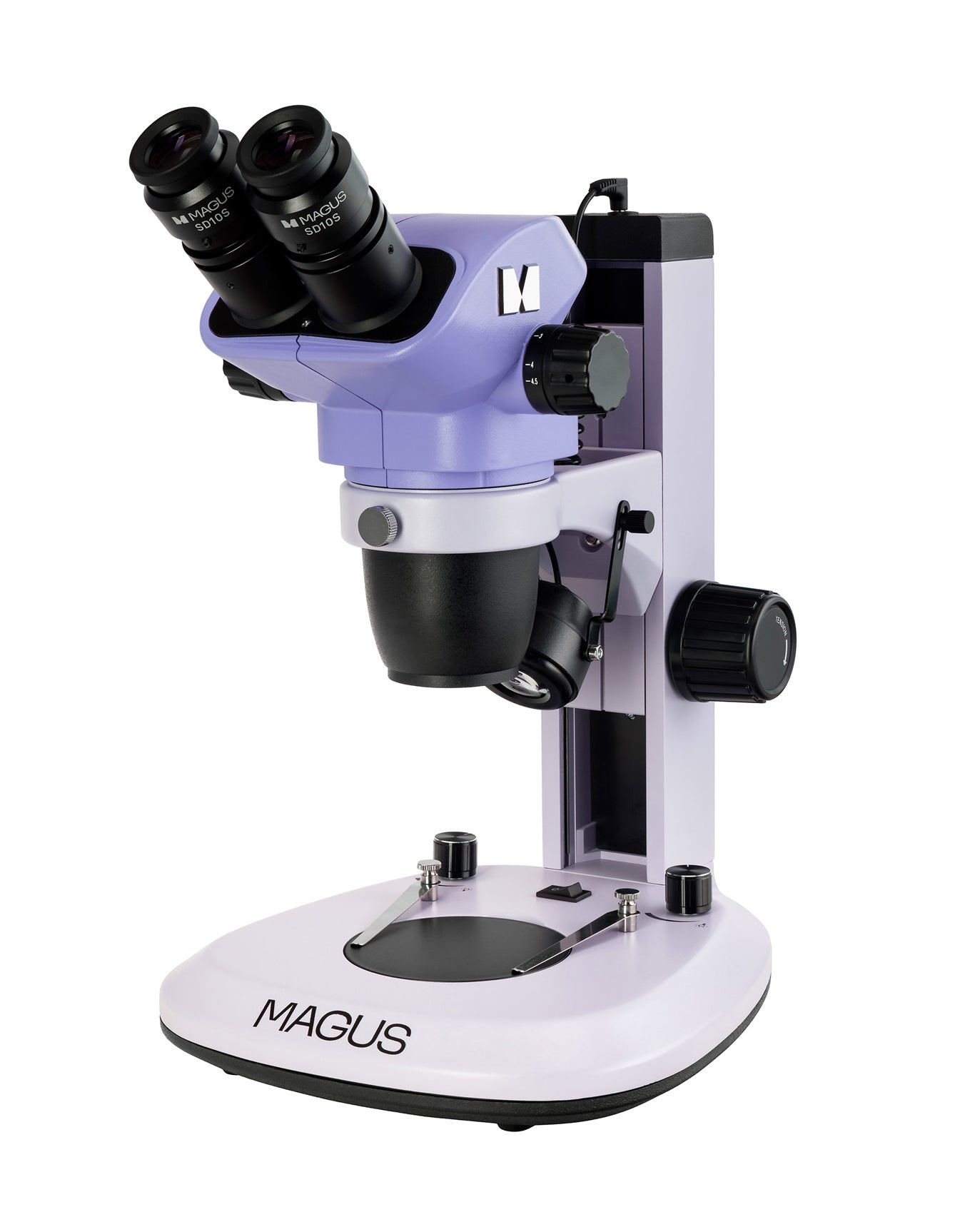
MAGUS Stereo 7B Stereomicroscope
MAGUS Stereo 7B Stereomicroscope
In stock
Couldn't load pickup availability
A stereoscopic microscope is an indispensable tool for detailed study of volumetric samples. It reproduces the virtual volume of an object and allows its structure to be examined, thus providing a clear picture of its topography. The device is equipped with transmitted and reflected light illuminators and allows working with both transparent and opaque samples. Polarized light and darkfield methods are available.
The advantages of the Greenough optical system are the large depth of field and the three-dimensionality of the image thanks to the 15° stereoscopic angle. A stereoscopic microscope magnifies an object and accurately transmits its position in space: the image is formed without inversion. This makes the microscope an ideal tool for manipulating objects within a working area of 105 to 177 millimeters. Stereoscopic microscopes or stereo microscopes are widely used for quality control in restoration, assembly, soldering, jewelry, and similar processes.
The MAGUS Stereo 7B microscope head has 2 eyepiece tubes. If you need to connect a digital camera, it is inserted into one of the tubes. For comfortable and efficient observation, the head can be rotated up to 360° and locked in any intermediate position. The microscope comes with 2 eyepieces with 10x magnification and a 22mm field of view. Diopters can be adjusted on the eyepieces, and for eyeglass wearers, eye accommodation is at a convenient distance.
The zoom objective changes the object's magnification by 6.7x without blurring it. The image is formed volumetrically and vertically. You can add magnifications or fields of view, as well as modify the working distance, using auxiliary objectives of different magnifications.
The MAGUS Stereo 7B model only has coarse focusing. There are two focusing knobs located on either side of the stand. The stiffness of movement can be adjusted.
The stage is equipped with two different plates. The transparent one is used for working with transmitted light. It disperses light, so the object receives uniform and soft illumination. The second plate is black and white. It is installed on the stage according to the principle of contrast with the observed object and is used for opaque samples.
The microscope is equipped with illuminators for transmitted and reflected light. Reflected light forms oblique illumination. Both illuminators are based on 3W LEDs with a lifespan of 50,000 hours.
The microscope is complemented by a wide variety of additional components that can be purchased separately. The range includes eyepieces and auxiliary objective lenses: they provide different magnifications, modify the field of view and working distance of the microscope. Digital cameras with extensive functionality will allow you to view images on the screen or document your observations. To measure objects, you can purchase calibration slides. To perform studies with the darkfield method or polarized light, the microscope can be equipped with a darkfield condenser and a polarizing device, respectively. To further expand the functionality of the microscope, there are several illuminators: classic ring, ring with polarizer or sector switching, and gooseneck type. A variety of stands will allow you to choose the optimal position of the microscope head above the working surface and expand the working space.
Key features:
- Stereoscopic microscope using the Greenough optical system with a 15° stereoscopic angle
- Equipped with transmitted and reflected light illuminators and can work with transparent and opaque objects
- Supports working in polarized light and darkfield method
- The binocular head rotates 360° and can be locked in any intermediate position
- The microscope produces an image with a magnification of 6.7 to 45x without changing its spatial orientation, which is convenient when manipulating the object
- The working area is 105 to 177 mm
- The model is equipped with a coarse focusing mechanism with two knobs
The kit includes:
- Base with integrated transmitted light source, integrated power supply, and A stand with focusing mechanism
- Microscope head: objective with binocular head
- 10x/22mm eyepiece with long eye relief and diopter adjustment (2 units)
- Black and white plate
- Transparent plate
- Oblique reflected light illuminator
- AC power cable
- Dust cover
- User manual and warranty card
Available upon request:
- 10x/22mm eyepiece with scale
- 15x/16mm eyepiece (2 units)
- 20x/12mm eyepiece (2 units)
- 25x/9mm eyepiece (2 units)
- 30x/8mm eyepiece (2 units)
- 0.5x auxiliary objective lens
- 1.5x auxiliary objective lens
- 2x auxiliary objective lens
- Polarizing device
- Darkfield condenser
- Ring illuminator
- Ring illuminator with polarizing filter
- Ring illuminator with sector switching
- Gooseneck illuminator
- Mechanical stage
- Universal stand with focusing mount
- Gem clamp
- Digital camera
- Calibration slides
⚠️ NOTAS DE ADVERTENCIA
GAFAS PARA LA OBSERVACIÓN DE ECLIPSE
- INSTRUCCIONES: Revise antes de cada uso. No utilice ni deseche si está dañado, rasgado, perforado o separado de alguna manera del marco. No lo use con otros dispositivos ópticos. No es un juguete. Los niños deben usarlo solo bajo la supervisión de un adulto. Limítese a 3 minutos de uso continuo, con interrupciones durante varias horas. No se mueva mientras usa este producto, no conduzca un vehículo ni opere maquinaria. No lo use si tiene un ojo enfermo o después de una operación ocular.
- ADVERTENCIA: Nunca mire directamente al sol sin protección ocular especial. Siempre use gafas de eclipse al observar el eclipse solar, especialmente si una parte del sol es visible. Mirar directamente al sol puede causar daños permanentes si no se toman las precauciones adecuadas. Se debe usar protección ocular adecuada, diseñada específicamente para la observación solar, para evitar que los rayos dañinos del sol lleguen a los ojos. Deséchelo después de 3 años y no lo utilice después de ese tiempo.
OBSERVACIÓN SOLAR CON TELESCOPIO
- Nunca mire al sol a través de un ocular/telescopio sin un filtro de protección verificado. Un filtro lunar nunca puede usarse para la observación solar. El filtro lunar solo es adecuado para la observación de la luna. El filtro solar debe montarse en la apertura del telescopio, no en el ocular. De lo contrario, el rayo de luz concentrado por la óptica destruirá inmediatamente la película del filtro, lo que provocará daños oculares graves e incluso ceguera total.
- Revise el filtro solar antes de cada observación solar y asegúrese de que no esté dañado. Manténgalo frente a una fuente de luz intensa para poder detectar posibles grietas y/o agujeros. No use el telescopio para la observación solar, incluso si el filtro solar está solo ligeramente dañado. En este caso, comuníquese con el fabricante para obtener las piezas de repuesto correspondientes.
- Siempre use el filtro solar cuando observe el sol. Asegúrese de que este filtro esté colocado correctamente en el telescopio según las instrucciones. El uso del filtro solar está destinado únicamente para su uso con este telescopio.
- Revise el ajuste del filtro solar antes de cada observación solar. Si se suelta accidentalmente de la abertura del objetivo, esto puede causar daños oculares inmediatos y permanentes, e incluso ceguera.
- Si el filtro solar no puede montarse de manera suficientemente firme en el tubo, mejore el ajuste colocando varias tiras de fieltro autoadhesivas o similares entre el filtro solar y la abertura del objetivo. Nunca use el filtro solar si no puede colocarse correctamente en el telescopio. En tal caso, siempre contacte primero con nuestro servicio al cliente.
- Tenga mucho cuidado al observar el sol. Incluso una mirada corta a través de la óptica sin protección puede causar daños oculares graves e incluso ceguera total.
- Los niños, incluso con el filtro montado correctamente, no deben mirar al sol a través del telescopio. Nunca deje a los niños sin supervisión.
- Nunca deje la óptica sin supervisión. Los niños y los adultos inexpertos podrían dirigir el telescopio hacia el sol sin las precauciones adecuadas y perder la vista.
- No realice observaciones solares sin la consulta previa de un médico después de una operación ocular o cualquier otra enfermedad ocular.
- Las ondas/pliegues en la película son normales y no constituyen un defecto del producto.
- No exponga el dispositivo a altas temperaturas.
ADVERTENCIAS Y SEGURIDAD DE LAS PILAS
- NO USE pilas falsas en los productos. Use solo las pilas proporcionadas. Use la pila EXCLUSIVAMENTE para el propósito previsto.
- Guarde las pilas fuera del alcance de los niños y mascotas.
- NO USE pilas que parezcan tener la carcasa dañada, inflada o modificada. No use pilas que hayan goteado, huelan, estén hinchadas o derretidas o presenten abolladuras, óxido, grietas o rayones.
- La pila NO debe ser desmontada, aplastada, perforada, triturada ni manipulada de ninguna otra forma.
- La pila NO debe exponerse a líquidos.
- No debe intentar secar una pila mojada o húmeda con un dispositivo o fuente de calor.
- El dispositivo o la pila NO deben ser colocados cerca de una fuente de calor o bajo la luz solar directa.
- La pila NO debe tocar objetos metálicos.
- La pila NO debe ser almacenada junto a materiales peligrosos o inflamables. Guarde la pila en un lugar fresco, seco y bien ventilado.
- La pila NO debe insertarse incorrectamente al cargarla.
- La pila NO debe cargarse bajo luz solar directa ni a temperaturas extremas. Cárguela a temperatura ambiente (20 °C – 26 °C).
- Evite dejar caer la pila o el producto. Si sospecha que la pila está dañada, reemplácela.
- Nunca deje su dispositivo conectado a la corriente más de 24 horas. Deje que la pila se agote y luego recárguela.
- Para obtener los mejores resultados, reemplace las pilas según el uso después de 12 meses o antes.
- Siga las regulaciones locales para la eliminación de las pilas usadas. NO arroje la pila al fuego ni al agua.