
Omegon
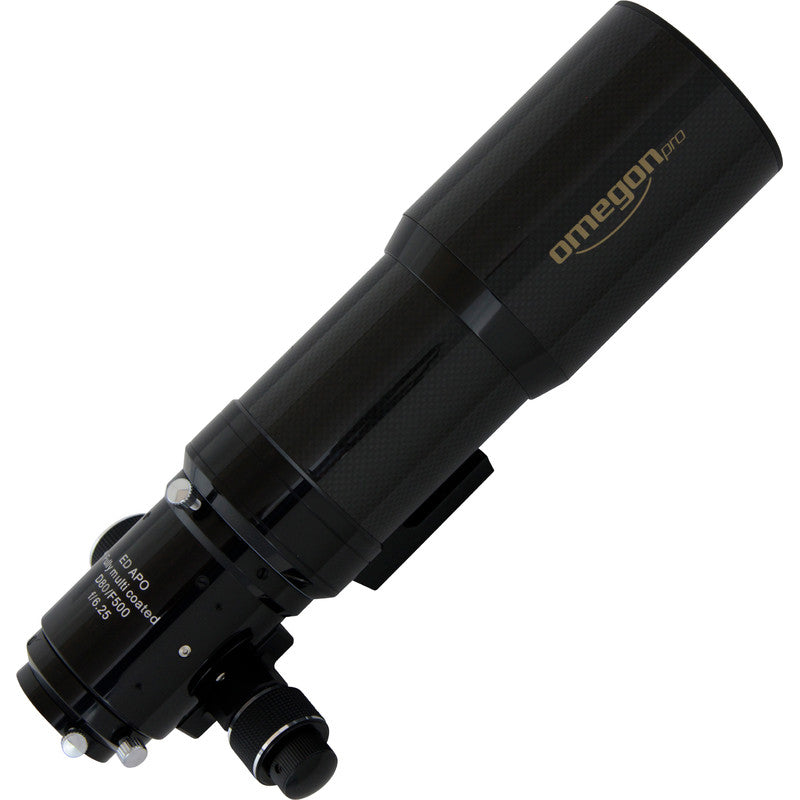
Apochromatic refractor Pro APO AP 80/500 ED Carbon OTA + Field Flattener
Apochromatic refractor Pro APO AP 80/500 ED Carbon OTA + Field Flattener
Couldn't load pickup availability
- SECURE PAYMENT
- AVAILABLE ON REQUEST
- ESTIMATED DELIVERY: 3 WEEKS
The Optical System
The Omegon apo refractor is an example of an excellent optical system, mature design, and excellent mechanics. This exceptional telescope offers the user, astrophotographer, observer, or nature lover, a unique view of the sky and nature. It guarantees crystal-clear stars right up to the edge of the field of view as well as outstanding precision mechanics.
The Doublet Apochromat
The objective of the Omegon ED Doublet Apochromat includes TrueColor glass. The two-lens objective consists of an ideal combination of OHARA FPL-53 and S-NBM51 glass. These are high and low refractive index glasses, respectively, with excellent transmittance. A very special feature is the use of S-NBM51 glass, generally used in apochromatic constructions of fluorescence microscopes. Its advantage: the optical system renders objects with excellent contrast and outstanding sharpness. The fine details it reveals when observing planets cannot be reproduced, for example, by any Schmidt-Cassegrain type telescope.
The advantages of the carbon tube: Carbon telescope tubes are particularly lightweight and therefore perfect for small mounts. Carbon has inherent stability and durability. It also exhibits very low thermal expansion. This is very useful for astrophotographers, as the focus position remains stable throughout the night.
The Eyepiece Focuser
The telescope is equipped with a Crayford type focuser. It belongs to a new generation of patent-pending telescope tubes. The essential advantages of this telescope tube are absolute precision and enormous stability. It can even support accessories weighing up to 10kg, thanks to an additional locking screw. Even under great force, the telescope tube does not shift a millimeter. Once you have found the focus, it will not change even if the telescope's position relative to the sky changes.
The 1 to 11 reduction serves as a fine-tuning tool and allows for a much more accurate adjustment than most telescopes. Are you already an astrophotography enthusiast with a full-frame camera or do you want to be one in the future? Even when using a full-frame camera, you will get vignetting-free representations. You can rotate the entire eyepiece focuser tube; you just have to loosen the locking screw, and you have 360° of freedom.
Including carrying case
The supplied carrying case is the ideal place to store valuable optical instruments. Ultra-robust, with sleeves and metal armor, it withstands many shocks without causing problems. Its interior is filled with sponge material with the exact shape of the tube for safe storage.
The advantages at a glance:
- Multiple bonuses on all optical surfaces
- Sophisticated aperture system to suppress reflections
- Crystal clear star representation and excellent contrasts
- Lightweight and durable: carbon tube
- Carbon moisture protection cap with felt lining
- Sensitive focusing: eyepiece focuser tube with 1:11 reduction factor and protective cap
Features:
- ED-Apo doublet with 80mm aperture and 500mm focal length
- 2'' eyepiece focuser with 360° rotation area
- Extended length 46cm, retracted length 39cm
- OTA weight only 2.8 kg, complete weight including case 6 kg
- External case dimensions 56x20x32cm
Omegon Field Flattener Lens - Perfectly Flat Fields for Great Astrophotos
Images obtained with many telescopes, whether refractors or reflectors, suffer from field curvature. The image appears slightly bowed, and stars at the edges do not shine or appear as sharp as those in the center. Unfocused discs appear. However, the Omegon Field Flattener lens can, as if by magic, create flat photographs with pinpoint stars right up to the outer edges of the visual field.
Easily Solved Problem
Field curvature is an image distortion that goes unnoticed in visual observation and photography with small chips. It becomes noticeable when taking snapshots with large chip or full-frame cameras. There is always the option to crop photos and leave out the edges, but it's not worth investing so much money in a good camera for that. This lens elegantly solves the problem.
Flatness across the entire field of view
The field of view remains completely flat, and the focal length of the equipment is maintained.
For use with f/4 to f/8 telescopes
It can be used with any refractor with an aperture ratio between f/4 and f/8.
M48 thread for greater brightness
It has an M48 thread on each side. This type of thread does not limit the amount of incident light as T2 or M42 do in 2" telescopes. With the M48, you enjoy the full luminous beam.
Other accessories: 109 mm Backfocus
To use this lens, there must be a distance of 109 mm between the lens plane and the camera chip. This distance is called backfocus. In this space, other accessories such as a filter wheel or an OAG can be attached, and if there is still space, there are always Omegon extension rings of different lengths. Whether or not you are going to take advantage of this to introduce accessories, please take into account the recommendation of our experts on the use of adapters.
All advantages:
- Flat field of view in refractors
- Compatible with f/4 to f/8 telescopes
- M48 thread for greater brightness in 2"
- Backfocus from 108 mm, depending on the telescope's focal length. At 500 mm → 118 mm, at 600 mm → 113 mm
- Multilayer coating on all optical surfaces
⚠️ NOTAS DE ADVERTENCIA
GAFAS PARA LA OBSERVACIÓN DE ECLIPSE
- INSTRUCCIONES: Revise antes de cada uso. No utilice ni deseche si está dañado, rasgado, perforado o separado de alguna manera del marco. No lo use con otros dispositivos ópticos. No es un juguete. Los niños deben usarlo solo bajo la supervisión de un adulto. Limítese a 3 minutos de uso continuo, con interrupciones durante varias horas. No se mueva mientras usa este producto, no conduzca un vehículo ni opere maquinaria. No lo use si tiene un ojo enfermo o después de una operación ocular.
- ADVERTENCIA: Nunca mire directamente al sol sin protección ocular especial. Siempre use gafas de eclipse al observar el eclipse solar, especialmente si una parte del sol es visible. Mirar directamente al sol puede causar daños permanentes si no se toman las precauciones adecuadas. Se debe usar protección ocular adecuada, diseñada específicamente para la observación solar, para evitar que los rayos dañinos del sol lleguen a los ojos. Deséchelo después de 3 años y no lo utilice después de ese tiempo.
OBSERVACIÓN SOLAR CON TELESCOPIO
- Nunca mire al sol a través de un ocular/telescopio sin un filtro de protección verificado. Un filtro lunar nunca puede usarse para la observación solar. El filtro lunar solo es adecuado para la observación de la luna. El filtro solar debe montarse en la apertura del telescopio, no en el ocular. De lo contrario, el rayo de luz concentrado por la óptica destruirá inmediatamente la película del filtro, lo que provocará daños oculares graves e incluso ceguera total.
- Revise el filtro solar antes de cada observación solar y asegúrese de que no esté dañado. Manténgalo frente a una fuente de luz intensa para poder detectar posibles grietas y/o agujeros. No use el telescopio para la observación solar, incluso si el filtro solar está solo ligeramente dañado. En este caso, comuníquese con el fabricante para obtener las piezas de repuesto correspondientes.
- Siempre use el filtro solar cuando observe el sol. Asegúrese de que este filtro esté colocado correctamente en el telescopio según las instrucciones. El uso del filtro solar está destinado únicamente para su uso con este telescopio.
- Revise el ajuste del filtro solar antes de cada observación solar. Si se suelta accidentalmente de la abertura del objetivo, esto puede causar daños oculares inmediatos y permanentes, e incluso ceguera.
- Si el filtro solar no puede montarse de manera suficientemente firme en el tubo, mejore el ajuste colocando varias tiras de fieltro autoadhesivas o similares entre el filtro solar y la abertura del objetivo. Nunca use el filtro solar si no puede colocarse correctamente en el telescopio. En tal caso, siempre contacte primero con nuestro servicio al cliente.
- Tenga mucho cuidado al observar el sol. Incluso una mirada corta a través de la óptica sin protección puede causar daños oculares graves e incluso ceguera total.
- Los niños, incluso con el filtro montado correctamente, no deben mirar al sol a través del telescopio. Nunca deje a los niños sin supervisión.
- Nunca deje la óptica sin supervisión. Los niños y los adultos inexpertos podrían dirigir el telescopio hacia el sol sin las precauciones adecuadas y perder la vista.
- No realice observaciones solares sin la consulta previa de un médico después de una operación ocular o cualquier otra enfermedad ocular.
- Las ondas/pliegues en la película son normales y no constituyen un defecto del producto.
- No exponga el dispositivo a altas temperaturas.
ADVERTENCIAS Y SEGURIDAD DE LAS PILAS
- NO USE pilas falsas en los productos. Use solo las pilas proporcionadas. Use la pila EXCLUSIVAMENTE para el propósito previsto.
- Guarde las pilas fuera del alcance de los niños y mascotas.
- NO USE pilas que parezcan tener la carcasa dañada, inflada o modificada. No use pilas que hayan goteado, huelan, estén hinchadas o derretidas o presenten abolladuras, óxido, grietas o rayones.
- La pila NO debe ser desmontada, aplastada, perforada, triturada ni manipulada de ninguna otra forma.
- La pila NO debe exponerse a líquidos.
- No debe intentar secar una pila mojada o húmeda con un dispositivo o fuente de calor.
- El dispositivo o la pila NO deben ser colocados cerca de una fuente de calor o bajo la luz solar directa.
- La pila NO debe tocar objetos metálicos.
- La pila NO debe ser almacenada junto a materiales peligrosos o inflamables. Guarde la pila en un lugar fresco, seco y bien ventilado.
- La pila NO debe insertarse incorrectamente al cargarla.
- La pila NO debe cargarse bajo luz solar directa ni a temperaturas extremas. Cárguela a temperatura ambiente (20 °C – 26 °C).
- Evite dejar caer la pila o el producto. Si sospecha que la pila está dañada, reemplácela.
- Nunca deje su dispositivo conectado a la corriente más de 24 horas. Deje que la pila se agote y luego recárguela.
- Para obtener los mejores resultados, reemplace las pilas según el uso después de 12 meses o antes.
- Siga las regulaciones locales para la eliminación de las pilas usadas. NO arroje la pila al fuego ni al agua.
Telescope accessories
-

Astronomy cameras
Astronomy cameras , specially designed to capture images from space, offer several...
-

Alignment Accessories
Collimation is the exact orientation of the optics within a telescope. It...


