

Omegon
Cassegrain Pro CC 154/1848 OTA Telescope
Cassegrain Pro CC 154/1848 OTA Telescope
In stock
Couldn't load pickup availability
Stunning astronomical photographs with a professional telescope
This Cassegrain telescope was created to take astrophotographs of the highest quality and beauty. Images have more contrast and sharpness right to the edge. It is not surprising that professional observatories almost exclusively use this type of telescopes. Now this technique is also affordable for amateurs. Fancy taking your astrophotography to a professional level?
Summary of its advantages:
- Primary mirror with 94% reflection for clearer images than a standard telescope
- 8 scattered light baffles for greater contrast and sharpness
- Quartz mirror for a better image in the acclimatization phase: focus remains stable even during long nights of photography
- 2" and 1.25" Crayford focuser to avoid mirror displacement and achieve great rear focus. For astrophotography simply attach your SLR camera with the included 50mm and 25mm connectors
- Complete illumination with APS-C sensors or sensors up to 30 mm diameter
Who is this telescope designed for?
A Cassegrain telescope is a system for taking beautiful astronomical photographs that you can be proud of. Many types of telescopes are created to do everything from photography to visual observation. But that is not entirely true, everyone knows that there is no expert in everything. That's why this telescope was created especially for astrophotographers who like to photograph compact objects. We don't want a mediocre telescope to take mediocre photos. We want an instrument for astrophotography experts. This telescope is perfect for first-class sky photography.
Full illumination for most sensors
This Omegon Cassegrain telescope is ideal for photographing the starry sky. Connect cameras with sensors up to 30mm in diameter and benefit from full illumination without vignetting.
Why is a Cassegrain telescope better than a Schmidt-Cassegrain?
The primary mirror of the Omegon Cassegrain is parabolic and the secondary mirror is hyperbolic. For this reason there will be much fewer image aberrations: the image field is flatter, the coma is lower and the field sharpness is considerably higher. This means you will be able to take much more beautiful star photos and even see the finer details. Your astrophotos will be fascinating in every way.
What are the advantages of this telescope over a SC?
- Sharper image
- There are no lenses in the path of the light ray and, therefore, there is no need for an infrared filter for photographing the planets.
- Larger image field useful for photography, with fewer optical aberrations
- Less obstruction, which increases contrast
- No chromatic aberrations
- There are no ghosting images in the photographs.
Faster acclimatization process
Who wants to set up the telescope and then wait forever? With this telescope there will be no waiting. The parabolic quartz primary mirror hardly deforms during the cooling phase and is much more stable than Pyrex. This means that from the first minute the telescope shows you a crystal clear image.
Primary quartz mirror with 94% reflectivity
94% Enhanced Coating: This coating is special because every percentage point counts for clearer, higher contrast images. This mirror is the champion of its range, offering 6% more reflectivity than the standard fitted to most telescopes.
From now on you will be able to get clear images of faint deep sky objects.
Crayford: more than enough focus
Attach any accessory to your telescope and don't worry about focusing. With most cameras you can easily achieve a sharp image thanks to the large back focus of this telescope. You can also use a reducer or even binoculars.
8 scattered light deflectors
They provide more contrast for sharper images where more details can be seen.
No mirror shift
Ping-pong was a popular sport, but as a photographer trying to capture a planetary nebula in the eyepiece it's not that fun. The good news is that you no longer need to play ping-pong to take a good photo because, unlike an SC telescope, this Cassegrain has a fixed parabolic primary mirror. This way the object does not bounce around the eyepiece and stays where it should be.
What objects can you photograph?
Omegon's Cassegrain is unrivaled in the photography of compact objects in the Solar System or interstellar space. With its long focal length, even small nebulae can be reached. This telescope is great for:
- Craters of the Moon
- Planets
- Groups of distant galaxies, planetary nebulae
- Globular star clusters
Specifications
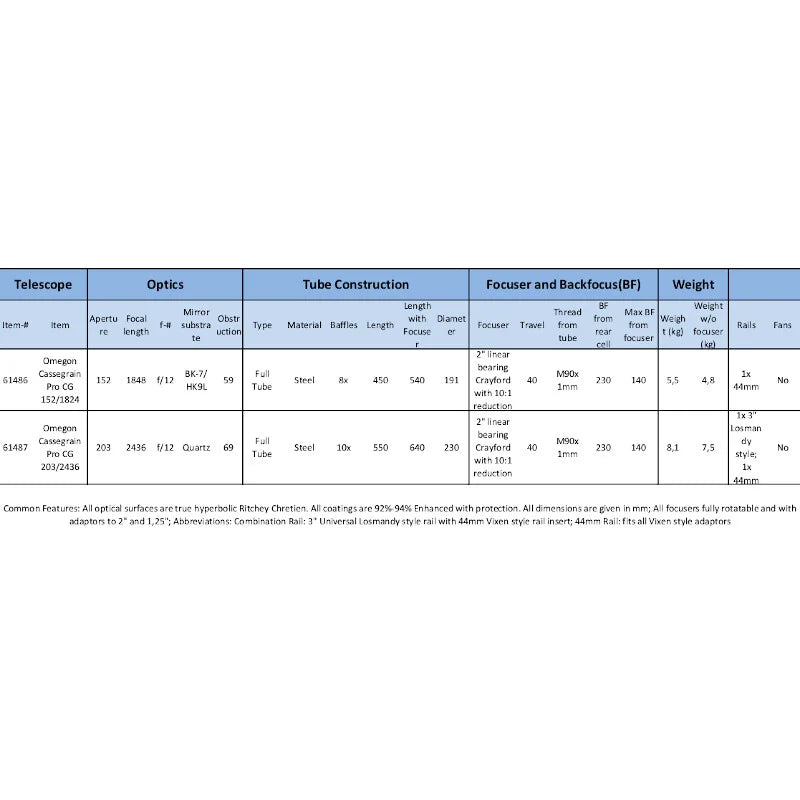
| Optical system | |
| Guy | Reflector |
| Type of construction | cassegrain |
| Opening (mm) | 152 |
| Focal length (mm) | 1848 |
| Aperture ratio (f/) | 12 |
| Resolution capacity | 0.91 |
| limit value (mag) | 14.1 |
| Light collecting capacity | 472 |
| Maximum useful magnification | 300 |
| Tube weight (kg) | 6 |
| Tube length (mm) | 540 |
| Tube diameter (mm) | 191 |
| Tube construction | complete tube |
| Telescopic eyepiece tube | |
| Type of construction | Crayford |
| Connection (eyepiece side) | 2 |
| Mount | |
| Frame type | rimless |
| Type of construction | OTA |
| GoTo | No |
| In general | |
| Series | Pro CC |
| Applications | |
| Moon and planets | Yeah |
| Nebulae and galaxies | Yeah |
| Nature observation | Yeah |
| Astrophotography | Yeah |
| Sun | not recommended (only with appropriate sunscreen) |
| Recommended for | |
| Beginners | No |
| Advanced | Yeah |
| Observatories | No |


⚠️ NOTAS DE ADVERTENCIA
GAFAS PARA LA OBSERVACIÓN DE ECLIPSE
- INSTRUCCIONES: Revise antes de cada uso. No utilice ni deseche si está dañado, rasgado, perforado o separado de alguna manera del marco. No lo use con otros dispositivos ópticos. No es un juguete. Los niños deben usarlo solo bajo la supervisión de un adulto. Limítese a 3 minutos de uso continuo, con interrupciones durante varias horas. No se mueva mientras usa este producto, no conduzca un vehículo ni opere maquinaria. No lo use si tiene un ojo enfermo o después de una operación ocular.
- ADVERTENCIA: Nunca mire directamente al sol sin protección ocular especial. Siempre use gafas de eclipse al observar el eclipse solar, especialmente si una parte del sol es visible. Mirar directamente al sol puede causar daños permanentes si no se toman las precauciones adecuadas. Se debe usar protección ocular adecuada, diseñada específicamente para la observación solar, para evitar que los rayos dañinos del sol lleguen a los ojos. Deséchelo después de 3 años y no lo utilice después de ese tiempo.
OBSERVACIÓN SOLAR CON TELESCOPIO
- Nunca mire al sol a través de un ocular/telescopio sin un filtro de protección verificado. Un filtro lunar nunca puede usarse para la observación solar. El filtro lunar solo es adecuado para la observación de la luna. El filtro solar debe montarse en la apertura del telescopio, no en el ocular. De lo contrario, el rayo de luz concentrado por la óptica destruirá inmediatamente la película del filtro, lo que provocará daños oculares graves e incluso ceguera total.
- Revise el filtro solar antes de cada observación solar y asegúrese de que no esté dañado. Manténgalo frente a una fuente de luz intensa para poder detectar posibles grietas y/o agujeros. No use el telescopio para la observación solar, incluso si el filtro solar está solo ligeramente dañado. En este caso, comuníquese con el fabricante para obtener las piezas de repuesto correspondientes.
- Siempre use el filtro solar cuando observe el sol. Asegúrese de que este filtro esté colocado correctamente en el telescopio según las instrucciones. El uso del filtro solar está destinado únicamente para su uso con este telescopio.
- Revise el ajuste del filtro solar antes de cada observación solar. Si se suelta accidentalmente de la abertura del objetivo, esto puede causar daños oculares inmediatos y permanentes, e incluso ceguera.
- Si el filtro solar no puede montarse de manera suficientemente firme en el tubo, mejore el ajuste colocando varias tiras de fieltro autoadhesivas o similares entre el filtro solar y la abertura del objetivo. Nunca use el filtro solar si no puede colocarse correctamente en el telescopio. En tal caso, siempre contacte primero con nuestro servicio al cliente.
- Tenga mucho cuidado al observar el sol. Incluso una mirada corta a través de la óptica sin protección puede causar daños oculares graves e incluso ceguera total.
- Los niños, incluso con el filtro montado correctamente, no deben mirar al sol a través del telescopio. Nunca deje a los niños sin supervisión.
- Nunca deje la óptica sin supervisión. Los niños y los adultos inexpertos podrían dirigir el telescopio hacia el sol sin las precauciones adecuadas y perder la vista.
- No realice observaciones solares sin la consulta previa de un médico después de una operación ocular o cualquier otra enfermedad ocular.
- Las ondas/pliegues en la película son normales y no constituyen un defecto del producto.
- No exponga el dispositivo a altas temperaturas.
ADVERTENCIAS Y SEGURIDAD DE LAS PILAS
- NO USE pilas falsas en los productos. Use solo las pilas proporcionadas. Use la pila EXCLUSIVAMENTE para el propósito previsto.
- Guarde las pilas fuera del alcance de los niños y mascotas.
- NO USE pilas que parezcan tener la carcasa dañada, inflada o modificada. No use pilas que hayan goteado, huelan, estén hinchadas o derretidas o presenten abolladuras, óxido, grietas o rayones.
- La pila NO debe ser desmontada, aplastada, perforada, triturada ni manipulada de ninguna otra forma.
- La pila NO debe exponerse a líquidos.
- No debe intentar secar una pila mojada o húmeda con un dispositivo o fuente de calor.
- El dispositivo o la pila NO deben ser colocados cerca de una fuente de calor o bajo la luz solar directa.
- La pila NO debe tocar objetos metálicos.
- La pila NO debe ser almacenada junto a materiales peligrosos o inflamables. Guarde la pila en un lugar fresco, seco y bien ventilado.
- La pila NO debe insertarse incorrectamente al cargarla.
- La pila NO debe cargarse bajo luz solar directa ni a temperaturas extremas. Cárguela a temperatura ambiente (20 °C – 26 °C).
- Evite dejar caer la pila o el producto. Si sospecha que la pila está dañada, reemplácela.
- Nunca deje su dispositivo conectado a la corriente más de 24 horas. Deje que la pila se agote y luego recárguela.
- Para obtener los mejores resultados, reemplace las pilas según el uso después de 12 meses o antes.
- Siga las regulaciones locales para la eliminación de las pilas usadas. NO arroje la pila al fuego ni al agua.