

Sky-Watcher
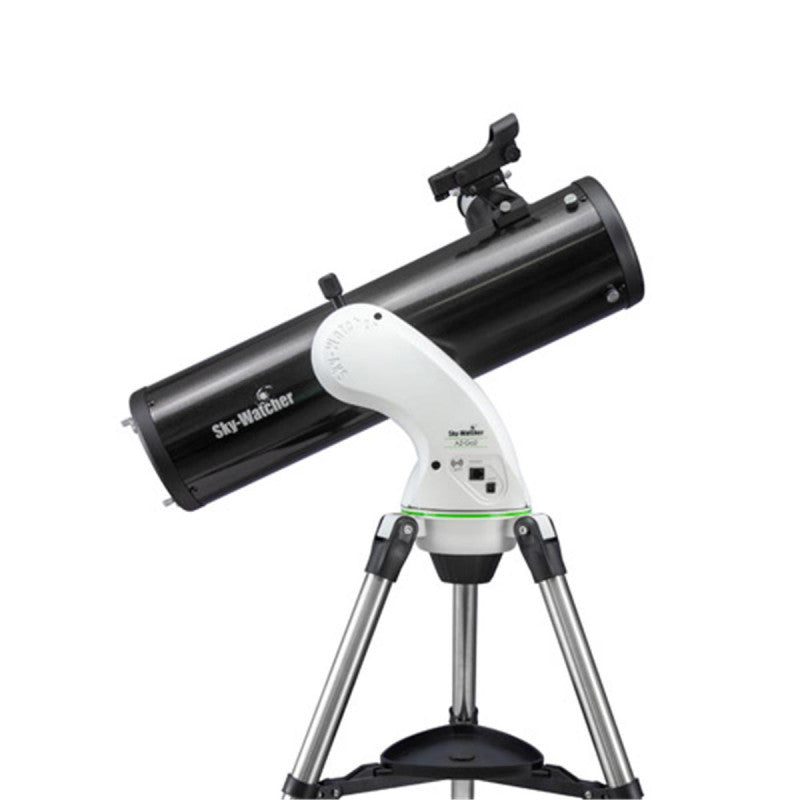
Sky-Watcher 130/650 telescope on an AZ-Go2 mount
Sky-Watcher 130/650 telescope on an AZ-Go2 mount
In stock
🚚 Estimated delivery: 15 days
Couldn't load pickup availability
- A first instrument to begin planetary observation
- 130mm diameter telescope for beginners in deep sky observation.
- With motorized altazimuth mount for easy observation.
- Automated tracking and scoring (GOTO)
With its 130mm primary mirror, the Sky-Watcher Newton 130 It captures 30% more light than a 114mm telescope Under dark skies, it's possible to observe in greater detail than with a smaller instrument. It promises beginners looking to invest in a bright and affordable telescope many fruitful evenings of observing. For planetary observation With the help of a Barlow lens or a short focal length eyepiece, it will reveal Numerous details of Jupiter, Saturn, and the Moon .
Its Newtonian design offers several advantages over other types of instruments (refractors and Cassegrain telescopes). First, the mirrors are cheaper to manufacture (spherical mirror) for the same diameter, and their focal ratio is generally lower. The central obstruction is also less than in Cassegrain telescopes; If the collimation (mirror alignment) is maintained correctly, the image quality is good for planetary observation. .
The SynScan Go-To automatic timing system
This version of the AZ GOTO mount (without hand controller) requires downloading the free app SynScan . You can control the mount directly from your smartphone or tablet thanks to a built-in Wi-Fi card. When the connection is active, you will be able to control the mount from the SynScan application with the same functions as your handheld controller.
For greater user convenience, Sky-Watcher has equipped part of its range of instruments with a motorized dual-axis GOTO altazimuth mount, capable of fast pointing and tracking. This eliminates the need to know the position of stars or distant deep-sky objects; the Sky-Watcher AZ-Go2 mount automatically moves the instrument to the desired target. After calibration (polar alignment), orienting the optical tube to the north, and leveling, you can select one- or two-star alignment. The database contains over 42,900 objects, including those from the main catalogs (Messier, NGC, IC, as well as the planets, the Moon, and the Sun).
For maximum convenience, the mount is moved quickly using the buttons in the SynScan app on your smartphone or tablet. Easy to use, it helps you quickly point the instrument at any galaxy, nebula, cluster, or object in the solar system. Discover in detail the famous Andromeda Galaxy, the fabulous mantles surrounding the heart of Orion, the Hercules cluster M13 and its core, rich with thousands of stars. Saturn, Jupiter, and the Moon are also wonders you can explore at your leisure.
Displaying the date, time, and observation location on the hand controller, along with the "Tour" function, allows you to point the AZ-Go2 at the most interesting objects throughout the night. Enjoy a guided tour of the sky from your observation point, based on the object presented in a drop-down list.
The ability to track (motorized) any object eliminates the need for constant manual adjustments The object remains centered in the field of view, which facilitates the discovery of details, especially on planets. Thanks to a payload capacity of approximately 5 kg The Sky-Watcher 130mm Newtonian telescope has good support and vibrations are quickly dampened despite its single-arm fork mount. The instrument is attached using a Vixen-style male dovetail; therefore, it can be easily and quickly removed from the mount. Another long-term advantage is the possibility of upgrading the mount: it can accommodate other instruments (telescopes, refractors) thanks to its Vixen-style female dovetail mount.
You can also use the "Point and Go" function: simply point your smartphone at a region of the sky and the mount will automatically move to that area using the SynScan app. Continuous updates will be developed to improve the application's functionality. It can also be controlled from a PC via Wi-Fi and is compatible with ASCOM and EQMOD.
Specs
| Characteristics | Sky-Watcher Newton 130mm Telescope on AZ-Go2 |
|---|---|
| optical tube | |
| Optical formula | Newton |
| Mirrors | Primary parabolic, secondary planar |
| Effective diameter | 130 mm |
| Focal length | 650 mm |
| F/D ratio | 5 |
| Separating power | 0.9 arc seconds |
| Limiting magnitude | 13.3 |
| Clarity | 360x |
| Maximum recommended increase | 200x |
| optical tube | Metal + integrated dovetail |
| eyepiece mount | Sliding rack 50.8 mm (with reducer 31.75 mm) |
| Optical tube dimensions | Length 615 mm - Outer diameter 160 mm |
| Weight of the optical tube | 3.5 kg |
| Mount | |
| Gentle |
SynScan Go-To altazimuthal mount, dual-axis motorization with automatic aiming, DC servomotors - Resolution: 0.8923 arc seconds, PC port for manual driver updates or control with most software |
| load capacity | approximately 5 kg |
| SynScan reference system |
Using an included Wi-Fi card and the SynScan app with 42,900 objects from standard celestial catalogs. Scan speeds: 1x, 2x, 16x, 32x, 64x, 128x, 400x, 500x, 600x, 800x. Tracking modes: Sidereal, Lunar or Solar. |
| Weight | 2.7 kilos |
| Tripod | Height-adjustable aluminum tripod (from 67 cm to 114 cm) |
| Food |
Battery compartment (batteries not included) Optional 12V DC power supply |


⚠️ NOTAS DE ADVERTENCIA
GAFAS PARA LA OBSERVACIÓN DE ECLIPSE
- INSTRUCCIONES: Revise antes de cada uso. No utilice ni deseche si está dañado, rasgado, perforado o separado de alguna manera del marco. No lo use con otros dispositivos ópticos. No es un juguete. Los niños deben usarlo solo bajo la supervisión de un adulto. Limítese a 3 minutos de uso continuo, con interrupciones durante varias horas. No se mueva mientras usa este producto, no conduzca un vehículo ni opere maquinaria. No lo use si tiene un ojo enfermo o después de una operación ocular.
- ADVERTENCIA: Nunca mire directamente al sol sin protección ocular especial. Siempre use gafas de eclipse al observar el eclipse solar, especialmente si una parte del sol es visible. Mirar directamente al sol puede causar daños permanentes si no se toman las precauciones adecuadas. Se debe usar protección ocular adecuada, diseñada específicamente para la observación solar, para evitar que los rayos dañinos del sol lleguen a los ojos. Deséchelo después de 3 años y no lo utilice después de ese tiempo.
OBSERVACIÓN SOLAR CON TELESCOPIO
- Nunca mire al sol a través de un ocular/telescopio sin un filtro de protección verificado. Un filtro lunar nunca puede usarse para la observación solar. El filtro lunar solo es adecuado para la observación de la luna. El filtro solar debe montarse en la apertura del telescopio, no en el ocular. De lo contrario, el rayo de luz concentrado por la óptica destruirá inmediatamente la película del filtro, lo que provocará daños oculares graves e incluso ceguera total.
- Revise el filtro solar antes de cada observación solar y asegúrese de que no esté dañado. Manténgalo frente a una fuente de luz intensa para poder detectar posibles grietas y/o agujeros. No use el telescopio para la observación solar, incluso si el filtro solar está solo ligeramente dañado. En este caso, comuníquese con el fabricante para obtener las piezas de repuesto correspondientes.
- Siempre use el filtro solar cuando observe el sol. Asegúrese de que este filtro esté colocado correctamente en el telescopio según las instrucciones. El uso del filtro solar está destinado únicamente para su uso con este telescopio.
- Revise el ajuste del filtro solar antes de cada observación solar. Si se suelta accidentalmente de la abertura del objetivo, esto puede causar daños oculares inmediatos y permanentes, e incluso ceguera.
- Si el filtro solar no puede montarse de manera suficientemente firme en el tubo, mejore el ajuste colocando varias tiras de fieltro autoadhesivas o similares entre el filtro solar y la abertura del objetivo. Nunca use el filtro solar si no puede colocarse correctamente en el telescopio. En tal caso, siempre contacte primero con nuestro servicio al cliente.
- Tenga mucho cuidado al observar el sol. Incluso una mirada corta a través de la óptica sin protección puede causar daños oculares graves e incluso ceguera total.
- Los niños, incluso con el filtro montado correctamente, no deben mirar al sol a través del telescopio. Nunca deje a los niños sin supervisión.
- Nunca deje la óptica sin supervisión. Los niños y los adultos inexpertos podrían dirigir el telescopio hacia el sol sin las precauciones adecuadas y perder la vista.
- No realice observaciones solares sin la consulta previa de un médico después de una operación ocular o cualquier otra enfermedad ocular.
- Las ondas/pliegues en la película son normales y no constituyen un defecto del producto.
- No exponga el dispositivo a altas temperaturas.
ADVERTENCIAS Y SEGURIDAD DE LAS PILAS
- NO USE pilas falsas en los productos. Use solo las pilas proporcionadas. Use la pila EXCLUSIVAMENTE para el propósito previsto.
- Guarde las pilas fuera del alcance de los niños y mascotas.
- NO USE pilas que parezcan tener la carcasa dañada, inflada o modificada. No use pilas que hayan goteado, huelan, estén hinchadas o derretidas o presenten abolladuras, óxido, grietas o rayones.
- La pila NO debe ser desmontada, aplastada, perforada, triturada ni manipulada de ninguna otra forma.
- La pila NO debe exponerse a líquidos.
- No debe intentar secar una pila mojada o húmeda con un dispositivo o fuente de calor.
- El dispositivo o la pila NO deben ser colocados cerca de una fuente de calor o bajo la luz solar directa.
- La pila NO debe tocar objetos metálicos.
- La pila NO debe ser almacenada junto a materiales peligrosos o inflamables. Guarde la pila en un lugar fresco, seco y bien ventilado.
- La pila NO debe insertarse incorrectamente al cargarla.
- La pila NO debe cargarse bajo luz solar directa ni a temperaturas extremas. Cárguela a temperatura ambiente (20 °C – 26 °C).
- Evite dejar caer la pila o el producto. Si sospecha que la pila está dañada, reemplácela.
- Nunca deje su dispositivo conectado a la corriente más de 24 horas. Deje que la pila se agote y luego recárguela.
- Para obtener los mejores resultados, reemplace las pilas según el uso después de 12 meses o antes.
- Siga las regulaciones locales para la eliminación de las pilas usadas. NO arroje la pila al fuego ni al agua.